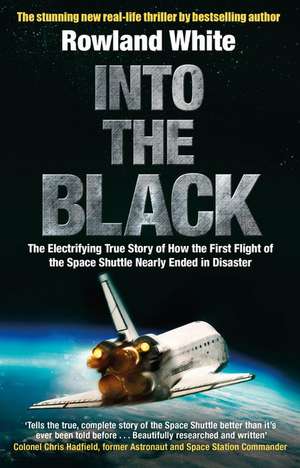
Into the Black
Autor Rowland Whiteen Limba Engleză Paperback – 4 mai 2017
Pentru a parcurge această lucrare, cititorul are nevoie de un nivel de experiență mediu în domeniul istoriei tehnice, fiind necesară o înțelegere prealabilă a principiilor de bază ale zborului orbital și ale contextului geopolitic din perioada Războiului Rece. Remarcăm că Into the Black nu este doar o cronică a zborului, ci o analiză tehnică detaliată a modului în care NASA a proiectat cea mai avansată mașinărie de zbor a epocii: naveta spațială Columbia. Suntem de părere că valoarea adăugată a acestui volum rezidă în documentarea riguroasă, bazată pe surse primare și materiale declasificate care scot la iveală un aspect mai puțin cunoscut: colaborarea secretă cu agenția de spionaj NRO pentru a fotografia scutul termic avariat în timp ce naveta se afla pe orbită. Abordarea diferă de cea din Bold They Rise de David Hitt prin faptul că este mai puțin abstractă și mult mai aplicată pe tensiunea operativă a misiunii STS-1, concentrându-se pe riscurile imediate ale plăcilor ceramice lipsă. În contextul operei autorului, Into the Black continuă tradiția narativă începută cu Phoenix Squadron și Vulcan 607, unde Rowland White explorează momente critice din aviație. Dacă în Harrier 809 accentul cădea pe logistica de luptă, aici autorul analizează ingineria de la granița dintre aeronautică și astronautică. Tonul este unul practic, axat pe specificații tehnice și pe presiunea procesului decizional sub constrângeri de timp și securitate națională, oferind o perspectivă rară asupra primei navete reutilizabile din lume.
Preț: 80.28 lei
Preț vechi: 96.03 lei
-16%
Carte disponibilă
Livrare economică 06-18 noiembrie
Livrare express 22-28 octombrie pentru 46.99 lei
Specificații
ISBN-10: 0552160229
Pagini: 640
Dimensiuni: 126 x 198 x 43 mm
Greutate: 0.45 kg
Editura: Transworld Publishers Ltd
V-ar putea interesa
-
 The Penguin Book of Outer Space ExplorationJohn LogsdonPreț: 92.86 lei
 -
 Dark StarMatthew H. HerschPreț: 354.16 lei
 -
 Apollo 13James Lovell-26%Preț: 67.83 lei92.14 lei
 -
 -45%Preț: 78.20 lei143.43 lei
 -
 The Complete Book of SpacecraftMichael H. Gorn-19%Preț: 184.00 lei227.67 lei
 -
 The Apollo 8Jeffrey KlugerPreț: 110.00 lei
 -
 Lockheed Blackbird: Beyond the Secret Missions – The Missing ChaptersPaul F. Crickmore-36%Preț: 377.69 lei587.36 lei
 -
 Sally RideLynn SherrPreț: 115.60 lei
 -
 Preț: 163.35 lei
 -
 The X-15 Rocket Plane: Flying the First Wings into SpaceMichelle EvansPreț: 213.41 lei
 -
 -25%Preț: 86.96 lei115.88 lei
 -
 Bringing Columbia Home: The Untold Story of a Lost Space Shuttle and Her CrewMichael D. LeinbachPreț: 145.08 lei
 -
 -23%Preț: 307.79 lei397.60 lei
 -
 -16%Preț: 81.46 lei96.73 leiRecomandat
 -
 Space Shuttle: A Photographic JourneyLuke Wesley PricePreț: 200.64 lei
 -
 Once Upon a Time in SpaceJames BluemelPreț: 215.96 lei
 -
 SpaceTim Peake-31%Preț: 64.75 lei93.38 lei
 -
 NASA Space Shuttle Owners'' Workshop ManualDavid BakerPreț: 193.84 lei
 -
 Space Shuttle: Fact ArchiveRobert Godwin-12%Preț: 53.18 lei60.24 lei
 -
 A Passion for SpaceMarianne J. DysonPreț: 324.12 lei
De ce să citești această carte
Această carte se adresează pasionaților de inginerie aerospațială și istorie militară care doresc să înțeleagă complexitatea tehnică din spatele programului Space Shuttle. Cititorul câștigă acces la detalii inedite despre prima misiune Columbia, descoperind cum s-au gestionat defecțiunile critice ale scutului termic prin colaborări secrete cu agenții de spionaj. Este o lecție fascinantă despre inovație sub presiune și despre limitele tehnologiei din anii '80.
Despre autor
Rowland White este un autor britanic recunoscut pentru lucrările sale de istorie a aviației, apreciate pentru rigoarea documentării. Printre succesele sale editoriale se numără Vulcan 607, Phoenix Squadron și Storm Front, toate fiind incluse în topurile de vânzări Sunday Times. Expertiza sa în analiza conflictelor aeriene și a tehnologiei militare îi permite să abordeze subiecte complexe cu o claritate tehnică deosebită, transformând datele de arhivă în narațiuni documentare extrem de precise, ancorate în realitatea operațională a piloților și inginerilor.
Notă biografică
For more information on Rowland White and his books visit his website at rowlandwhite.com or find him on Twitter at @rowlandwhite
Descriere scurtă
On board were men with the Right Stuff. The Shuttle's Commander, moonwalker John Young, was already a veteran of five spaceflights. Alongside him, Pilot Bob Crippen was making his first, but Crip, taken in by the space agency after the cancellation of a top secret military space station programme in 1969, had worked on the Shuttle's development for a decade. Never before had a crew been so well prepared for their mission.
Yet less than an hour after Young and Crippen's spectacular departure from the Cape it was clear that all was not well. Tiles designed to protect Columbia from the blowtorch burn of re-entry were missing from the heatshield. If the damage to their ship was too great the astronauts would be unable to return safely to earth. But neither they nor mission control possessed any way of knowing.
Instead, NASA turned to the National Reconnaissance Office, a spy agency hidden deep inside the Pentagon whose very existence was classified. To help, the NRO would attempt something that had never been done before. Success would require skill, pinpoint timing and luck ...
Drawing on brand new interviews with astronauts and engineers, archive material and newly declassified documents, Rowland White, bestselling author of Vulcan 607, has pieced together the dramatic untold story of the mission for the first time. Into the Black is a thrilling race against time; a gripping high stakes cold-war story, and a celebration of a beyond the state-of-the-art machine that, hailed as one of the seven new wonders of the world, rekindled our passion for spaceflight.
*With a foreword by Astronaut Richard Truly*
'Beautifully researched and written, Into the Black tells the true, complete story of the Space Shuttle better than it's ever been told before.'
Colonel Chris Hadfield, former Astronaut and Space Station Commander
'Brilliantly revealed, Into the Black is the finely tuned true story of the first flight of the Space Shuttle Columbia. Rowland White has magnificently laid bare the unknown dangers and unseen hazards of that first mission ... Once read, not forgotten.'
Clive Cussler