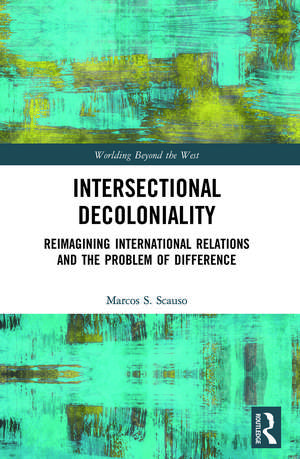
Intersectional Decoloniality: Reimagining International Relations and the Problem of Difference: Worlding Beyond the West
Autor Marcos S. Scausoen Limba Engleză Paperback – 29 apr 2022
The author analyzes a number of struggles that emerge among Andean indigenous intellectuals, governmental projects, and International Relations scholars from the Global North. From different perspectives, actors propose and promote diverse ways to deal with “others”. By focusing on the epistemic assumptions and the marginalizing effects that emerge from these constructions, the author separates four ways to think about difference, and analyzes their implications. The genealogical journey linking the chapters in this book not only examines the specificities of Bolivian discussions, but also connects this geo-historical focal point with the rest of the world, other positions concerning the problem of difference, and the broader implications of thinking about respect, action, and coexistence. To achieve this goal, the author emphasizes the potential implications of intersectional decoloniality, highlighting its relationship with discussions that engage post-colonial, decolonial, feminist, and interpretivist scholars. He demonstrates the ways in which intersectional decoloniality moves beyond some of the limitations found in other discourses, proposing a reflexive, bottom-up, intersectional, and decolonial possibility of action and ally-ship.
This book is aimed primarily at students, scholars, and educated practitioners of IR, but its engagement with diverse literature, discussions of epistemic politics, and normative implications crosses boundaries of Political Science, Sociology, Gender Studies, Latin American Studies, and Anthropology.
Din seria Worlding Beyond the West
-
 Preț: 416.32 lei
 -
 Preț: 377.21 lei
 - 15%
 Preț: 435.82 lei
 -
 Preț: 455.98 lei
 -
 Preț: 444.29 lei
 -
 Preț: 395.72 lei
 -
 Preț: 419.89 lei
 -
 Preț: 424.32 lei
 -
 Preț: 401.59 lei
 -
 Preț: 426.32 lei
 -
 Preț: 407.70 lei
 -
 Preț: 331.08 lei
 -
 Preț: 372.88 lei
 -
 Preț: 376.66 lei
 - 18%
 Preț: 1251.35 lei
 -
 Preț: 372.65 lei
 -
 Preț: 434.04 lei
 -
 Preț: 423.33 lei
 - 18%
 Preț: 1115.17 lei
 -
 Preț: 492.35 lei
 -
 Preț: 424.32 lei
 -
 Preț: 427.59 lei
 -
 Preț: 420.45 lei
 - 18%
 Preț: 1112.48 lei
 - 18%
 Preț: 1115.51 lei
 - 15%
 Preț: 434.95 lei
 - 18%
 Preț: 1123.53 lei
 - 18%
 Preț: 1115.51 lei
 -
 Preț: 421.64 lei
 -
 Preț: 459.36 lei
Preț: 412.96 lei
Puncte Express: 619
Carte indisponibilă temporar
Livrare prin curier în România Termenul estimat este afișat lângă disponibilitate.
Transport gratuit pentru acest produs Plată online sau ramburs, în funcție de opțiunile comenzii.
Retur gratuit în 14 zile Comandă securizată și suport în română.
Specificații
ISBN-13: 9780367537333
ISBN-10: 0367537338
Pagini: 256
Dimensiuni: 156 x 234 x 20 mm
Greutate: 0.4 kg
Ediția:1
Editura: Taylor & Francis
Colecția Routledge
Seria Worlding Beyond the West
Locul publicării:Oxford, United Kingdom
ISBN-10: 0367537338
Pagini: 256
Dimensiuni: 156 x 234 x 20 mm
Greutate: 0.4 kg
Ediția:1
Editura: Taylor & Francis
Colecția Routledge
Seria Worlding Beyond the West
Locul publicării:Oxford, United Kingdom
Public țintă
PostgraduateCuprins
Introduction 1. Colonialisms in/for Bolivia and IR 2. Revolutionary Indianismo and the Universalization of an "Other" 3. Indianismo Amáutico and the Universalization of an "Other" 4. The Universalization of Evo Morales and Plurinationality 5. Post-structuralism as a Limited Western Ally 6. A Profession of Faith, Intersectional Decoloniality, and Beyond 7. The Problem of Difference and I.R. Concluding Thoughts
Notă biografică
Marcos S. Scauso is an Assistant Professor of Political Science in the Department of Philosophy and Political Science at Quinnipiac University, USA. Previously, he was a research fellow at the Kroc Institute for International Peace Studies at the University of Notre Dame, USA. His research lies at the intersection of International Relations and identity politics, with a concentration on indigenous voices in post-colonial Latin America and issues of intersectionality. He holds a PhD in Political Science, with a primary focus on International Relations and secondary interests in Political Theory, from the University of California, Irvine, USA. He has directed two research documentaries about indigenous activisms in Argentina and Bolivia, which inspired his current book project.
Descriere
This book assesses diverse ways to think about "others" while also emphasizing the advantages of decolonial intersectionality. The author analyzes the struggles that emerge among Andean indigenous intellectuals, governmental projects, and IR scholars from the Global North.