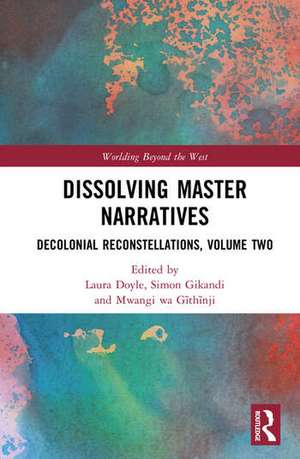
Dissolving Master Narratives: Decolonial Reconstellations, Volume Two: Worlding Beyond the West
Editat de Laura Doyle, Simon Gikandi, Mwangi wa Gĩthĩnjien Limba Engleză Hardback – 10 apr 2025
Collaboratively conceived, the volumes are founded on the observation that we cannot fully uproot the epistemological-material violence of coercive systems, nor fully (re)imagine more ethical visions of planetary community, without shared attention to the deeper histories of place and peoples that shape the present. Accordingly, the volumes gather social scientists and humanists, Indigenous and non-Indigenous scholars, and intersectional and materialist thinkers who reconceptualize longue-durée history and its afterlives. They engage in the dual project to dismantle eurocentric, colonial, androcentric frameworks and to make visible the legacies of care and creative world-making that have sustained human communities. Uncovering pasts that are as complex and dynamic as the present, the contributors brilliantly transform notions of temporality, relationality, polity, conjuncture, resistance, and experimentation within histories of struggle and alliance. They richly decolonize political imaginaries. The co-editors’ introductions articulate fresh frameworks of “deep place” and “deep time” freed from eurocentric modernity paradigms, indicating pathways toward decolonial collaboration and institutional change.
Decolonial Reconstellations offers invaluable resources for researchers and teachers in decolonial, postcolonial, anti-colonial, and Indigenous studies, and will also strongly appeal to feminist, anti-racist, Marxist, and critical theory scholars across disciplines.
Din seria Worlding Beyond the West
-
 Preț: 416.32 lei
 -
 Preț: 377.21 lei
 - 15%
 Preț: 435.82 lei
 -
 Preț: 455.98 lei
 -
 Preț: 444.29 lei
 -
 Preț: 395.72 lei
 -
 Preț: 419.89 lei
 -
 Preț: 424.32 lei
 -
 Preț: 401.59 lei
 -
 Preț: 426.32 lei
 -
 Preț: 407.70 lei
 -
 Preț: 331.08 lei
 -
 Preț: 372.88 lei
 -
 Preț: 376.66 lei
 - 18%
 Preț: 1251.35 lei
 -
 Preț: 372.65 lei
 -
 Preț: 434.04 lei
 -
 Preț: 423.33 lei
 - 18%
 Preț: 1115.17 lei
 -
 Preț: 492.35 lei
 -
 Preț: 424.32 lei
 -
 Preț: 427.59 lei
 -
 Preț: 412.96 lei
 -
 Preț: 420.45 lei
 - 18%
 Preț: 1112.48 lei
 - 15%
 Preț: 434.95 lei
 - 18%
 Preț: 1123.53 lei
 - 18%
 Preț: 1115.51 lei
 -
 Preț: 421.64 lei
 -
 Preț: 459.36 lei
Preț: 1115.51 lei
Preț vechi: 1360.37 lei
-18% Recomandat
Puncte Express: 1673
Carte tipărită la comandă
Livrare economică 09-23 decembrie
Livrare prin curier în România Termenul estimat este afișat lângă disponibilitate.
Transport gratuit pentru acest produs Plată online sau ramburs, în funcție de opțiunile comenzii.
Retur gratuit în 14 zile Comandă securizată și suport în română.
Specificații
ISBN-13: 9781032848822
ISBN-10: 1032848820
Pagini: 274
Ilustrații: 30
Dimensiuni: 156 x 234 x 18 mm
Greutate: 0.54 kg
Ediția:1
Editura: Taylor & Francis
Colecția Routledge
Seria Worlding Beyond the West
Locul publicării:Oxford, United Kingdom
ISBN-10: 1032848820
Pagini: 274
Ilustrații: 30
Dimensiuni: 156 x 234 x 18 mm
Greutate: 0.54 kg
Ediția:1
Editura: Taylor & Francis
Colecția Routledge
Seria Worlding Beyond the West
Locul publicării:Oxford, United Kingdom
V-ar putea interesa
-
 Human Geography: A Very Short IntroductionPatricia Daley-20%Preț: 57.15 lei71.12 lei
 -
 The Dialectic of Cosmopolitan TimeShaj Mathew-29%Preț: 447.04 lei627.75 lei
 -
 Decolonizing Language and Other Revolutionary IdeasNgugi Wa Thiong'OPreț: 164.89 lei
 -
 Preț: 379.10 lei
 -
 Decolonizing Global Health: A Critical Realist PerspectiveFerdinand C Mukumbang-5%Preț: 368.26 lei387.65 lei
 -
 Preț: 251.02 lei
 -
 Decolonizing GeographySarah A RadcliffePreț: 142.72 lei
 -
 A Decolonial Ecology: Thinking from the Caribbean WorldMalcom FerdinandPreț: 160.69 lei
 -
 Forms of the VisiblePhilippe DescolaPreț: 290.51 lei
 -
 We, the DecolonizedH. BéjiPreț: 138.11 lei
 -
 Wild FictionsAmitav Ghosh-23%Preț: 106.87 lei139.59 lei
 -
 We Are Green and TremblingGabriela Cabezón CámaraPreț: 135.93 lei
 -
 Africa in the World’s TimeMamadou DioufPreț: 115.05 lei
 -
 Resisting ErasureAdam HaniehPreț: 70.17 lei
 -
 Recognising the StrangerIsabella HammadPreț: 70.30 lei
 -
 -18%Preț: 353.32 lei432.20 lei
 -
 Decolonizing KnowledgeAssociate Sunera Thobani-10%Preț: 165.07 lei182.45 lei
Public țintă
Academic, Postgraduate, and Undergraduate AdvancedCuprins
Preface
Introduction
Laura Doyle, Simon Gikandi, Mwangi wa Gĩthĩnji
1. The Afterlife of Colonialism in Narratives of Civilizational Collapse: The Maya Region of the Americas
Patricia A. McAnany
2. Multiple Temporalities in Nineteenth-Century Ibero-America: Questioning Temporalization and the Persistence of the Past
Nadia R. Altschul
3. “Unmodern” Subjects: Africa, Fetishism, and European Self-fashioning
Simon Gikandi
4. Abjuration and Subjectivity: Palmares, Quilombolas, and Republicanism
Siba N'Zatioula Grovogui
5. Race and Renaissance Historiographies
Maghan Keita
6. Decolonial Reflections on Abbasid Political Thought: The Adab‑Siyāsa Ethos
Hayrettin Yücesoy
7. Science in the Mirror of the Qur’an: Islam and Rationalism in the East African Context
Alamin Mazrui
8. “Literature Translated”: The Moral Grounds of Comparison in Ottoman Letters
Mehtap Ozdemir
9. Theorizing the Horizon: From World to Worlds to Planetarity
Jane Hwang Degenhardt, Asha Nadkarni, and Malcolm Sen
Afterword
10. ‘Worlds of Difference’ /Different World(s) - Reading Decolonial Reconstellations Within and Beyond the Pluriverse
Scarlett Cornelissen
Introduction
Laura Doyle, Simon Gikandi, Mwangi wa Gĩthĩnji
1. The Afterlife of Colonialism in Narratives of Civilizational Collapse: The Maya Region of the Americas
Patricia A. McAnany
2. Multiple Temporalities in Nineteenth-Century Ibero-America: Questioning Temporalization and the Persistence of the Past
Nadia R. Altschul
3. “Unmodern” Subjects: Africa, Fetishism, and European Self-fashioning
Simon Gikandi
4. Abjuration and Subjectivity: Palmares, Quilombolas, and Republicanism
Siba N'Zatioula Grovogui
5. Race and Renaissance Historiographies
Maghan Keita
6. Decolonial Reflections on Abbasid Political Thought: The Adab‑Siyāsa Ethos
Hayrettin Yücesoy
7. Science in the Mirror of the Qur’an: Islam and Rationalism in the East African Context
Alamin Mazrui
8. “Literature Translated”: The Moral Grounds of Comparison in Ottoman Letters
Mehtap Ozdemir
9. Theorizing the Horizon: From World to Worlds to Planetarity
Jane Hwang Degenhardt, Asha Nadkarni, and Malcolm Sen
Afterword
10. ‘Worlds of Difference’ /Different World(s) - Reading Decolonial Reconstellations Within and Beyond the Pluriverse
Scarlett Cornelissen
Recenzii
"This triple-tier collection on decoloniality is most distinctive in the way it opens new pathways for understanding the complexly intertwined past and present histories of communities, which are often located outside a hegemonic European modernity, while simultaneously pointing to radically transformative future possibilities. Bringing together non-indigenous and indigenous histories, the core purpose of this well-conceived project is to retrieve deep-time and deep-place histories, demonstrating to us that there is no living history with a dead past. Its lasting value is the interdisciplinary approach, which invites readers to adopt a nuanced, pluriversal understanding of the planetary universe and of the many shifting streams and legacies of history that point toward reconstellations of a decolonial space. “Decoloniality,” the volumes argue, has to be both intersectional and global in reach, while remaining steeped in the values of conviviality and poetics of relationality -- if it is to uproot epistemological and material violence imposed by the tyranny of colonial modernity. The volumes offer a rare multi-dimensional approach to decoloniality that opens up new avenues of exploration."
- James Ogude is Professor and Senior Research Fellow, Centre for the Advancement of Scholarship, University of Pretoria. Ogude’s most recent edited volumes include, Ubuntu and the Reconstitution of Community and (with Tafadzwa Mushonga), Environmental Humanities of Extraction in Africa: Poetics and Politics of Exploitation (Routledge), and (with Neil Kortenaar) The Archives of African Literature, (forthcoming).
"Decolonial Reconstellations magnificently launches “World Studies” as a sustained project of decentering of Western/modern and androcentric narratives of history, the economy, and "progress." It is based on the re-grounding insight that if there were, and are, multiple histories, there must also be multiple new beginnings for other world histories, and hence multiple possibles and futures emerging from the deep times and deep places existing, and at times even thriving, all over the world. Taken together, these volumes provide a cogent introduction to World Studies as a genuine pluriversalization of world histories -- essential at this historical juncture of planetary crisis and urgent civilizational transitions. This book will be of great interest to courses in history, anthropology, geography, political ecology and development, global, ethnic, and diverse area studies."
- Arturo Escobar, author of Pluriversal Politics (2020) and co-author of Relationality: An Emergent Politics of Life Beyond the Human (2024).
- James Ogude is Professor and Senior Research Fellow, Centre for the Advancement of Scholarship, University of Pretoria. Ogude’s most recent edited volumes include, Ubuntu and the Reconstitution of Community and (with Tafadzwa Mushonga), Environmental Humanities of Extraction in Africa: Poetics and Politics of Exploitation (Routledge), and (with Neil Kortenaar) The Archives of African Literature, (forthcoming).
"Decolonial Reconstellations magnificently launches “World Studies” as a sustained project of decentering of Western/modern and androcentric narratives of history, the economy, and "progress." It is based on the re-grounding insight that if there were, and are, multiple histories, there must also be multiple new beginnings for other world histories, and hence multiple possibles and futures emerging from the deep times and deep places existing, and at times even thriving, all over the world. Taken together, these volumes provide a cogent introduction to World Studies as a genuine pluriversalization of world histories -- essential at this historical juncture of planetary crisis and urgent civilizational transitions. This book will be of great interest to courses in history, anthropology, geography, political ecology and development, global, ethnic, and diverse area studies."
- Arturo Escobar, author of Pluriversal Politics (2020) and co-author of Relationality: An Emergent Politics of Life Beyond the Human (2024).
Notă biografică
Laura Doyle is Professor Emerita at the University of Massachusetts-Amherst and founding Co-Director of the World Studies Interdisciplinary Project (WSIP) with Mwangi wa Gĩthĩnji. Book publications include Inter-imperiality: Vying Empires, Gendered Labors, and the Literary Arts of Alliance (Wallerstein Prize); Bordering on the Body (Leeson Prize); Freedom’s Empire; and two edited collections Bodies of Resistance: New Phenomenologies of Politics, Agency, and Culture; and Geomodernisms: Race, Modernism, Modernity. Doyle has received a Leverhulme Research Professorship (UK), a Rockefeller Fellowship in Intercultural Scholarship in Afro-American Studies (Princeton University), and two ACLS Fellowships.
Simon Gikandi is Class of 1943 University Professor of English at Princeton University and Chair of the English Department. His most recent book, Slavery and the Culture of Taste, was awarded both the MLA James Russell Lowell Award and the Melville J. Herskovits Award of the African Studies Association. In addition to numerous articles, his several books include The Novel in Africa and the Caribbean since 1950 (Volume 11 of the Oxford History of the Novel in English). Gikandi has served as President of the Modern Language Association and as editor of PMLA, its official journal.
Mwangi wa Gĩthĩnji is Associate Professor and Associate Chair of Economics at the University of Massachusetts-Amherst and founding Co-Director of the World Studies Interdisciplinary Project with Laura Doyle. His publications include Ten Millionaires and Ten Million Beggars: A Study of Inequality and Development in Kenya; the co-authored An Employment Targeted Plan for Kenya; and numerous articles. He has served in multiple editorial roles and consulted with agencies and NGOs, including the UNDP, Economic Commission for Africa, Africa Center for Economic Transformation, and the Society for International Development.
Simon Gikandi is Class of 1943 University Professor of English at Princeton University and Chair of the English Department. His most recent book, Slavery and the Culture of Taste, was awarded both the MLA James Russell Lowell Award and the Melville J. Herskovits Award of the African Studies Association. In addition to numerous articles, his several books include The Novel in Africa and the Caribbean since 1950 (Volume 11 of the Oxford History of the Novel in English). Gikandi has served as President of the Modern Language Association and as editor of PMLA, its official journal.
Mwangi wa Gĩthĩnji is Associate Professor and Associate Chair of Economics at the University of Massachusetts-Amherst and founding Co-Director of the World Studies Interdisciplinary Project with Laura Doyle. His publications include Ten Millionaires and Ten Million Beggars: A Study of Inequality and Development in Kenya; the co-authored An Employment Targeted Plan for Kenya; and numerous articles. He has served in multiple editorial roles and consulted with agencies and NGOs, including the UNDP, Economic Commission for Africa, Africa Center for Economic Transformation, and the Society for International Development.
Descriere
The observation that we cannot fully uproot the epistemological-material violence of coercive systems, nor fully (re)imagine more ethical visions of planetary community, without shared attention to the deeper histories of place and peoples that shape the present.