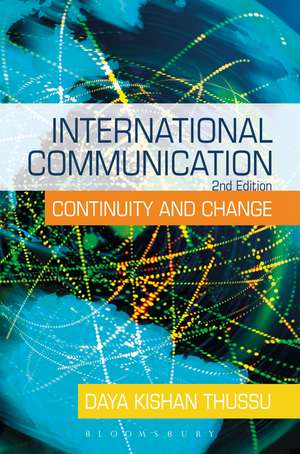
International Communication: Continuity and Change
Autor Daya Kishan Thussuen Limba Engleză Paperback – 28 iul 2006
Ajunsă la cea de-a treia ediție, lucrarea International Communication de Daya Kishan Thussu rămâne un text de referință pentru înțelegerea modului în care media și telecomunicațiile s-au transformat sub presiunea globalizării. Această nouă ediție aduce o actualizare necesară asupra vitezei uluitoare cu care s-au schimbat fluxurile informaționale de la începutul noului mileniu, punând un accent sporit pe procesele de liberalizare și privatizare care au permis corporațiilor transnaționale să își extindă influența. Structura cărții este riguros organizată, debutând cu o perspectivă istorică ce urmărește evoluția de la era telegrafului și a agențiilor de presă clasice până la propaganda din timpul Războiului Rece.
Descoperim în această ediție o analiză critică a teoriilor clasice — precum dependența, hegemonia sau sfera publică — recalibrată pentru contextul digital actual. Autorul nu se limitează la teorie, ci introduce studii de caz relevante, de la ascensiunea Reuters la utilizarea comunicațiilor prin satelit în scopuri educaționale. Această abordare completează perspectiva oferită de International Communication and Globalization de Ali Mohammadi, adăugând o dimensiune istorică și politică mult mai detaliată asupra structurilor de putere care guvernează fluxul de informații.
În contextul operei sale, volumul de față servește drept fundament pentru cercetările ulterioare ale lui Daya Kishan Thussu din Electronic Empires sau Mapping BRICS Media. Dacă în lucrările sale despre puterile emergente autorul se concentrează pe actori specifici precum China sau grupul BRICS, International Communication oferă cadrul teoretic universal necesar oricărui student sau specialist pentru a înțelege tensiunea dintre continuitatea structurilor imperiale de comunicare și schimbările tehnologice disruptive.
Preț: 311.13 lei
Preț vechi: 388.49 lei
-20%
Carte tipărită la comandă
Livrare economică 30 mai-13 iunie
Specificații
ISBN-10: 034088892X
Pagini: 360
Ilustrații: illustrations
Dimensiuni: 156 x 234 x 19 mm
Greutate: 0.55 kg
Ediția:2 Revised edition. Auflage
Editura: Bloomsbury Publishing
Colecția Bloomsbury Academic
Locul publicării:London, United Kingdom
V-ar putea interesa
-
 Preț: 151.42 lei
 -
 -6%Preț: 323.64 lei345.95 lei
 -
 Intercultural PragmaticsIstvan Kecskes-14%Preț: 675.98 lei786.02 lei
 -
 Humanity's LawRuti TeitelPreț: 279.23 lei
 -
 The Practice of Public DiplomacyW. RughPreț: 376.51 lei
 -
 Freedom's BattleGary J. BassPreț: 146.95 lei
 -
 Advocacy and Social Work PracticeTom Wilks-22%Preț: 187.11 lei240.05 lei
 -
 Branding Cities: Cosmopolitanism, Parochialism, and Social ChangeStephanie Hemelryk DonaldPreț: 453.04 lei
 -
 Preț: 295.57 lei
 -
 The Nature and Origins of Mass OpinionJohn R. ZallerPreț: 213.90 lei
 -
 -37%Preț: 250.76 lei398.75 lei
 -
 The Ethics of Armed Humanitarian InterventionDon E. ScheidPreț: 216.43 lei
 -
 International Law and International RelationsDavid ArmstrongPreț: 272.33 lei
 -
 International Public Relations and Public DiplomacyGuy J. GolanPreț: 415.54 lei
 -
 Managing the Public's Trust in Non-profit OrganizationsChristopher D.B. BurtPreț: 361.78 lei
De ce să citești această carte
Această carte este esențială pentru studenții de la Științele Comunicării și Relații Internaționale, oferind o sinteză clară între istoria mass-media și teoriile politice moderne. Cititorul câștigă o înțelegere profundă a modului în care informația este utilizată ca instrument de putere economică și politică, beneficiind de studii de caz care fac conceptele abstracte ușor de asimilat.
Despre autor
Daya Kishan Thussu este profesor de comunicare internațională și co-director al India Media Centre în cadrul Universității din Westminster, Marea Britanie. Cu o experiență vastă în cercetarea media, el este fondatorul și editorul executiv al prestigiosului jurnal Global Media and Communication. Expertiza sa se concentrează pe fluxurile globale de știri, comunicarea pentru dezvoltare și ascensiunea media în economiile emergente, fiind unul dintre cei mai respectați cercetători care analizează decolonizarea studiilor media și impactul global al noilor imperii electronice.
Descriere
Professor Robert W. McChesney, University of Illinois, USA
The second edition of International Communication examines the profound changes that have taken place, and are continuing to take place at an astonishing speed, in international media and communication since the turn of the new millennium.
Building on the success of the first edition, the second maps out the expansion of media and telecommunications corporations within the macro-economic context of liberalisation, deregulation and privitisation. It then goes on to explore the impact of such growth on audiences in different cultural contexts and from regional, national and international perspectives. Each chapter contains engaging case studies which exemplify the main concepts and arguments.
Recenzii
This is an excellent publication... What Daya Thussu has succeeded in doing is combining, in one well-written tome, a rich over-view of the world's contemporary media and communications environment.
Cuprins
Chapter 1: The Historical Context of International Communication
Communication and Empire
The Growth of the Telegraph
The Era of News Agencies
Case Study: The Rise of Reuters
The Advent of Popular Media
Radio and International Communication
The Cold War - From Communist Propaganda to Capitalist Persuasion
Case Study: Covert Communication - RFE and RL
International Communication and Development
Case Study: Satellite Instructional Television Experiment
The Demand for a New World Information and Communication Order
Chapter 2: Approaches to Theorizing International Communication
'Free Flow of Information'
Modernization Theory
Dependency Theory
Structural Imperialism
Hegemony
Critical Theory
The Public Sphere
Cultural Studies Perspectives on International Communication
Theories of the information society
Discourses of Globalization
A Critical International Communication Theory?
International Communication in International Politics
Internationalizing International Communication Theory
Chapter 3: Creating a Global Communication Infrastructure
The Privatization of Telecommunications
Free Trade in Communication Products and Services
Liberalization of the Telecom Sector
Privatizing Space - the Final Frontier
Case Study: Intelsat
The Global Satellite Industry
Regional Satellite Services
The Globalization of Telecoms
Infrastructure for Internet
Who Controls the Internet Infrastructure?
Regulating an unregulated global Communication market
The 'T-treaty Trinity' and Further Digital Deregulation?
Implications of a Liberalized Global Communication Regime
Chapter 4: The Global Media Market
Convergence
Global Media Conglomerates
Case Study: Murdoch: A Global Media Mogul
Televising Sport Globally
Global News and Information Networks
Case Study: CNN - The 'World's News Leader'
Setting the Global News Agenda
Chapter 5: The Global and the Local in Media Cultures
The Globalization of American Consumer Culture
Global Trade in Media Products
Public service to Private Profit - European Broadcasting
Case Study: Children's Television - Catching Them Young
Hollywood Hegemony
Concerns for cultural Diversity
Global English
Regionalizing and Localizing Media Cultures
Global Music
Case Study: MTV
Adaptation, Hybridity or Hegemony?
Cultural Relativism and Revivalism
Culture as 'Soft Power'
Chapter 6: Contraflow in Global Media
The Globalization of China's Media
Contraflow in Global Entertainment
The Other Hollywood - The Indian Film Industry
Case Study: Zee TV - The Globalization of Indian Entertainment
Globalization of Geo-linguistic Television
The Transnationalization of Telenovelas
Case Study: The Dramatic Rise of Turkish TV Dramas
Case Study: Hallyu - the Korean Wave
Case Study: Nigerian cinema Goes Global - Nollywood
Contraflow in Global TV News
Case Study: Al Jazeera - The 'Island' that Became a Global News Phenomenon
The 'RT Effect'
Contra or Complementary Flows?
Cultures of Diaspora and 'Migratory' Media
Chapter 7: International Communication in the Digital Age
Digital Capitalism and a 'Free Flow of Commerce'
Case Study: The 'Googlization' of Global Communication
The Facebook Effect
Communicating 'Cyber-Capitalism with Chinese Characteristics'
Internet and Political Communication
Case Study: The Globalization of 'Fake News'
How the Web Has Affected Journalism
International Communication as Infotainment and Edutainment
Case Study: Infotainment 2.0
Global Edutainment
Governance and Regulation in the Digital Age
Global Communication: covert Spying and Overt Surveillance
Communication for Development
The 'Chindia' Effect
Internationalizing International Communication Studies
International Communication: Continuity and Change
Glossary
Appendix I: A Chronology of International Communication
Appendix II: Useful Websites
Appendix III: Discussion Questions
References
Index