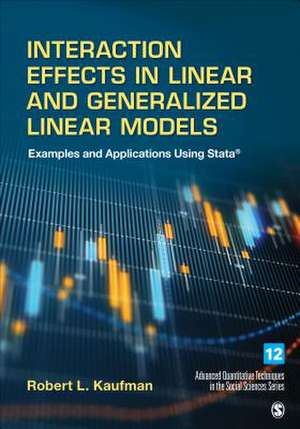
Interaction Effects in Linear and Generalized Linear Models: Examples and Applications Using Stata: Advanced Quantitative Techniques in the Social Sciences
Autor Robert L. Kaufmanen Limba Engleză Electronic book text – 19 sep 2018
–Nicole Kalaf-Hughes, Bowling Green State University
Offering a clear set of workable examples with data and explanations, Interaction Effects in Linear and Generalized Linear Models is a comprehensive and accessible text that provides a unified approach to interpreting interaction effects. The book develops the statistical basis for the general principles of interpretive tools and applies them to a variety of examples, introduces the ICALC Toolkit for Stata, and offers a series of start-to-finish application examples to show students how to interpret interaction effects for a variety of different techniques of analysis, beginning with OLS regression.
The author’s website at www.icalcrlk.com provides a downloadable toolkit of Stata® routines to produce the calculations, tables, and graphics for each interpretive tool discussed. Also available are the Stata® dataset files to run the examples in the book.



Preț: 382.20 lei
Puncte Express: 573
Indisponibil temporar
Doresc să fiu notificat când acest titlu va fi disponibil:
Se trimite...
Specificații
ISBN-13: 9781506365398
ISBN-10: 1506365396
Pagini: 608
Dimensiuni: 178 x 254 mm
Ediția:1
Editura: SAGE Publications
Colecția Sage Publications, Inc
Seria Advanced Quantitative Techniques in the Social Sciences
Locul publicării:Thousand Oaks, United States
ISBN-10: 1506365396
Pagini: 608
Dimensiuni: 178 x 254 mm
Ediția:1
Editura: SAGE Publications
Colecția Sage Publications, Inc
Seria Advanced Quantitative Techniques in the Social Sciences
Locul publicării:Thousand Oaks, United States
V-ar putea interesa
-
 Preț: 124.51 lei
 -
 Fieldwork with ChildrenRobyn M. Holmes-15%Preț: 626.06 lei736.54 lei
 -
 Game Theory TopicsEvelyn C. FinkPreț: 320.48 lei
 -
 Effect Size for Anova DesignsJose M CortinaPreț: 325.85 lei
 -
 Using Nvivo in Qualitative ResearchLyn Richards-18%Preț: 693.53 lei845.76 lei
 -
 A Companion to Qualitative ResearchUwe Flick-19%Preț: 524.74 lei647.83 lei
 -
 Evaluation BasicsJacqueline B Kosecoff-15%Preț: 614.10 lei722.47 lei
 -
 Naturalistic InquiryYvonna S. Lincoln-18%Preț: 828.06 lei1009.82 lei
 -
 Maximum Likelihood Estimation: Logic and PracticeScott R. EliasonPreț: 341.36 lei
 -
 Doing Research on Sensitive TopicsRaymond M. Lee-18%Preț: 780.57 lei951.92 lei
 -
 Action Research for Professional SellingPeter McDonnell-23%Preț: 1141.39 lei1487.28 lei
 -
 Reframing Evaluation Through Appreciative InquiryHallie S. Preskill-15%Preț: 455.30 lei535.65 lei
 -
 -29%Preț: 1125.51 lei1579.87 lei
 -
 Mixed Methods Applications in Action ResearchNataliya V. Ivankova-23%Preț: 661.64 lei859.27 lei
 -
 Heteroskedasticity in RegressionRobert L. KaufmanPreț: 327.56 lei
 -
 Best Practices in Logistic RegressionJason W. Osborne-15%Preț: 636.31 lei748.60 lei
 -
 Evaluability AssessmentMichael S. Trevisan-15%Preț: 446.38 lei525.14 lei
 -
 Empowerment EvaluationDavid M. Fetterman-23%Preț: 878.93 lei1141.47 lei
 -
 Visualization Analysis and DesignTamara Munzner-20%Preț: 574.27 lei717.84 lei
 -
 Credible and Actionable EvidenceStewart I. Donaldson-15%Preț: 622.12 lei731.91 lei
 -
 -23%Preț: 657.02 lei853.28 lei
 -
 The Action Research DissertationKathryn Herr-23%Preț: 655.89 lei851.80 lei
Recenzii
“This
book
is
remarkable
in
its
accessible
treatment
of
interaction
effects.
Although
this
concept
can
be
challenging
for
students
(even
those
with
some
background
in
statistics),
this
book
presents
the
material
in
a
very
accessible
manner,
with
plenty
of
examples
to
help
the
reader
understand
how
to
interpret
their
results.”
“Interaction Effects in Linear and Generalized Linear Modelsprovides an intuitive approach that benefits both new users of Stata getting acquainted with these statistical models as well as experienced students looking for a refresher. The topic of interactions is greatly important given that many of our main theories in the social and behavioral sciences rely on moderating effects of variables. This book does a terrific job of guiding the reader through the various statistical commands available in Stata and explaining the results and taking the reader through different considerations in graphically presenting their results.”
“Interaction Effects in Linear and Generalized Linear Modelsprovides an intuitive approach that benefits both new users of Stata getting acquainted with these statistical models as well as experienced students looking for a refresher. The topic of interactions is greatly important given that many of our main theories in the social and behavioral sciences rely on moderating effects of variables. This book does a terrific job of guiding the reader through the various statistical commands available in Stata and explaining the results and taking the reader through different considerations in graphically presenting their results.”
Cuprins
Series
Editor’s
Introduction
Preface
Acknowledgments
About the Author
1. Introduction and Background
Overview: Why Should You Read This Book?
The Logic of Interaction Effects in Linear Regression Models
The Logic of Interaction Effects in GLMs
Diagnostic Testing and Consequences of Model Misspecification
Roadmap for the Rest of the Book
Chapter 1 Notes
PART I. PRINCIPLES
2. Basics of Interpreting the Focal Variable’s Effect in the Modeling Component
Mathematical (Geometric) Foundation for GFI
GFI Basics: Algebraic Regrouping, Point Estimates, and Sign Changes
Plotting Effects
Summary
Special Topics
Chapter 2 Notes
3. The Varying Significance of the Focal Variable’s Effect
Test Statistics and Significance Levels
JN Mathematically Derived Significance Region
Empirically Defined Significance Region
Confidence Bounds and Error Bar Plots
Summary and Recommendations
Chapter 3 Notes
4. Linear (Identity Link) Models: Using the Predicted Outcome for Interpretation
Options for Display and Reference Values
Reference Values for the Other Predictors (Z)
Constructing Tables of Predicted Outcome Values
Charts and Plots of the Expected Value of the Outcome
Conclusion
Special Topics
Chapter 4 Notes
5. Nonidentity Link Functions: Challenges of Interpreting Interactions in Nonlinear Models
Identifying the Issues
Mathematically Defining the Confounded Sources of Nonlinearity
Revisiting Options for Display and Reference Values
Solutions
Summary and Recommendations
Derivations and Calculations
Chapter 5 Notes
PART II. APPLICATIONS
6. ICALC Toolkit: Syntax, Options, and Examples
Overview
INTSPEC: Syntax and Options
GFI Tool: Syntax and Options
SIGREG Tool: Syntax and Options
EFFDISP Tool: Syntax and Options
OUTDISP Tool: Syntax and Options
Next Steps
Chapter 6 Notes
7. Linear Regression Model Applications
Overview
Single-Moderator Example
Two-Moderator Example
Special Topics
Chapter 7 Notes
8. Logistic Regression and Probit Applications
Overview
One-Moderator Example (Nominal by Nominal)
Three-Way Interaction Example (Interval by Interval by Nominal)
Special Topics
Chapter 8 Notes
9. Multinomial Logistic Regression Applications
Overview
One-Moderator Example (Interval by Interval)
Two-Moderator Example (Interval by Two Nominal)
Special Topics
Chapter 9 Notes
10. Ordinal Regression Models
Overview
One-Moderator Example (Interval by Nominal)
Two-Moderator Interaction Example (Nominal by Two Interval)
Special Topics
Chapter 10 Notes
11. Count Models
Overview
One-Moderator Example (Interval by Nominal)
Three-Way Interaction Example (Interval by Interval by Nominal)
Special Topics
Chapter 11 Notes
12. Extensions and Final Thoughts
Extensions
Final Thoughts: Dos, Don’ts, and Cautions
Chapter 12 Notes
Appendix: Data for Examples
Chapter 2: One-Moderator Example
Chapter 2: Two-Moderator Mixed Example
Chapter 2: Two-Moderator Interval Example
Chapter 2: Three-Way Interaction Example
Chapter 3: One-Moderator Example
Chapter 3: Two-Moderator Example
Chapter 3: Three-Way Interaction Example
Chapter 4: Tables One-Moderator Example and Figures Example 3
Chapter 4: Tables Two-Moderator Example
Chapter 4: Figures Examples 1 and 2
Chapter 4: Figures Example 4
Chapter 4: Tables Three-Way Interaction Example and Figures Example 5
Chapter 5: Examples 1 and 2
Chapter 5: Example 3
Chapter 5: Example 4
Chapter 6: One-Moderator Example
Chapter 6: Two-Moderator Example
Chapter 6: Three-Way Interaction Example
Chapter 7: One-Moderator Example
Chapter 7: Two-Moderator Example
Chapter 8: One-Moderator Example
Chapter 8: Three-Way Interaction Example
Chapter 9: One-Moderator Example
Chapter 9: Two-Moderator Example
Chapter 10: One-Moderator Example
Chapter 10: Two-Moderator Example
Chapter 11: One-Moderator Example
Chapter 11: Three-Way Interaction Example
Chapter 12: Polynomial Example
Chapter 12: Heckman Example
Chapter 12: Survival Analysis Example
References
Data Sources
Index
Preface
Acknowledgments
About the Author
1. Introduction and Background
Overview: Why Should You Read This Book?
The Logic of Interaction Effects in Linear Regression Models
The Logic of Interaction Effects in GLMs
Diagnostic Testing and Consequences of Model Misspecification
Roadmap for the Rest of the Book
Chapter 1 Notes
PART I. PRINCIPLES
2. Basics of Interpreting the Focal Variable’s Effect in the Modeling Component
Mathematical (Geometric) Foundation for GFI
GFI Basics: Algebraic Regrouping, Point Estimates, and Sign Changes
Plotting Effects
Summary
Special Topics
Chapter 2 Notes
3. The Varying Significance of the Focal Variable’s Effect
Test Statistics and Significance Levels
JN Mathematically Derived Significance Region
Empirically Defined Significance Region
Confidence Bounds and Error Bar Plots
Summary and Recommendations
Chapter 3 Notes
4. Linear (Identity Link) Models: Using the Predicted Outcome for Interpretation
Options for Display and Reference Values
Reference Values for the Other Predictors (Z)
Constructing Tables of Predicted Outcome Values
Charts and Plots of the Expected Value of the Outcome
Conclusion
Special Topics
Chapter 4 Notes
5. Nonidentity Link Functions: Challenges of Interpreting Interactions in Nonlinear Models
Identifying the Issues
Mathematically Defining the Confounded Sources of Nonlinearity
Revisiting Options for Display and Reference Values
Solutions
Summary and Recommendations
Derivations and Calculations
Chapter 5 Notes
PART II. APPLICATIONS
6. ICALC Toolkit: Syntax, Options, and Examples
Overview
INTSPEC: Syntax and Options
GFI Tool: Syntax and Options
SIGREG Tool: Syntax and Options
EFFDISP Tool: Syntax and Options
OUTDISP Tool: Syntax and Options
Next Steps
Chapter 6 Notes
7. Linear Regression Model Applications
Overview
Single-Moderator Example
Two-Moderator Example
Special Topics
Chapter 7 Notes
8. Logistic Regression and Probit Applications
Overview
One-Moderator Example (Nominal by Nominal)
Three-Way Interaction Example (Interval by Interval by Nominal)
Special Topics
Chapter 8 Notes
9. Multinomial Logistic Regression Applications
Overview
One-Moderator Example (Interval by Interval)
Two-Moderator Example (Interval by Two Nominal)
Special Topics
Chapter 9 Notes
10. Ordinal Regression Models
Overview
One-Moderator Example (Interval by Nominal)
Two-Moderator Interaction Example (Nominal by Two Interval)
Special Topics
Chapter 10 Notes
11. Count Models
Overview
One-Moderator Example (Interval by Nominal)
Three-Way Interaction Example (Interval by Interval by Nominal)
Special Topics
Chapter 11 Notes
12. Extensions and Final Thoughts
Extensions
Final Thoughts: Dos, Don’ts, and Cautions
Chapter 12 Notes
Appendix: Data for Examples
Chapter 2: One-Moderator Example
Chapter 2: Two-Moderator Mixed Example
Chapter 2: Two-Moderator Interval Example
Chapter 2: Three-Way Interaction Example
Chapter 3: One-Moderator Example
Chapter 3: Two-Moderator Example
Chapter 3: Three-Way Interaction Example
Chapter 4: Tables One-Moderator Example and Figures Example 3
Chapter 4: Tables Two-Moderator Example
Chapter 4: Figures Examples 1 and 2
Chapter 4: Figures Example 4
Chapter 4: Tables Three-Way Interaction Example and Figures Example 5
Chapter 5: Examples 1 and 2
Chapter 5: Example 3
Chapter 5: Example 4
Chapter 6: One-Moderator Example
Chapter 6: Two-Moderator Example
Chapter 6: Three-Way Interaction Example
Chapter 7: One-Moderator Example
Chapter 7: Two-Moderator Example
Chapter 8: One-Moderator Example
Chapter 8: Three-Way Interaction Example
Chapter 9: One-Moderator Example
Chapter 9: Two-Moderator Example
Chapter 10: One-Moderator Example
Chapter 10: Two-Moderator Example
Chapter 11: One-Moderator Example
Chapter 11: Three-Way Interaction Example
Chapter 12: Polynomial Example
Chapter 12: Heckman Example
Chapter 12: Survival Analysis Example
References
Data Sources
Index
Descriere
Offering
a
clear
set
of
workable
examples
with
data
and
explanations, Interaction
Effects
in
Linear
and
Generalized
Linear
Models is
a
comprehensive
and
accessible
text
that
provides
a
unified
approach
to
interpreting
interaction
effects.
Notă biografică
Robert Kaufman (PhD University of Wisconsin, 1981) is professor of sociology and the Chair of the Department of Sociology at Temple University. His substantive research focuses on economic structure and labor market inequality, especially with respect to race, ethnicity, and gender. He has also explored other realms of race-ethnic inequality, including research on wealth, home equity, residential segregation, traffic stops and treatment by police, and media portrayals of crime. More abstract statistical issues motivate some of his current work on evaluating different methods for correcting for heteroskedasticity using Monte Carlo simulations. Dr. Kaufman has published papers on quantitative methods in American Sociological Review, American Journal of Sociology, Sociological Methodology, Sociological Methods and Research, and Social Science Quarterly. He served on the editorial board of Sociological Methods and Research for 15 years and has taught graduate-level statistics courses nearly every year for the past 30 years.