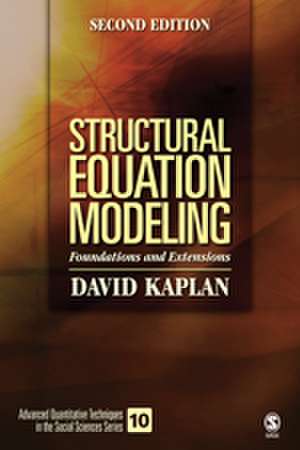
Structural Equation Modeling: Foundations and Extensions: Advanced Quantitative Techniques in the Social Sciences, cartea 10
Autor David W. Kaplanen Limba Engleză Electronic book text – 11 oct 2012
- traditional SEM for continuous latent variables, including assumption issues as well as latent growth curve modeling for continuous growth factors
- SEM for categorical latent variables, including latent class analysis, Markov models (latent and mixed latent), and growth mixture modeling.
Through the use of detailed, empirical examples, Kaplan demonstrates how SEM can provide a unique lens on the problems social and behavioural scientists face. The book has been enhanced with certain features that will guide the student and researcher through the foundations and critical assumptions of SEM.

Preț: 516.96 lei
Preț vechi: 561.91 lei
-8%
Puncte Express: 775
Indisponibil temporar
Doresc să fiu notificat când acest titlu va fi disponibil:
Se trimite...
Specificații
ISBN-13: 9781452245126
ISBN-10: 1452245126
Pagini: 272
Dimensiuni: 152 x 229 mm
Ediția:Second Edition
Editura: SAGE Publications
Colecția Sage Publications, Inc
Seria Advanced Quantitative Techniques in the Social Sciences
Locul publicării:Thousand Oaks, United States
ISBN-10: 1452245126
Pagini: 272
Dimensiuni: 152 x 229 mm
Ediția:Second Edition
Editura: SAGE Publications
Colecția Sage Publications, Inc
Seria Advanced Quantitative Techniques in the Social Sciences
Locul publicării:Thousand Oaks, United States
Cuprins
Preface
to
the
Second
Edition
1. Historical Foundations of Structural Equation Modeling for Continuous and Categorical Latent Variables
2. Path Analysis: Modeling Systems of Structural Equations Among Observed Variables
3. Factor Analysis
4. Structural Equation Models in Single and Multiple Groups
5. Statistical Assumptions Underlying Structural Equation Modeling
6. Evaluating and Modifying Structural Equation Models
7. Multilevel Structural Equation Modeling
8. Latent Growth Curve Modeling
9. Structural Models for Categorical and Continuous Latent Variables
10. Epilogue: Toward a New Approach to the Practice of Structural Equation Modeling
1. Historical Foundations of Structural Equation Modeling for Continuous and Categorical Latent Variables
2. Path Analysis: Modeling Systems of Structural Equations Among Observed Variables
3. Factor Analysis
4. Structural Equation Models in Single and Multiple Groups
5. Statistical Assumptions Underlying Structural Equation Modeling
6. Evaluating and Modifying Structural Equation Models
7. Multilevel Structural Equation Modeling
8. Latent Growth Curve Modeling
9. Structural Models for Categorical and Continuous Latent Variables
10. Epilogue: Toward a New Approach to the Practice of Structural Equation Modeling
Descriere
Clearly
and
precisely
shows
how
SEM
can
be
used
to
answer
or
provide
insight
to
substantive
questions,
specifically
by
weaving
a
small
set
of
empirical
examples
and
data
throughout
the
chapters