
Intelligent Sustainable Systems: Lecture Notes in Networks and Systems, cartea 828
Editat de Atulya K. Nagar, Dharm Singh Jat, Durgesh Kumar Mishra, Amit Joshien Limba Engleză Paperback – 8 mar 2024
În domeniul vast al inteligenței artificiale și al sustenabilității, găsim în această lucrare o resursă tehnică riguroasă ce documentează progresele prezentate la conferința WS4 2023. Suntem de părere că volumul Intelligent Sustainable Systems reușește să pună în dialog tehnologiile de ultimă oră cu necesitățile ecologice și sociale actuale. Dacă titlul Sustainable Intelligent Systems de Amit Joshi v-a oferit cadrul teoretic necesar înțelegerii impactului societal, această carte oferă instrumentele practice și studiile de caz esențiale pentru implementarea acestor concepte în scenarii reale. Structura este organizată metodical în secțiuni ce acoperă infrastructura IT, sistemele securizate pentru tehnologii de generație viitoare și aplicații complexe în informatica biomedicală. Putem afirma că progresia de la modelele de management al cunoștințelor (Capitolul 1) la aplicații specifice de control industrial, precum sistemele de umidificare bazate pe logică fuzzy (Capitolul 2), demonstrează o abordare orientată spre inginerie și soluții aplicate. Această lucrare se înscrie organic în seria de volume editate de Atulya K. Nagar, completând tematicile abordate în Soft Computing for Problem Solving, dar mutând accentul de la algoritmii fundamentali către sustenabilitatea sistemică.
Din seria Lecture Notes in Networks and Systems
- 18%
 Preț: 1777.32 lei
 - 20%
 Preț: 1107.82 lei
 - 20%
 Preț: 977.73 lei
 - 20%
 Preț: 1224.62 lei
 - 18%
 Preț: 1337.49 lei
 - 20%
 Preț: 1388.65 lei
 - 20%
 Preț: 1391.13 lei
 - 20%
 Preț: 296.41 lei
 - 18%
 Preț: 1083.39 lei
 - 20%
 Preț: 1251.65 lei
 - 20%
 Preț: 1563.80 lei
 - 20%
 Preț: 1101.45 lei
 - 20%
 Preț: 1390.94 lei
 - 18%
 Preț: 1172.24 lei
 - 20%
 Preț: 1390.03 lei
 - 20%
 Preț: 1399.33 lei
 - 18%
 Preț: 1325.53 lei
 - 18%
 Preț: 1340.29 lei
 - 18%
 Preț: 1327.69 lei
 - 20%
 Preț: 1293.34 lei
 - 18%
 Preț: 1329.01 lei
 - 18%
 Preț: 928.77 lei
 - 18%
 Preț: 965.11 lei
 - 20%
 Preț: 1624.40 lei
 - 20%
 Preț: 1386.55 lei
 - 18%
 Preț: 1503.67 lei
 - 20%
 Preț: 1265.71 lei
 - 20%
 Preț: 1264.30 lei
 - 20%
 Preț: 1762.31 lei
 - 20%
 Preț: 1902.56 lei
 - 20%
 Preț: 1872.46 lei
 - 20%
 Preț: 670.56 lei
 - 20%
 Preț: 2183.95 lei
 - 20%
 Preț: 1278.83 lei
 - 20%
 Preț: 1406.23 lei
 - 20%
 Preț: 945.88 lei
 - 20%
 Preț: 1672.88 lei
 - 20%
 Preț: 1696.64 lei
 - 18%
 Preț: 1064.66 lei
 - 18%
 Preț: 1115.29 lei
 - 18%
 Preț: 1488.95 lei
 - 20%
 Preț: 1578.44 lei
 - 18%
 Preț: 3259.15 lei
Preț: 1384.51 lei
Preț vechi: 1730.65 lei
-20%
Carte tipărită la comandă
Livrare economică 06-20 iunie
Specificații
ISBN-10: 9819981107
Pagini: 396
Ilustrații: XIII, 380 p. 113 illus., 90 illus. in color.
Dimensiuni: 155 x 235 x 22 mm
Greutate: 0.6 kg
Ediția:2024
Editura: Springer
Colecția Lecture Notes in Networks and Systems
Seria Lecture Notes in Networks and Systems
Locul publicării:Singapore, Singapore
V-ar putea interesa
-
 -20%Preț: 1377.72 lei1722.15 lei
 -
 -20%Preț: 386.19 lei482.74 lei
 -
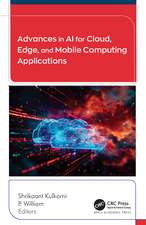 Advances in AI for Cloud, Edge, and Mobile Computing ApplicationsShrikaant Kulkarni-94%Preț: 101.70 lei1571.69 lei
 -
 Digital Sustainability: Inclusion and TransformationFernando Luís Almeida-18%Preț: 1350.32 lei1646.73 lei
 -
 Advances in Smart Medical, IoT & Artificial IntelligenceMohammed Serrhini-20%Preț: 1394.25 lei1742.81 lei
 -
 Sustainable Smart Cities 2.0Priyanka Mishra-24%Preț: 773.56 lei1017.85 lei
 -
 -20%Preț: 591.47 lei739.35 lei
 -
 -20%Preț: 511.28 lei639.09 lei
 -
 Intelligent Sustainable Systems: Proceedings of ICISS 2022Jennifer S. Raj-20%Preț: 1583.97 lei1979.96 lei
 -
 Information Systems for Intelligent SystemsChakchai So-In-20%Preț: 1861.87 lei2327.34 lei
 -
 -20%Preț: 1588.49 lei1985.61 lei
 -
 Intelligent SystemsSiba K. Udgata-18%Preț: 1329.01 lei1620.76 lei
 -
 Recent Advances in Artificial Intelligence and Smart ApplicationsJyotsna K. Mandal-18%Preț: 965.11 lei1176.97 lei
 -
 -18%Preț: 1185.81 lei1446.11 lei
 -
 -20%Preț: 1563.80 lei1954.75 lei
 -
 ICT Systems and SustainabilityMilan Tuba-24%Preț: 1311.19 lei1725.25 lei
 -
 Intelligent Sustainable Systems: Proceedings of ICISS 2023Jennifer S. Raj-20%Preț: 1422.28 lei1777.84 lei
 -
 Intelligent Sustainable SystemsAtulya K. Nagar-20%Preț: 1235.07 lei1543.84 lei
 -
 Proceedings of Second International Conference on Intelligent SystemJoão Manuel R. S. Tavares-24%Preț: 1325.22 lei1743.71 lei
 -
 ICT: Smart Systems and TechnologiesM. Shamim Kaiser-18%Preț: 1332.70 lei1625.24 lei
De ce să citești această carte
Recomandăm această carte cercetătorilor și practicienilor care au nevoie de soluții concrete pentru integrarea AI în proiecte sustenabile. Cititorul câștigă acces la metodologii verificate de control industrial și securitate, fiind un instrument de lucru prețios pentru cei care dezvoltă infrastructuri IT inteligente sau soluții de bioinformatică, oferind un echilibru între inovația algoritmică și responsabilitatea față de resurse.
Despre autor
Atulya K. Nagar este un profesor și cercetător proeminent, cu o activitate editorială vastă în cadrul editurii Springer. Expertiza sa se concentrează pe aplicarea metodelor de calcul avansat în rezolvarea problemelor complexe, fiind un coordonator frecvent al conferințelor internaționale de profil. În lucrări precum A Nature-Inspired Approach to Cryptology, Nagar explorează intersecția dintre algoritmii naturali și securitate, o temă care se regăsește și în acest volum sub forma sistemelor securizate pentru viitor. Alături de co-editori precum Amit Joshi și Dharm Singh Jat, acesta contribuie constant la literatura de specialitate dedicată sistemelor inteligente și dezvoltării sustenabile.
Cuprins
Notă biografică
Dharm Singh Jat received his Master of Engineering and Ph.D. in Computer Science and Engineering from prestigious universities in India. He is Professor of Computer Science at Namibia University of Science and Technology (NUST). From 1990 to 2014, he was with the College of Technology and Engineering, Maharana Pratap University of Agricultural and Technology—[MPUAT], Udaipur, India. He has guided about 8 Ph.D. and 24 master’s research scholars. He is Author of more than 150 peer-reviewed articles and Author or editor of more than 20 books. His interests span the areas of multimedia communications, wireless technologies, mobile communication systems, edge roof computing and software-defined networks, network security, Internet of Things. He has given several guest lecturer/invited talks at various prestigious conferences. He is Fellow of The Institution of Engineers (I), Fellow of Computer Society of India, Chartered Engineer (I), Senior Member IEEE and Distinguished ACM Speaker. He also developed experiments based on simulation software for network experiments, research and project work for undergraduate and postgraduate students. His research is in developing video communication platforms for solving QoS issues in video communications and also developed a framework for video transmission over wireless networks for undergraduate and postgraduate students.
Durgesh Kumar Mishra has received M.Tech. degree in Computer Science from DAVV, Indore, in 1994 and Ph.D. degree in Computer Engineering in 2008. Presently, he has been working as Director and Professor (CSE), Symbiosis University of Applied Sciences, Indore, India. Founder Director, Microsoft Innovation Center (LAB) at SAIT. He is also Visiting Faculty at IIT-Indore, MP, India. He has 24 years of teaching and 10 years of research experience. He completed his Ph.D. under the guidance of Dr. M. Chandwani on Secure Multi-Party Computation for Preserving Privacy. He has published more than 90 papers in refereed international/national journals and conferences including IEEE, ACM conferences. He has organized many such conferences like WOCN, CONSEG and CSIBIG in the capacity of Conference General Chair and Editor of conference proceedings. His publications are listed in DBLP, Citeseer-x, Elsevier and Scopus. He is Senior Member of IEEE and held many positions like Chairman IEEE Computer Society Madhya Pradesh Section (2021-2023). Chairman, IEEE MP-Subsection (2011-2012) and Chairman IEEE Computer Society Bombay Chapter (2009-2010). He was Chairman in CSI Division IV Communication at National Level (2014-2016). He visited and delivered his invited talk in Taiwan, Bangladesh, Singapore, Nepal, USA, UK and France. He has authored a book on “Database Management Systems”. He has been a consultant to the sales tax and labor department of the government of Madhya Pradesh, India. He has been awarded with “Paper Presenter award at International Level”by CSI. He visited MIT Boston and presented his presentation on Security and Privacy. He also chaired a panel on “Digital Monozukuri” at “Norbert Winner in the 21st century” at Boston. He became Member of Bureau of Indian Standards (BIS), Government of India, for Information Security domain.
Amit Joshi is Entrepreneur and Researcher who has completed his graduation (B.Tech.) in Information Technology and M.Tech. in Computer Science and Engineering and completed his research in the areas of Cloud Computing and Cryptography in Medical imaging with a focus on analysis of the current Government Strategies and World forums needs in different sectors on security purposes. He has an experience of around 10 years in academic and industry in prestigious organizations. He is Active Member of ACM, IEEE, CSI, AMIE, IACSIT-Singapore, IDES, ACEEE, NPA and many other professional societies. Currently, he is International Chair of InterYIT at International Federation of Information Processing (IFIP, Austria). He has presented and published more than 50 papers in National and International Journals/Conferences of IEEE and ACM. He has also edited more than 20 books which are published by Springer, ACM and other reputed publishers. Apart from this academic involvement, he is also associated with the Business and Industry Community across the globe. He is currently Director of Global Knowledge Research Foundation, and his major work area is focused on building and making effective linkages among bureaucrats, industry associations, academic leaders and regulatory authorities for effective connectivity for taking up common issues related to research in different sectors. He is Director of Knowledge Chamber of Commerce and Industry. He majorly focuses on Academic Tie-ups for Medical, Engineering and Management sectors, and for the same, he is representing the organization in many delegations to countries including USA, UK, Canada, Israel and visited more than 15 countries. He always looks forward and strive for networking in various sectors with a focus on Education and Industry Sector.