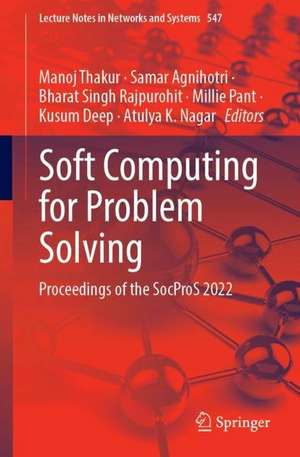
Soft Computing for Problem Solving: Lecture Notes in Networks and Systems, cartea 547
Editat de Manoj Thakur, Samar Agnihotri, Bharat Singh Rajpurohit, Millie Pant, Kusum Deep, Atulya K. Nagaren Limba Engleză Paperback – 2 mar 2023
În domeniile inteligenței artificiale și ale științei datelor, volumul Soft Computing for Problem Solving reprezintă o resursă tehnică riguroasă ce documentează progresele prezentate la conferința SocProS 2022. Observăm o orientare clară către rezolvarea problemelor complexe din lumea reală, unde metodele computaționale tradiționale devin ineficiente. Lucrarea este structurată pentru a evidenția atât inovațiile algoritmice, cât și implementările lor practice, acoperind un spectru larg de tehnici, de la rețele neuronale și Deep Learning, până la metode statistice și optimizări euristice precum algoritmul genetic sau optimizarea prin roiuri de particule.
Remarcăm progresia logică a conținutului, care începe cu metodologii de benchmarking pentru segmentarea imaginilor medicale și avansează spre aplicații de nișă, cum ar fi analiza emoțiilor studenților prin CNN sau clasificarea malware-ului bazată pe Transfer Learning. Complementar volumului Soft Computing: Theories and Applications, care pune un accent deosebit pe managementul lanțului de aprovizionare și criptanaliză, acest titlu se distinge prin profunzimea studiilor de caz din domeniul sănătății (analiza semnalelor EEG pentru somn și detectarea crizelor epileptice) și al viziunii computerizate aplicate. Structura capitolelor indică o abordare experimentală solidă, oferind detalii despre preprocesarea datelor și arhitecturile neurale hibride, precum modelele CNN-LSTM.
În contextul evoluției rapide a tehnologiilor de calcul, Soft Computing for Problem Solving servește drept punte între cercetarea academică și ingineria aplicată. Volumul nu se limitează la teorie, ci explorează validarea modelelor în condiții de date imbalansate și medii cu resurse computaționale scăzute, fiind o referință esențială pentru cei care dezvoltă soluții de forecasting sau sisteme de diagnostic automatizat.
Din seria Lecture Notes in Networks and Systems
- 20%
 Preț: 1107.82 lei
 - 18%
 Preț: 2039.79 lei
 - 20%
 Preț: 1224.62 lei
 - 18%
 Preț: 1343.14 lei
 - 20%
 Preț: 1513.82 lei
 - 20%
 Preț: 296.41 lei
 - 18%
 Preț: 1110.13 lei
 - 20%
 Preț: 1345.64 lei
 - 20%
 Preț: 1648.37 lei
 - 20%
 Preț: 1160.96 lei
 - 20%
 Preț: 1390.94 lei
 - 20%
 Preț: 1395.91 lei
 - 18%
 Preț: 1260.25 lei
 - 20%
 Preț: 1390.03 lei
 - 20%
 Preț: 1399.33 lei
 - 18%
 Preț: 1325.53 lei
 - 18%
 Preț: 1340.29 lei
 - 18%
 Preț: 1327.69 lei
 - 20%
 Preț: 1403.92 lei
 - 18%
 Preț: 1400.84 lei
 - 18%
 Preț: 928.77 lei
 - 18%
 Preț: 1017.19 lei
 - 20%
 Preț: 1700.56 lei
 - 20%
 Preț: 1287.92 lei
 - 20%
 Preț: 1461.49 lei
 - 18%
 Preț: 1564.35 lei
 - 24%
 Preț: 898.76 lei
 - 18%
 Preț: 1228.09 lei
 - 18%
 Preț: 1236.51 lei
 - 18%
 Preț: 1282.39 lei
 - 18%
 Preț: 1243.71 lei
 - 20%
 Preț: 1286.21 lei
 - 18%
 Preț: 1263.44 lei
 - 20%
 Preț: 1403.63 lei
 - 18%
 Preț: 1397.87 lei
 - 20%
 Preț: 1453.89 lei
 - 20%
 Preț: 1305.75 lei
 - 20%
 Preț: 1845.06 lei
 - 18%
 Preț: 1166.70 lei
 - 20%
 Preț: 1470.33 lei
 - 18%
 Preț: 1450.39 lei
 - 20%
 Preț: 1902.56 lei
 - 20%
 Preț: 1872.46 lei
Preț: 1842.57 lei
Preț vechi: 2303.21 lei
-20%
Carte disponibilă
Livrare economică 16-30 noiembrie
Specificații
ISBN-10: 9811965242
Pagini: 756
Ilustrații: XXII, 733 p. 237 illus., 197 illus. in color.
Dimensiuni: 155 x 235 x 38 mm
Greutate: 1.26 kg
Ediția:1st ed. 2023
Editura: Springer
Colecția Lecture Notes in Networks and Systems
Seria Lecture Notes in Networks and Systems
Locul publicării:Singapore, Singapore
V-ar putea interesa
-
 -5%Preț: 539.39 lei567.79 lei
 -
 Advances in Intelligent Disease Diagnosis and TreatmentChee-Peng Lim-20%Preț: 1329.49 lei1661.87 lei
 -
 -20%Preț: 1207.79 lei1509.74 lei
 -
 Soft Computing: Theories and ApplicationsTarun K. Sharma-20%Preț: 1012.52 lei1265.64 lei
 -
 Soft Computing: Theories and ApplicationsRajesh Kumar-20%Preț: 1947.67 lei2434.59 lei
 -
 Data Science and ApplicationsSatyasai Jagannath Nanda-18%Preț: 1327.69 lei1619.13 lei
 -
 -5%Preț: 1332.39 lei1402.52 lei
 -
 -20%Preț: 1400.89 lei1751.11 lei
 -
 Soft Computing: Theories and ApplicationsRajesh Kumar-20%Preț: 1290.41 lei1613.01 lei
 -
 Communication and Intelligent SystemsHarish Sharma-20%Preț: 1385.71 lei1732.14 lei
 -
 Machine Vision and Augmented IntelligenceKoushlendra Kumar Singh-20%Preț: 1161.23 lei1451.54 lei
 -
 Intelligent TechnologiesHimansu Das-20%Preț: 1321.42 lei1651.78 lei
 -
 Computing and Machine LearningJagdish Chand Bansal-20%Preț: 1408.28 lei1760.35 lei
 -
 Soft Computing and Signal ProcessingHushairi Zen-18%Preț: 1340.29 lei1634.51 lei
 -
 High Performance Computing, Smart Devices and NetworksRuchika Malhotra-20%Preț: 1480.55 lei1850.69 lei
 -
 Soft Computing and Signal ProcessingVustikayala Sivakumar Reddy-20%Preț: 1401.39 lei1751.74 lei
 -
 Proceedings of Second International Conference on Intelligent SystemJoão Manuel R. S. Tavares-24%Preț: 1325.22 lei1743.71 lei
 -
 Fourth Congress on Intelligent SystemsSandeep Kumar-20%Preț: 1331.31 lei1664.13 lei
 -
 Fourth Congress on Intelligent SystemsSandeep Kumar-20%Preț: 1210.67 lei1513.33 lei
 -
 -18%Preț: 1179.90 lei1438.89 lei
De ce să citești această carte
Această carte este indispensabilă cercetătorilor și inginerilor care lucrează la intersecția dintre Machine Learning și Data Science. Cititorul câștigă acces la metodologii de ultimă oră pentru optimizarea algoritmilor și soluții concrete pentru probleme de clasificare și predicție în domenii critice precum medicina și finanțele. Este un ghid practic pentru implementarea arhitecturilor Deep Learning în scenarii complexe unde precizia și eficiența sunt vitale.
Despre autor
Volumul este coordonat de un colectiv de editori de prestigiu, printre care se numără Manoj Thakur, Kusum Deep și Millie Pant, experți recunoscuți în domeniul optimizării numerice și al inteligenței computaționale. Kusum Deep este profesor la IIT Roorkee, având o experiență vastă în algoritmi de optimizare inspirați din natură, în timp ce Millie Pant s-a specializat în aplicarea tehnicilor de soft computing în inginerie. Expertiza lor combinată asigură rigoarea selecției lucrărilor incluse în seria Lecture Notes in Networks and Systems.
Descriere scurtă
Cuprins
Notă biografică
Dr. Samar Agnihotri received the M.Sc. (Engg.) and Ph.D. degrees in electrical sciences from IISc Bangalore. From 2010 to 2012, he was Postdoctoral Fellow with the Department of Information Engineering, the Chinese University of Hong Kong. He is currently Associate Professor with the School of Computing and Electrical Engineering, IIT Mandi. His research interests include communication and information theory. Dr. Bharat Singh Rajpurohit received the M.Tech. degree in power apparatus and electric drives from the Indian Institute of Technology Roorkee, Roorkee, India, in 2005 and the Ph.D. degree in electrical engineering from the Indian Institute of Technology Kanpur, Kanpur, India, in 2010. He is currently Professor with the School of Computing and Electrical Engineering, Indian Institute of Technology Mandi, Mandi, India. His major research interests include electric drives, renewable energy integration, and intelligent and energy-efficient buildings. He is Member of the International Society for Technology in Education, the Institution of Engineers, India, and the Institution of Electronics and Telecommunication Engineers.
Dr. Millie Pant is Professor at the Department of Applied Mathematics and Scientific Computing, Indian Institute of Technology Roorkee (IIT Roorkee) in India. Her areas of interests include numerical optimization, operations research, decision-making techniques, and artificial intelligence.
Dr. Kusum Deep is Professor at the Department of Mathematics, Indian Institute of Technology Roorkee. Her research interests include numerical optimization, nature-inspired optimization, computational intelligence, genetic algorithms, parallel genetic algorithms, and parallel particle swarm optimization. Prof. Atulya K. Nagar holds Foundation Chair as Professor of Mathematical Sciences and is Pro-Vice-Chancellor (Research) at Liverpool Hope University, UK. He is responsible for developing Sciences and Engineering and has been the Head of the School of Mathematics, Computer Science, and Engineering which he established at the university. He received a prestigious Commonwealth Fellowship for pursuing his doctorate (D.Phil.) in Applied Nonlinear Mathematics, which he earned from the University of York (UK) in 1996. He holds B.Sc. (Hons), M.Sc., and M.Phil. (with distinction) in Mathematical Physics from the MDS University of Ajmer, India. Prior to joining Liverpool Hope, he was with the Brunel University, London. He is an internationally respected scholar working at the cutting edge of nonlinear mathematics, theoretical computer science, and systems engineering. He has edited volumes on intelligent systems andapplied mathematics. He is well published with over 450 publications in prestigious publishing outlets. He has an extensive background and experience of working in universities in the UK and India. He has been an expert reviewer for the Biotechnology and Biological Sciences Research Council (BBSRC) grants peer-review committees for Bioinformatics Panel; Engineering and Physical Sciences Research Council (EPSRC) for High Performance Computing Panel; and served on the Peer-Review College of the Arts and Humanities Research Council (AHRC) as Scientific Expert member. Prof. Nagar sits on the JISC Research Strategy group, and he is Fellow of the Institute of Mathematics and its applications (FIMA) and Fellow of the Higher Education Academy (FHEA).