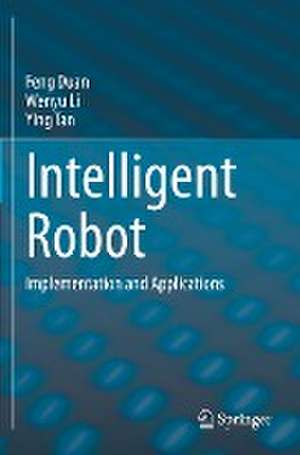
Intelligent Robot
Autor Feng Duan, Wenyu Li, Ying Tanen Limba Engleză Paperback – 23 feb 2024
Resursele practice de cod și exemplele de implementare bazate pe platforma ROS (Robot Operating System) constituie nucleul acestui volum tehnic. Găsim în această carte o abordare structurată care facilitează tranziția de la conceptele teoretice la dezvoltarea efectivă de roboți inteligenți, fiind un instrument de referință pentru inginerii care doresc să stăpânească ecosistemul ROS. Structura este riguros organizată în trei secțiuni: o introducere în istoria și compoziția roboților, o parte tehnică dedicată integrării funcțiilor de viziune, voce și navigație, și o secțiune finală de studii de caz. Suntem de părere că progresia capitolelor este ideală pentru învățarea aplicată. După configurarea mediului de programare în capitolele inițiale, volumul trece rapid la utilizarea robotului Turtlebot pentru a exemplifica teoria navigației autonome și a manipulării obiectelor. Pe linia practică a volumului Introduction to Intelligent Robot System Design de Gang Peng, dar cu focus pe dezvoltarea roboților de serviciu, Intelligent Robot se distinge prin detalierea unor funcții complexe precum recunoașterea comenzilor lungi și interacțiunea prin gesturi (wave hand to order food). Fiecare capitol tehnic, de la cel despre viziunea robotică la cel despre manipularea prin „mâini” robotice, echilibrează explicația algoritmilor cu pașii de execuție în ROS. Cartea nu se limitează la a descrie ce este un robot, ci ghidează cititorul prin procesul de a face un robot să funcționeze într-un mediu real, cum ar fi un restaurant sau un spațiu de asistență domestică. Este o resursă esențială pentru cei care urmăresc să integreze pachete software open-source în platforme hardware complexe.
Preț: 394.22 lei
Carte tipărită la comandă
Livrare economică 23-28 noiembrie
Specificații
ISBN-10: 9811982554
Pagini: 304
Ilustrații: XII, 290 p. 1 illus.
Dimensiuni: 155 x 235 x 17 mm
Greutate: 0.46 kg
Ediția:2023
Editura: Springer
Locul publicării:Singapore, Singapore
V-ar putea interesa
-
 -25%Preț: 93.65 lei125.53 lei
 -
 Introduction to Autonomous Mobile Robots, second editionDavide Scaramuzza-14%Preț: 587.96 lei683.67 lei
 -
 Principles of Robot MotionGeorge A. Kantor-14%Preț: 582.58 lei677.42 lei
 -
 -31%Preț: 441.34 lei639.30 lei
 -
 So That's How It Works! Robots and AITom Jackson-40%Preț: 57.36 lei95.06 lei
 -
 The Big Book of RobotsCampbell BooksPreț: 84.16 lei
 -
 Introduction to Robotics, Global EditionJohn Craig-9%Preț: 596.70 lei655.72 lei
 -
 The Essential Book of AIAnne Rooney-20%Preț: 76.61 lei95.77 lei
 -
 -8%Preț: 591.74 lei643.20 lei
 -
 The LEGO MINDSTORMS EV3 LaboratoryDaniele Benedettelli-19%Preț: 215.56 lei264.52 lei
 -
 Learn Robotics with Raspberry PiMatt Timmons-Brown-34%Preț: 116.45 lei177.71 lei
 -
 Lots of Things to Know About RobotsJames MaclainePreț: 79.22 lei
 -
 Racing RobotsElizabeth DalePreț: 48.72 lei
 -
 First Sticker Book RobotsAlice BeechamPreț: 46.53 lei
 -
 RobotsHenny Admoni-29%Preț: 69.75 lei98.14 lei
 -
 Walking Robots into Real WorldKarsten Berns-18%Preț: 1177.33 lei1435.77 lei
 -
 Robotics Goes MOOCBruno SicilianoPreț: 404.01 lei
 -
 Robot Operating System (ROS)Anis Koubâa-18%Preț: 1171.25 lei1428.35 lei
 -
 Foundations of RoboticsDamith HerathPreț: 368.73 lei
 -
 -24%Preț: 1166.40 lei1534.74 lei
De ce să citești această carte
Această carte se adresează studenților și inginerilor care doresc să treacă de la teorie la construcția propriu-zisă a roboților folosind ROS. Cititorul câștigă competențe directe în programarea funcțiilor de navigație, viziune și vorbire. Motivul principal pentru a alege acest volum este prezența celor trei scenarii de utilizare finală, care demonstrează cum funcțiile individuale lucrează împreună pentru a crea un robot de serviciu funcțional.
Despre autor
Feng Duan, Wenyu Li și Ying Tan sunt experți în robotică și sisteme inteligente, aducând o vastă experiență în cercetarea și dezvoltarea aplicațiilor bazate pe Robot Operating System (ROS). Lucrarea lor, publicată sub egida editurii Springer, reflectă tendințele actuale din mediul academic și industrial din Asia, punând accent pe robotica de serviciu și interacțiunea om-robot. Autorii sunt recunoscuți pentru capacitatea de a sintetiza tehnologii complexe de viziune artificială și navigație autonomă în ghiduri accesibile pentru noua generație de dezvoltatori de sisteme autonome.