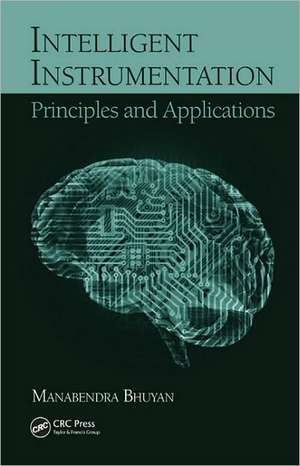
Intelligent Instrumentation: Principles and Applications
Autor Manabendra Bhuyanen Limba Engleză Hardback – 17 noi 2010
Explaining the underlying design methodologies of intelligent instrumentation, Intelligent Instrumentation: Principles and Applications provides a comprehensive and authoritative resource on the scientific foundations from which to coordinate and advance the field. Employing a textbook-like language, this book translates methodologies to more than 80 numerical examples, and provides applications in 14 case studies for a complete and working understanding of the material.
Beginning with a brief introduction to the basic concepts of process, process parameters, sensors and transducers, and classification of transducers, the book describes the performance characteristics of instrumentation and measurement systems and discusses static and dynamic characteristics, various types of sensor signals, and the concepts of signal representations, various transforms, and their operations in both static and dynamic conditions. It describes smart sensors, cogent sensors, soft sensors, self-validating sensors, VLSI sensors, temperature-compensating sensors, microcontrollers and ANN-based sensors, and indirect measurement sensors.
The author examines intelligent sensor signal conditioning such as calibration, linearization, and compensation, along with a wide variety of calibration and linearization techniques using circuits, analog-to-digital converters (ADCs), microcontrollers, ANNs, and software. The final chapters highlight ANN techniques for pattern classification, recognition, prognostic diagnosis, fault detection, linearization, and calibration as well as important interfacing protocols in the wireless networking platform.
Preț: 1499.71 lei
Preț vechi: 1998.58 lei
-25%
Puncte Express: 2250
Carte indisponibilă temporar
Doresc să fiu notificat când acest titlu va fi disponibil:
Se trimite...
Specificații
ISBN-13: 9781420089530
ISBN-10: 1420089536
Pagini: 546
Ilustrații: 262 b/w images, 52 tables and 511 Equations, 8 in text boxes
Dimensiuni: 156 x 234 x 25 mm
Greutate: 0.95 kg
Ediția:1
Editura: CRC Press
Colecția CRC Press
Locul publicării:Boca Raton, United States
ISBN-10: 1420089536
Pagini: 546
Ilustrații: 262 b/w images, 52 tables and 511 Equations, 8 in text boxes
Dimensiuni: 156 x 234 x 25 mm
Greutate: 0.95 kg
Ediția:1
Editura: CRC Press
Colecția CRC Press
Locul publicării:Boca Raton, United States
V-ar putea interesa
-
 Principles of Measurement SystemsJohn Bentley-9%Preț: 604.99 lei664.82 lei
 -
 -32%Preț: 607.91 lei891.45 lei
 -
 Oh's Intensive Care ManualJonathan M. Handy-29%Preț: 675.87 lei954.81 leiRecomandat
 -
 Computer Architecture: A Quantitative ApproachJohn L. Hennessy-40%Preț: 521.63 lei867.20 lei
 -
 -40%Preț: 608.24 lei1011.37 lei
 -
 Computational Intelligence in Design and ManufacturingAndrew Kusiak-14%Preț: 908.20 lei1056.05 lei
 -
 -20%Preț: 339.95 lei424.94 lei
 -
 Principles and Applications of Electrical Engineering ISEGiorgio Rizzoni-25%Preț: 386.30 lei517.94 lei
 -
 ElectronicsNeil Storey-9%Preț: 553.60 lei608.36 lei
 -
 MechatronicsW. Bolton-11%Preț: 655.94 lei737.02 lei
 -
 The MicroprocessorDarshak S. Vasavada-19%Preț: 592.43 lei731.39 lei
 -
 Smart Sensors and SystemsYongpan Liu-15%Preț: 526.03 lei618.86 lei
 -
 Instrumentation: Theory and Practice, Part 1Issam Abu-MahfouzPreț: 449.74 lei
 -
 Measurement and Sensor SystemsAlexander W. Koch-24%Preț: 935.61 lei1231.06 lei
 -
 -20%Preț: 458.54 lei573.18 lei
 -
 Intelligent SystemsSiba K. Udgata-18%Preț: 1329.01 lei1620.76 lei
 -
 -18%Preț: 1094.29 lei1334.51 lei
 -
 Control and Information SciencesI. Thirunavukkarasu-18%Preț: 1369.27 lei1669.84 lei
 -
 Control and Information SciencesV. I. George-18%Preț: 1336.91 lei1630.38 lei
Public țintă
UndergraduateCuprins
Background of Instrumentation. Sensor Performance Characteristics. Signals and System Dynamics. Intelligent Sensors. Linearization, Calibration, and Compensation. Sensors with Artificial Intelligence. Intelligent Sensor Standards and Protocols. Questions. Index
Descriere
Evaluating current topics in instrumentation and sensor engineering courses, this book employs principles-based explanations to delineate the technology. Using commercial devices and technology to support theoretical bases, the author provides solid answers to questions such as: What makes a sensor intelligent? What are the various ways to classify them? How can a classical instrumentation system be provided with the intelligent features? and What are the recent technologies of II/SS? The book includes illustrations, photographs, numerical problems and case studies to explain the theory.