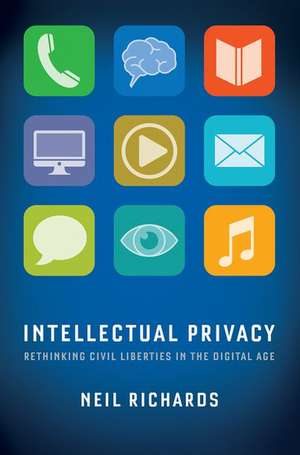
Intellectual Privacy: Rethinking Civil Liberties in the Digital Age
Autor Neil Richardsen Limba Engleză Hardback – 5 mar 2015
Preț: 267.69 lei
Preț vechi: 336.40 lei
-20%
Puncte Express: 402
Carte tipărită la comandă
Livrare economică 13-24 noiembrie
Livrare prin curier în România Termenul estimat este afișat lângă disponibilitate.
Transport gratuit de la 400.00 lei Plată online sau ramburs, în funcție de opțiunile comenzii.
Retur gratuit în 14 zile Comandă securizată și suport în română.
Specificații
ISBN-13: 9780199946143
ISBN-10: 0199946140
Pagini: 240
Dimensiuni: 155 x 234 x 31 mm
Greutate: 0.48 kg
Editura: Oxford University Press
Colecția OUP USA
Locul publicării:New York, United States
ISBN-10: 0199946140
Pagini: 240
Dimensiuni: 155 x 234 x 31 mm
Greutate: 0.48 kg
Editura: Oxford University Press
Colecția OUP USA
Locul publicării:New York, United States
V-ar putea interesa
-
 You Can't Read This BookNick CohenPreț: 78.30 lei
 -
 Trigger WarningMick HumePreț: 62.47 lei
 -
 The Silent StateHeather BrookePreț: 108.14 lei
 -
 The Revolution will be DigitisedHeather BrookePreț: 111.82 lei
 -
 The Net DelusionEvgeny MorozovPreț: 133.61 lei
 -
 -31%Preț: 825.54 lei1195.69 lei
 -
 Free Speech: A Very Short IntroductionNigel Warburton-21%Preț: 54.82 lei69.38 lei
 -
 The Politics of Human RightsAndrew Vincent-11%Preț: 367.14 lei414.34 lei
 -
 Extreme Speech and DemocracyIvan Hare-21%Preț: 432.23 lei549.27 lei
 -
 -31%Preț: 493.47 lei714.25 lei
 -
 Obscenity RulesWhitney Strub-23%Preț: 590.13 lei766.40 lei
 -
 Beyond BarsJo GlanvillePreț: 162.17 lei
 -
 A Right to OffendBrian Winston-14%Preț: 292.73 lei342.06 lei
 -
 SJWs Always LieVox DayPreț: 132.62 lei
Recenzii
Intellectual Privacy is a book that every privacy scholar needs to read and a book that deserves a much wider readership than that. Though it is a legal book the detailed legal and historical analyses that Richards provides throughout the book are scholarly and yet accessible it has implications well beyond the law, from business practices to personal responsibilities.
This book brings fresh perspective and some clear ideas to privacy law and its interaction with freedom of speech. This book is stimulating and thought-provoking, and is recommended for those with an interest in privacy, free speech, and the interplay of those with technological innovation.
After tracking the origins of privacy theory and showing how the original idea, as promoted by Samuel Warren and Louis Brandeis, was flawed at its conception and misapplied over time, Richards carefully constructs a theory about the incubation of new ideas and explains that respect for privacy allows for intellectual exploration and development. This later section, in which Richards moves away from parsing court decisions in favor of a broader philosophical inquiry, is the heart of the book and stands as its main and important contribution to the literature.
This book brings fresh perspective and some clear ideas to privacy law and its interaction with freedom of speech. This book is stimulating and thought-provoking, and is recommended for those with an interest in privacy, free speech, and the interplay of those with technological innovation.
After tracking the origins of privacy theory and showing how the original idea, as promoted by Samuel Warren and Louis Brandeis, was flawed at its conception and misapplied over time, Richards carefully constructs a theory about the incubation of new ideas and explains that respect for privacy allows for intellectual exploration and development. This later section, in which Richards moves away from parsing court decisions in favor of a broader philosophical inquiry, is the heart of the book and stands as its main and important contribution to the literature.
Cuprins
- Introduction
- Part One: Tort Privacy
- 1. Tort Privacy
- 2. Speech
- 3. Disclosure
- 4. Invasion
- 5. Data
- Part Two: Intellectual Privacy
- 6. Intellectual Privacy
- 7. Thinking
- 8. Reading
- 9. Confiding
- Part Three: Information Policy and Civil Liberties
- 10. Beyond Tort Privacy
- 11. Beyond Law
- 12. Conclusion
- Acknowledgements