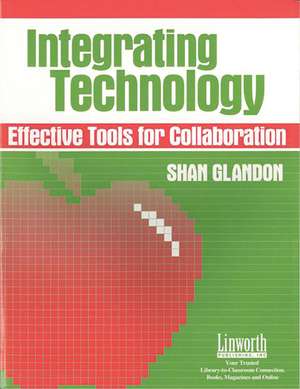
Integrating Technology: Effective Tools for Collaboration
Autor Shan Glandonen Limba Engleză Paperback – 2002
Each unit example begins with a completed planning form showing unit title and length, technology connections, suggested grade levels, activity focus, suggested collaborations between media specialist and teacher, basic resources ,and preparation tasks and lesson plans. The examples show key places within each unit where technology can be integrated easily. The collaborations connect with standards-based education in language arts, math, science and social studies. Ideas for whole-class projects are also included. Easy-to-follow unit outlines include evaluation rubrics for many subject areas, while user-friendly graphic organizers make integrating technology that much easier.
. Add exciting variety to the options K-8 students can use to demonstrate understanding and learning
. 22 sample collaborations show effective ways to incorporate technology in four core subjects
. All units meet the National Educational Standards for Students (ISTE 2000) and support the "Ten Learning and Teaching Principles of School Library Media Programs" outlined in Information Power
Preț: 233.47 lei
Preț vechi: 313.74 lei
-26%
Puncte Express: 350
Carte tipărită la comandă
Livrare economică 14-28 noiembrie
Livrare prin curier în România Termenul estimat este afișat lângă disponibilitate.
Transport gratuit de la 400.00 lei Plată online sau ramburs, în funcție de opțiunile comenzii.
Retur gratuit în 14 zile Comandă securizată și suport în română.
Specificații
ISBN-13: 9781586830557
ISBN-10: 1586830554
Pagini: 160
Dimensiuni: 216 x 279 x 8 mm
Greutate: 0.48 kg
Editura: Bloomsbury Publishing
Colecția Linworth
Locul publicării:New York, United States
ISBN-10: 1586830554
Pagini: 160
Dimensiuni: 216 x 279 x 8 mm
Greutate: 0.48 kg
Editura: Bloomsbury Publishing
Colecția Linworth
Locul publicării:New York, United States
V-ar putea interesa
-
 -16%Preț: 116.71 lei138.29 lei
 -
 -15%Preț: 535.29 lei629.75 lei
 -
 Introducing Applied Linguistics: Concepts and SkillsSusan HunstonPreț: 419.65 lei
 -
 The Handbook to Literary ResearchDelia da Sousa CorreaPreț: 380.12 lei
 -
 -15%Preț: 458.24 lei539.10 lei
 -
 The Really Useful Elementary Science BookJeffrey W. Bloom-15%Preț: 440.90 lei518.71 lei
 -
 Janice Vancleave's Teaching the Fun of Science to Young LearnersJanice VancleavePreț: 119.84 lei
 -
 Listening in the Language ClassroomJohn Field-8%Preț: 361.17 lei392.57 lei
 -
 Inspirational Ideas: PSHE and Citizenship 9-11Molly Potter-43%Preț: 94.91 lei166.23 lei
 -
 Inspirational ideas: Free Time Activities 5-7Molly Potter-42%Preț: 96.15 lei167.00 lei
 -
 -43%Preț: 80.72 lei141.34 lei
 -
 Preț: 61.28 lei
 -
 Tangram Tales: Story Theater Using the Ancient Chinese PuzzleDianne de Las Casas-26%Preț: 214.07 lei288.26 lei
 -
 The Little Book of Big Stuff about the BrainAndrew CurranPreț: 109.72 lei
Recenzii
Filled with lessons and activities that incorporate technology into classroom curricula, and in conjunction with the ISTE standards, this volume is a useful tool for library media specialists and classroom teachers alike. Each unit is organized by a grid of categories: Information Retrieval - print and Internet sites for information gathering; Student Productivity- what students will be creating; Problem Solving and Decision-Making; Communication and Collaboration; Teacher Delivery of lessons; and Classroom management. Each unit is then broken down into Objectives. The unit is outlined with the intended audience and the length of the unit. Student and teacher activities are aligned with the ISTE standards. Going beyond the typical research assignments and written reports, the final products are creative and varied. For example, in one activity on the Presidents, students are asked to write letters as a former president to either their wife or predecessor with four points that they need to include. Lessons and units are well laid out and easy to understand and implement with web sites and resources provided. Examples of worksheets are given throughout the book in a reduced format. This volume showcases how teachers and media specialists can collaborate from beginning to end of a project, from developing handouts to grading, where the team approach is the focus. Recommended.