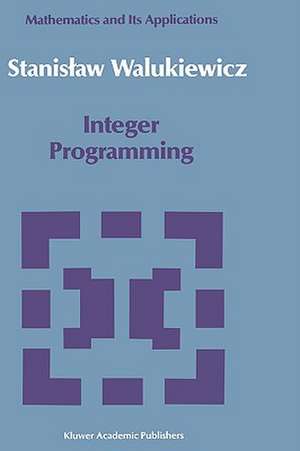
Integer Programming
Autor Stanislav Walukiewiczen Limba Engleză Hardback – 31 mai 1991
Preț: 205.94 lei
Preț vechi: 257.42 lei
-20%
Puncte Express: 309
Carte tipărită la comandă
Livrare economică 05-19 decembrie
Livrare prin curier în România Termenul estimat este afișat lângă disponibilitate.
Transport gratuit de la 400.00 lei Plată online sau ramburs, în funcție de opțiunile comenzii.
Retur gratuit în 14 zile Comandă securizată și suport în română.
Specificații
ISBN-13: 9780792307266
ISBN-10: 0792307267
Pagini: 182
Ilustrații: XVI, 182 p.
Dimensiuni: 156 x 234 x 13 mm
Greutate: 0.46 kg
Ediția:1990 edition
Editura: Springer
Locul publicării:Dordrecht, Netherlands
ISBN-10: 0792307267
Pagini: 182
Ilustrații: XVI, 182 p.
Dimensiuni: 156 x 234 x 13 mm
Greutate: 0.46 kg
Ediția:1990 edition
Editura: Springer
Locul publicării:Dordrecht, Netherlands
V-ar putea interesa
-
 COLL EDEXCEL GCSE MATHS FT ALLCollins GcsePreț: 88.94 lei
 -
 Preț: 89.98 lei
 -
 Preț: 47.49 lei
 -
 Preț: 89.78 lei
 -
 GCSE 9-1 Maths Higher Revision GuideCollins GcsePreț: 49.01 lei
 -
 Edexcel GCSE 9-1 Maths Higher Revision GuideCollins GcsePreț: 47.41 lei
 -
 LatticeDeepayan Sarkar-15%Preț: 587.03 lei690.63 lei
 -
 Exploring Abstract Algebra With Mathematica®Allen C. HibbardPreț: 388.57 lei
 -
 -9%Preț: 964.45 lei1059.83 lei
 -
 Optimization AlgorithmsSimon-9%Preț: 854.24 lei938.73 lei
 -
 Topics in Structural Graph TheoryLowell W. Beineke-23%Preț: 895.43 lei1162.89 lei
 -
 Theory of ComputationTourlakis-9%Preț: 860.47 lei945.58 lei
 -
 -11%Preț: 708.99 lei796.61 lei
 -
 -8%Preț: 666.28 lei724.22 lei
 -
 An Engineer's Guide to MathematicaEdward B. Magrab-23%Preț: 655.00 lei850.65 lei
 -
 Preț: 246.84 lei
 -
 Professor Stewart's Casebook of Mathematical MysteriesProfessor Ian Stewart-18%Preț: 64.61 lei79.27 lei
 -
 Cooperation: Game-Theoretic ApproachesSergiu Hart-20%Preț: 651.51 lei814.40 lei
Public țintă
ResearchCuprins
1. Introduction.- 2. Linear Programming.- 3. Unimodularity and Network Flows. Cutting-Plane Methods.- 4. Branch-and-Bound Methods.- 5. The Knapsack Problem.- 6. Equivalent Formulations for Integer Programs.- 7. Relaxations of Integer Problems. Duality.- 8. Some Particular Integer Programming Problems.- 9. Near-Optimal Methods.- 10. Conclusions.