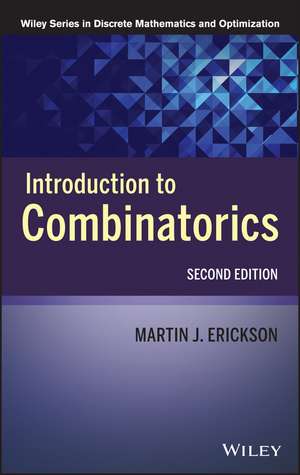
Erickson, M: Introduction to Combinatorics
en Limba Engleză Hardback – 29 mar 2013
În această a doua ediție a lucrării Erickson, M: Introduction to Combinatorics, descoperim o actualizare substanțială a unui text deja apreciat pentru concizie și claritate. Remarcăm introducerea a peste cincizeci de exemple noi, de la nivel de rutină la avansat, și o revizuire a tabelelor și referințelor care reflectă progresele recente în domenii precum designul combinatorial și codurile corectoare de erori. Ceea ce distinge acest volum de manualele standard este includerea unor subiecte care apar rar în literatura introductivă, precum secvența lui Alcuin sau rețeaua 24-dimensională a lui Leech. Notăm cu interes abordarea modernă a autorului Martin J. Erickson, care propune o metodologie de studiu investigativă. Această ediție pune un accent nou pe utilizarea programelor de calculator pentru rezolvarea exercițiilor, reflectând modul în care se practică astăzi matematica discretă. Structura narativă a cărții ghidează cititorul pas cu pas prin trei realizări majore ale domeniului: teorema lui Van der Waerden privind progresiile aritmetice, formula lui Pólya pentru enumerarea grafurilor și structura rețelei lui Leech. Ca alternativă la WALK THROUGH COMBINATORICS (3ED) de Bona Miklos pentru cursurile de combinatorică și teoria grafurilor, acest volum oferă avantajul unei densități informaționale mai mari într-un format mai compact (244 pagini), fiind ideal pentru programele care preferă o abordare directă și aplicată. În timp ce How to Count de R.B.J.T. Allenby se concentrează pe o abordare bazată pe probleme clasice, lucrarea de față introduce elemente de cercetare modernă și probleme deschise, stimulând curiozitatea academică dincolo de programa de examen.
Preț: 708.99 lei
Preț vechi: 796.61 lei
-11%
Carte tipărită la comandă
Livrare economică 27 noiembrie-11 decembrie
Specificații
ISBN-10: 1118637534
Pagini: 246
Dimensiuni: 163 x 241 x 22 mm
Greutate: 0.54 kg
Ediția:2nd edition
Locul publicării:Hoboken, United States
V-ar putea interesa
-
 Decision Support Systems for Business IntelligenceVicki L Sauter-9%Preț: 857.50 lei942.30 lei
 -
 Wavelets 2eGoswami-9%Preț: 903.65 lei993.02 lei
 -
 -27%Preț: 882.74 lei1209.23 lei
 -
 ProbabilitiesPeter OlofssonPreț: 319.39 lei
 -
 Data Mining Techniques in CRMTsiptsis-8%Preț: 657.72 lei714.91 lei
 -
 Spirituality and Family TherapyMartin John Erickson-5%Preț: 512.45 lei539.43 lei
 -
 Graph Edge ColoringStiebitz-9%Preț: 754.42 lei829.04 lei
 -
 A First Course in Applied MathematicsJorge Rebaza-9%Preț: 871.33 lei957.51 lei
 -
 Mathematics for the Liberal ArtsD Bindner-23%Preț: 664.98 lei863.60 lei
 -
 Math Unlimited: Essays in MathematicsR. Sujatha-15%Preț: 468.99 lei551.75 lei
 -
 -27%Preț: 1496.50 lei2036.32 lei
 -
 Manipulation de l'antipluralité en information incomplèteAurélien Mekuko YontaPreț: 261.59 lei
 -
 Modelisation Numerique de La Guitare Acoustique: Le Defi de MadagascarGrégoire Derveaux-18%Preț: 609.27 lei743.01 lei
 -
 -19%Preț: 506.26 lei625.01 lei
 -
 Sur certains aspects du principe d'incertitudeSaifallah GhobberPreț: 273.67 lei
 -
 Fonctions invexes généralisées et optimisation vectorielleHachem SlimaniPreț: 446.52 lei
 -
 -19%Preț: 573.69 lei708.26 lei
 -
 -15%Preț: 551.60 lei648.95 lei
 -
 -19%Preț: 635.59 lei784.67 lei
 -
 Système de gestion des déchets de La Communauté Urbaine de BordeauxNathan Jean PierrePreț: 362.08 lei
Public țintă
As a textbook or supplement for courses in combinatorics, graph theory, and discrete and/or finite mathematics at the upper–undergraduate level; as a reference for professors, teaching assistants, adjunct instructors, or anyone who wants to learn the various applications of elementary combinatorics; as recommended reading for teachers of mathematics and computer science who would like to convey a better understanding and appreciation of the field and apply it to their students; and academic and public libraries.De ce să citești această carte
Recomandăm această carte studenților de la facultățile de matematică și informatică ce doresc o introducere riguroasă, dar accesibilă, în combinatorică. Cititorul câștigă o înțelegere profundă a metodelor de rezolvare a problemelor discrete, beneficiind de exemple noi și exerciții asistate de calculator. Este un instrument esențial pentru pregătirea cursurilor de teoria grafurilor, oferind o perspectivă modernă asupra unor concepte fundamentale.
Despre autor
Martin J. Erickson este un matematician american și profesor universitar, cunoscut pentru capacitatea sa de a sintetiza concepte complexe în texte educaționale accesibile. Expertiza sa acoperă domenii variate ale matematicii discrete și analizei combinatoriale. Prin activitatea sa la editura Wiley, Erickson a contribuit la dezvoltarea literaturii didactice pentru nivelul universitar, punând accent pe interconexiunea dintre teorie și aplicațiile practice în informatică și statistică. Lucrările sale sunt adesea citate pentru stilul elegant și selecția riguroasă a problemelor propuse spre rezolvare.