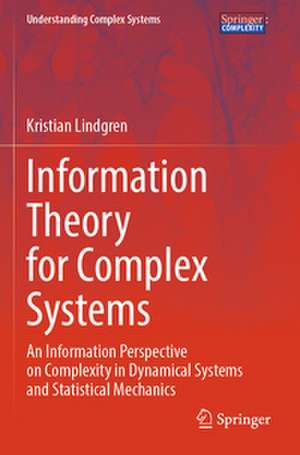
Information Theory for Complex Systems
Autor Kristian Lindgrenen Limba Engleză Paperback – 6 ian 2025
This book introduces a comprehensive framework tailored for dissecting complex systems across diverse disciplines. What defines a complex system? How can we harness information to quantify its order, structure, and intricacy? Delving into phenomena from the intricate processes in physical systems to the dynamic behaviours in cellular automata and pattern formation, readers will uncover the profound interplay between physics and information theory.
This intricate relationship provides fresh insight into physical phenomena, reimagining them through the lens of information. Notably, the book demystifies how seemingly opposing forces—rising order and increasing disorder—coexist, ultimately shedding light on the second law of thermodynamics as an outcome of deterministic, reversible dynamics beneath the surface.
Geared towards graduate students, this book presumes an undergraduate foundation in mathematics and physics, ensuring a deep, engaging exploration for its readers.
Preț: 675.96 lei
Preț vechi: 889.42 lei
-24%
Puncte Express: 1014
Carte tipărită la comandă
Livrare economică 17-23 noiembrie
Livrare prin curier în România Termenul estimat este afișat lângă disponibilitate.
Transport gratuit pentru acest produs Plată online sau ramburs, în funcție de opțiunile comenzii.
Retur gratuit în 14 zile Comandă securizată și suport în română.
Specificații
ISBN-13: 9783662683729
ISBN-10: 3662683725
Pagini: 168
Dimensiuni: 155 x 235 x 10 mm
Greutate: 0.27 kg
Editura: Springer
ISBN-10: 3662683725
Pagini: 168
Dimensiuni: 155 x 235 x 10 mm
Greutate: 0.27 kg
Editura: Springer
V-ar putea interesa
-
 The InformationJames GleickPreț: 108.66 lei
 -
 The Demon in the MachinePaul Davies-31%Preț: 63.55 lei92.67 lei
 -
 -11%Preț: 334.58 lei376.65 lei
 -
 Entropy: A Very Short IntroductionJames Binney-20%Preț: 56.73 lei70.88 lei
 -
 An Introduction to Statistical Mechanics and ThermodynamicsRobert H. Swendsen-9%Preț: 339.85 lei375.50 lei
 -
 The Mathematical Theory of CommunicationClaude E ShannonPreț: 170.77 lei
 -
 Notes on the Synthesis of FormChristopher AlexanderPreț: 234.11 lei
 -
 A Dynamical Systems Theory of ThermodynamicsWassim M Haddad-19%Preț: 721.97 lei891.32 lei
 -
 The Physical Nature of InformationGregory Falkovich-14%Preț: 397.84 lei462.59 lei
 -
 Physical Biology of the CellRob Phillips-9%Preț: 816.70 lei897.48 lei
 -
 Logic, Information and AgencyJohan van BenthemPreț: 242.50 lei
 -
 Probability Theory for Quantitative ScientistsLuca LeuzziPreț: 505.18 lei
 -
 -20%Preț: 134.29 lei167.85 lei
 -
 Preț: 123.51 lei
 -
 The Dark Forest Theory of the InternetBogna KoniorPreț: 86.72 lei
 -
 The Nature of Code: Simulating Natural Systems with JavaScriptDaniel Shiffman-34%Preț: 214.66 lei325.50 lei
 -
 Introducing ChaosIwona AbramsPreț: 63.55 lei
 -
 Complexity and EmergenceSergio Albeverio-18%Preț: 895.97 lei1092.64 lei
 -
 Statistics for ScientistsUmberto Michelucci-20%Preț: 275.88 lei344.84 lei
 -
 Data-Driven Cyber Physical SystemsFangyu Li-18%Preț: 1046.51 lei1276.23 lei
Cuprins
Introduction.- Information theory.- Information theory for lattice systems.- Cellular automata.- Physics and information theory.- Geometric information theory.- Pattern formation in chemical systems.- Chaos and information.- Appendix.- References.
Notă biografică
Kristian Lindgren is a Professor Emeritus in Complex Systems at Chalmers University of Technology. Originating from a background in physics, he has applied this foundational knowledge to the interdisciplinary study of complex systems across a variety of disciplines. His key research areas include information theory and statistical mechanics, as well as the application of information theory to complex and self-organizing systems. Lindgren has also delved into game theory as it applies to evolutionary systems and has utilized agent-based modelling to understand economic systems. He was one of the founders of the International Masters Programme in Complex Adaptive Systems at Chalmers in 2000 and has also served as the Director for the Graduate School (Ph.D.) in Complex Systems.
Textul de pe ultima copertă
This book introduces a comprehensive framework tailored for dissecting complex systems across diverse disciplines. What defines a complex system? How can we harness information to quantify its order, structure, and intricacy? Delving into phenomena from the intricate processes in physical systems to the dynamic behaviours in cellular automata and pattern formation, readers will uncover the profound interplay between physics and information theory.
This intricate relationship provides fresh insight into physical phenomena, reimagining them through the lens of information. Notably, the book demystifies how seemingly opposing forces—rising order and increasing disorder—coexist, ultimately shedding light on the second law of thermodynamics as an outcome of deterministic, reversible dynamics beneath the surface.
Geared towards graduate students, this book presumes an undergraduate foundation in mathematics and physics, ensuring a deep, engaging exploration for its readers.
Caracteristici
Offers a unique blend of information theory, dynamical systems, and physics Provides an in-depth exploration of information theory as applied to complex systems Aids in the understanding of various phenomena, such as the pattern formation in self-organizing systems