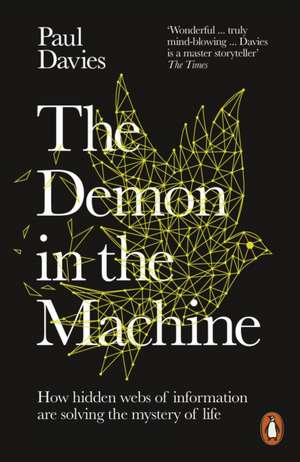
The Demon in the Machine
Autor Paul Daviesen Limba Engleză Paperback – 30 ian 2020
Subliniem, încă din primele pagini, că The Demon in the Machine nu este o simplă trecere în revistă a biologiei moleculare, ci o investigație metodologică asupra modului în care informația organizează materia vie. Paul Davies își structurează argumentația plecând de la o lacună istorică: deși Darwin a explicat evoluția speciilor, natura fundamentală a vieții a rămas un mister pentru fizica clasică. Autorul propune o abordare interdisciplinară, organizată riguros în șapte capitole care ghidează cititorul de la mecanismele celulare la complexitatea conștiinței, folosind conceptul de „demon” al lui Maxwell ca metaforă pentru procesarea informației la scară microscopică. Observăm un progres logic clar: după stabilirea premiselor în capitolele introductive, Davies introduce „Logica vieții” și „Darwinism 2.0”, sugerând că algoritmii și codurile digitale sunt la fel de reale în celule precum sunt în computere. Această perspectivă transformă biologia dintr-o știință a substanțelor într-una a fluxurilor de date. Cititorii familiarizați cu From Matter to Life de Sara Imari Walker vor aprecia modul în care Davies extinde dezbaterea despre tranziția de la materie la viață, oferind o claritate conceptuală sporită asupra modului în care organismele „conjura” ordinea din haos. În contextul operei sale, acest volum reprezintă o rafinare a temelor explorate anterior în Information and the Nature of Reality. Dacă în lucrările trecute Davies analiza informația ca fundament al realității fizice, aici se concentrează pe aplicabilitatea ei practică în medicină și tehnologie, discutând despre motoarele moleculare și navigația păsărilor prin prisma fizicii cuantice. Textul reușește să integreze domenii aparent disparate, precum oncologia și nanotehnologia, sub o singură umbrelă teoretică, oferind o viziune unitară asupra mecanismelor care fac viața posibilă.
Preț: 63.55 lei
Preț vechi: 92.67 lei
-31%
Carte disponibilă
Livrare economică 12-18 noiembrie
Livrare express 27-31 octombrie pentru 48.65 lei
Specificații
ISBN-10: 0141986409
Pagini: 272
Dimensiuni: 123 x 198 x 23 mm
Greutate: 0.2 kg
Editura: Penguin Books
Colecția Penguin
Locul publicării:London, United Kingdom
V-ar putea interesa
-
 Trilobite!Richard ForteyPreț: 78.14 lei
 -
 10% HumanAlanna Collen-5%Preț: 76.00 lei80.00 lei
 -
 Symphony in CRobert HazenPreț: 93.20 lei
 -
 Why We SleepMatthew Walker-30%Preț: 65.50 lei93.67 lei
 -
 BlueprintRobert Plomin-31%Preț: 64.49 lei93.07 lei
 -
 The Selfish Gene: 40th Anniversary editionRichard DawkinsPreț: 118.61 lei
 -
 The Extended Phenotype: The Long Reach of the GeneRichard Dawkins-17%Preț: 85.70 lei102.95 lei
 -
 Enzymes: A Very Short IntroductionPaul Engel-20%Preț: 57.12 lei71.12 lei
 -
 -16%Preț: 86.32 lei103.30 lei
 -
 Life Unfolding: How the human body creates itselfJamie A. Davies-19%Preț: 81.25 lei100.33 lei
 -
 The Better HalfSharon MoalemPreț: 141.59 lei
 -
 Stuff MattersMark Miodownik-25%Preț: 64.37 lei86.08 lei
 -
 Preț: 135.19 lei
 -
 The Magic of RealityRichard Dawkins-26%Preț: 62.80 lei84.54 lei
 -
 Letters from an AstrophysicistNeil DeGrasse Tyson-31%Preț: 72.84 lei105.07 lei
 -
 -27%Preț: 68.35 lei93.14 lei
 -
 Everything in Its PlaceOliver Sacks-44%Preț: 44.48 lei78.90 lei
 -
 Vitamin CSteve HickeyPreț: 93.24 lei
 -
 Preț: 94.17 lei
 -
 -29%Preț: 64.00 lei90.21 lei
 -
 -49%Preț: 47.06 lei92.93 lei
 -
 I Contain MultitudesEd Yong-23%Preț: 72.56 lei93.71 lei
 -
 A Crack in Creation: The New Power to Control EvolutionJennifer Doudna-18%Preț: 64.95 lei79.49 lei
 -
 BrainstormSuzanne O'Sullivan-18%Preț: 65.67 lei79.90 lei
 -
 Hacking the Code of LifeNessa Carey-5%Preț: 73.08 lei76.93 lei
 -
 Gene MachineVenki RamakrishnanPreț: 76.91 lei
 -
 The Epigenetics RevolutionNessa Carey-18%Preț: 70.83 lei86.66 lei
 -
 -26%Preț: 69.14 lei93.57 lei
 -
 GenomeMatt RidleyPreț: 92.21 lei
 -
 -24%Preț: 39.50 lei51.74 lei
De ce să citești această carte
Recomandăm această carte cititorilor care doresc să înțeleagă biologia dincolo de descrierile descriptive. Veți câștiga o perspectivă nouă asupra modului în care celulele funcționează ca sisteme de procesare a informației, similar computerelor. Este o lectură esențială pentru cei pasionați de fizică teoretică și astrobiologie, oferind răspunsuri argumentate științific la una dintre cele mai vechi întrebări ale umanității: ce anume separă materia vie de cea inertă?
Despre autor
Paul Charles William Davies este un fizician englez de renume mondial, scriitor și profesor la Arizona State University, unde conduce centrul BEYOND pentru concepte fundamentale în știință. Cu o carieră academică impresionantă la Cambridge și University College London, Davies s-a specializat în cosmologie, teoria cuantică a câmpurilor și astrobiologie. Este o voce autoritară în explorarea spațială, ocupând funcții de conducere în grupuri de lucru SETI și METI. Expertiza sa vastă îi permite să traducă concepte matematice și fizice complexe într-un limbaj accesibil, fiind unul dintre cei mai respectați comunicatori de știință contemporani.
Notă biografică
Recenzii
Important and imaginative
Boundary-transcending ... Davies claims that life's defining characteristics are better understood in terms of information ... there is grandeur in this view of life
Paul Davies is a courageous explorer of the boundaries of what we can know about our world. This book makes his explorations available to all who enjoy pushing those boundaries. Written with a light entertaining touch, even the most abstruse science acquires the clarity of exposition for which the author is justly renowned
This is one of the most exciting books I have read in years. Paul Davies celebrates a significant anniversary with a demonically brilliant investigation of a fundamental question that only the very latest science and philosophy can deal with. Now we have a view from the master that's as thrilling as it is satisfying. Superb.
The molecular biology revolution has led to extraordinary understandings of how life emerges from physical processes. But comprehension of the nuts and bolts of these processes omits a key feature of what is going on: what separates life from non-life is information. In this characteristically clearly written and engaging book, ranging from physics to biology and evolutionary theory to neuroscience, Paul Davies strongly makes the case that at its core, life is about information flows. There is much food for thought here. Highly recommended.
Paul Davies always probes the deepest questions in science. Here, addressing the deepest of all -- Schrödinger's What is Life? -- he tells us what life is: matter plus information - beyond the laws of physics, but compatible with them. To elaborate this thesis, he deploys his trademark talent: getting to the heart of the most abstruse and technical aspects of science (biology as well as physics), without jargon and with down-to-earth analogies
This creative demon shadows DNA and the promise of quantum computing, answering some basic questions. What is consciousness, why is life so good at predicting where it might go next? The bridge connecting fundamental physics, biology and the most advanced labs of computation is what Davies calls information patterns. He shows how it organizes for top-down creativity, and thereby holds off the grim reaper of entropy. With striking insight, and metaphors that illuminate the landscape of science today, Davies once again becomes a guide to the near future.
The Demon in the Machine encompasses some of the most intriguing and unsolved mysteries of the universe: the existence of an arrow of time imprinted on the cosmos, and the emergence of life itself. Davies' crisp but rich narrative succeeds in untangling various highly complex ideas and processes, while fluently and intelligently setting out its own arrow of argument.
Paul Davies narrates a gripping new drama in science, in which the plot is the story of life and the leading actor is information. With his characteristic blend of erudition and clarity, he brings together some of the most rapidly advancing knowledge in physics and technology to show how information controls biology. If you want to understand how the concept of life is changing, read this.
A tour-de-force of a fascinating and frontier topic: information as a distinguishing, central aspect of those physical systems known as living ones. The Demon in the Machine is simultaneously rigorous, state-of-the-art, and highly readable - very hard to put down
Paul Davies takes us on a fascinating tour of what is known about what life is. Along the way he speculates interestingly about what may become known. His theme, drawn from Darwin, Schrödinger, Turing, Gödel, Shannon and von Neumann, is that what separates life from non-life is information. But how? Exploring that question illuminates biology by revealing its deep roots in physics, mathematics and computer science.
What is life? Questions don't come much bigger than that. It's asked regularly by biologists, philosophers, lawyers, law-makers, astrobiologists and, occasionally, wide-eyed children. It's not so often asked by physicists, which makes Paul Davies' new book, The Demon In The Machine, that much more fascinating.
a vivid exposition of the new mathematics of biology, in which information flows play a central part
Davies - one of the most imaginative scientists working today - urges biologists studying the origins and evolution of life to pay more attention to flows of information and energy on top of traditional chemistry and physics. He is a clear guide to the emergence of information science as a key factor in biology research.
Descriere scurtă
When Darwin set out to explain the origin of species, he made no attempt to answer the deeper question: what is life?
For generations, scientists have struggled to make sense of this fundamental question. Life really does look like magic: even a humble bacterium accomplishes things so dazzling that no human engineer can match it. And yet, huge advances in molecular biology over the past few decades have served only to deepen the mystery. So can life be explained by known physics and chemistry, or do we need something fundamentally new?
In this penetrating and wide-ranging new analysis, world-renowned physicist and science communicator Paul Davies searches for answers in a field so new and fast-moving that it lacks a name, a domain where computing, chemistry, quantum physics and nanotechnology intersect. At the heart of these diverse fields, Davies explains, is the concept of information: a quantity with the power to unify biology with physics, transform technology and medicine, and even to illuminate the age-old question of whether we are alone in the universe.
From life's murky origins to the microscopic engines that run the cells of our bodies, The Demon in the Machine is a breath-taking journey across the landscape of physics, biology, logic and computing. Weaving together cancer and consciousness, two-headed worms and bird navigation, Davies reveals how biological organisms garner and process information to conjure order out of chaos, opening a window on the secret of life itself.
Cuprins
1. What is Life?
2. Enter the Demon
3. The Logic of Life
4. Darwinism 2.0
5. Spooky Life and Quantum Demons
6. Almost a Miracle
7. The Ghost in the Machine
Epilogue
Further Reading
Notes
Illustration Credits
Index