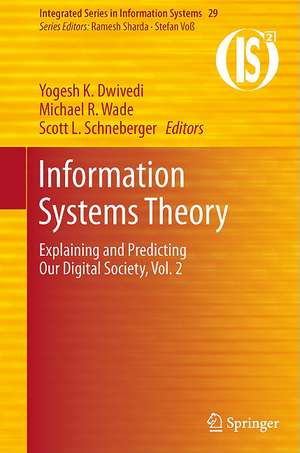
Information Systems Theory: Explaining and Predicting Our Digital Society, Vol. 2: Integrated Series in Information Systems, cartea 29
Editat de Yogesh K. Dwivedi, Michael R. Wade, Scott L. Schnebergeren Limba Engleză Hardback – 20 sep 2011
- To describe the various theories and models applicable to studying IS/IT management issues.
- To outline and describe, for each of the various theories and models, independent and dependent constructs, reference discipline/originating area, originating author(s), seminal articles, level of analysis (i.e. firm, individual, industry) and links with other theories.
- To provide a critical review/meta-analysis of IS/IT management articles that have used a particular theory/model.
- To discuss how a theory can be used to better understand how information systems can be effectively deployed in today’s digital world.
The first section of Volume 1 presents detailed descriptions of a set of theories centered around the IS lifecycle, including the Success Model, Technology Acceptance Model, User Resistance Theories, and four others. The second section of Volume 1 contains strategic and economic theories, including a Resource-Based View, Theory of Slack Resources, PortfolioTheory, Discrepancy Theory Models, and eleven others.
The first section of Volume 2 concerns socio-psychological theories. These include Personal Construct Theory, Psychological Ownership, Transactive Memory, Language-Action Approach, and nine others. The second section of Volume 2 deals with methodological theories, including Critical Realism, Grounded Theory, Narrative Inquiry, Work System Method, and four others.
Together, these theories provide a rich tapestry of knowledge around the use of theory in IS research. Since most of these theories are from contributing disciplines, they provide a window into the world of external thought leadership.
Din seria Integrated Series in Information Systems
- 15%
 Preț: 625.77 lei
 - 20%
 Preț: 957.38 lei
 - 20%
 Preț: 1236.74 lei
 -
 Preț: 374.37 lei
 - 15%
 Preț: 682.47 lei
 - 18%
 Preț: 809.96 lei
 - 20%
 Preț: 1435.43 lei
 - 15%
 Preț: 673.95 lei
 - 18%
 Preț: 726.77 lei
 - 15%
 Preț: 692.14 lei
 -
 Preț: 382.07 lei
 - 15%
 Preț: 619.91 lei
 - 18%
 Preț: 920.67 lei
 - 5%
 Preț: 1244.21 lei
 - 15%
 Preț: 620.41 lei
 - 15%
 Preț: 620.73 lei
 - 20%
 Preț: 1243.16 lei
 - 39%
 Preț: 1108.59 lei
 - 20%
 Preț: 616.78 lei
 - 5%
 Preț: 1740.44 lei
 - 18%
 Preț: 915.73 lei
 - 15%
 Preț: 628.42 lei
 - 20%
 Preț: 957.06 lei
 - 20%
 Preț: 623.55 lei
 - 20%
 Preț: 623.18 lei
 - 18%
 Preț: 930.61 lei
 - 15%
 Preț: 621.99 lei
 - 15%
 Preț: 625.01 lei
 - 18%
 Preț: 980.73 lei
 - 20%
 Preț: 629.08 lei
 - 20%
 Preț: 630.36 lei
Preț: 921.81 lei
Preț vechi: 1124.15 lei
-18%
Puncte Express: 1383
Carte tipărită la comandă
Livrare economică 08-22 iulie
Livrare prin curier în România Termenul estimat este afișat lângă disponibilitate.
Transport gratuit pentru acest produs Plată online sau ramburs, în funcție de opțiunile comenzii.
Retur gratuit în 14 zile Comandă securizată și suport în română.
Specificații
ISBN-13: 9781441997067
ISBN-10: 1441997067
Pagini: 472
Ilustrații: XXVI, 446 p.
Dimensiuni: 155 x 235 x 30 mm
Greutate: 0.84 kg
Ediția:2012
Editura: Springer
Colecția Springer
Seria Integrated Series in Information Systems
Locul publicării:New York, NY, United States
ISBN-10: 1441997067
Pagini: 472
Ilustrații: XXVI, 446 p.
Dimensiuni: 155 x 235 x 30 mm
Greutate: 0.84 kg
Ediția:2012
Editura: Springer
Colecția Springer
Seria Integrated Series in Information Systems
Locul publicării:New York, NY, United States
V-ar putea interesa
-
 -20%Preț: 322.43 lei403.04 lei
 -
 Cobham, D: Business Information SystemsDavid Cobham-17%Preț: 539.70 lei650.25 lei
 -
 Business Math For DummiesMary Jane SterlingPreț: 141.34 lei
 -
 -14%Preț: 696.85 lei810.29 lei
 -
 Solving Enterprise ApplicationLeonid Grinshpan-8%Preț: 487.63 lei530.04 lei
 -
 Implementing World Class It StrategyPeter A HighPreț: 296.05 lei
 -
 Information Systems DevelopmentRob Pooley-20%Preț: 1858.94 lei2323.67 lei
 -
 Consumer Adoption and Usage of BroadbandYogesh K. Dwivedi-19%Preț: 582.10 lei718.64 lei
 -
 E-Government Development and DiffusionYogesh K. Dwivedi-23%Preț: 1056.75 lei1372.40 lei
 -
 Adoption, Usage, and Global Impact of Broadband TechnologiesYogesh K. Dwivedi-23%Preț: 976.82 lei1268.60 lei
 -
 Transformational Government Through EGov PracticeMahmud Akhter Shareef-23%Preț: 1107.18 lei1437.89 lei
 -
 Mobile Marketing ChannelMahmud Akhter Shareef-20%Preț: 342.28 lei427.85 lei
 -
 Electronic Word of Mouth (eWOM) in the Marketing ContextElvira Ismagilova-20%Preț: 342.49 lei428.12 lei
 -
 XBRL for Interactive DataRoger DebrecenyPreț: 385.94 lei
 -
 The Integrated Architecture Framework Explained: Why, What, HowJack van't WoutPreț: 475.21 lei
Public țintă
Professional/practitionerCuprins
Employing Personal Construct Theory to Understand Information Systems: A Practical Guide for Researchers.- Psychological Ownership and the Individual Appropriation of Technology.- Transactive Memory and its Application in IS Research.- The Language-Action Approach: Information Systems Supporting Social Actions.- A Review of the Organizational Information Processing Theory.- Scientia Potentia Est: Organizational Learning, Absorptive Capacity and the Power of Knowledge.- Applying Actor Network Theory and Managing Controversy.- Using Concepts from Structuration Theory and Consequence of modernity to Understand IS Deployment in Healthcare Setting.- Hubble Bubble Toil and Trouble: The Special Case of Emergency Services.- ERP Diffusion and Assimilation Using IT-Innovation Framework.- The Yield Shift Theory of Satisfaction and its Application to the IS/IT Domain.- Intention-based Models: The Theory of Planned Behavior within the Context of IS.- Understanding IS Theory: An Interpretation of Key IS Theoretical Frameworks using Social Cognitive Theory.- The Potential of Critical Realism in IS Research.- Grounded Theory and Information Systems: Are We Missing the Point?.- Developing Theories in Information Systems Research: The Grounded Theory Method Applied.- The Mikropolis Model: A Framework for Transdisciplinary Research of Information Systems in Society.- Inquiring Systems: Theoretical Foundations for Current and Future Information Systems.- Information Systems Deployment as an Activity System.- The Work System Method as an Approach for Teaching and Researching Information Systems.-
Textul de pe ultima copertă
The overall mission of this book is to provide a comprehensive understanding and coverage of the various theories and models used in IS research. Specifically, it aims to focus on the following key objectives:
The first section of Volume 1 presents detailed descriptions of a set of theories centered around the IS lifecycle, including the Success Model, Technology Acceptance Model, User Resistance Theories, and four others. The second section of Volume 1 contains strategic and economic theories, including a Resource-Based View, Theory of Slack Resources, PortfolioTheory, Discrepancy Theory Models, and eleven others.
The first section of Volume 2 concerns socio-psychological theories. These include Personal Construct Theory, Psychological Ownership, Transactive Memory, Language-Action Approach, and nine others. The second section of Volume 2 deals with methodological theories, including Critical Realism, Grounded Theory, Narrative Inquiry, Work System Method, and four others.
Together, these theories provide a rich tapestry of knowledge around the use of theory in IS research. Since most of these theories are from contributing disciplines, they provide a window into the world of external thought leadership.
- To describe the various theories and models applicable to studying IS/IT management issues.
- To outline and describe, for each of the various theories and models, independent and dependent constructs, reference discipline/originating area, originating author(s), seminal articles, level of analysis (i.e. firm, individual, industry) and links with other theories.
- To provide a critical review/meta-analysis of IS/IT management articles that have used a particular theory/model.
- To discuss how a theory can be used to better understand how information systems can be effectively deployed in today’s digital world.
The first section of Volume 1 presents detailed descriptions of a set of theories centered around the IS lifecycle, including the Success Model, Technology Acceptance Model, User Resistance Theories, and four others. The second section of Volume 1 contains strategic and economic theories, including a Resource-Based View, Theory of Slack Resources, PortfolioTheory, Discrepancy Theory Models, and eleven others.
The first section of Volume 2 concerns socio-psychological theories. These include Personal Construct Theory, Psychological Ownership, Transactive Memory, Language-Action Approach, and nine others. The second section of Volume 2 deals with methodological theories, including Critical Realism, Grounded Theory, Narrative Inquiry, Work System Method, and four others.
Together, these theories provide a rich tapestry of knowledge around the use of theory in IS research. Since most of these theories are from contributing disciplines, they provide a window into the world of external thought leadership.
Caracteristici
Brings all IS theory together for first time in book form A practical reference for practitioners and researchers Covers all models and research approaches