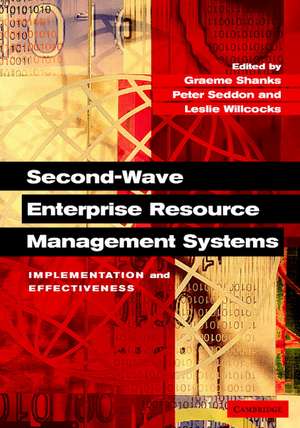
Second-Wave Enterprise Resource Planning Systems: Implementing for Effectiveness
Editat de Graeme Shanks, Peter B. Seddon, Leslie P. Willcocksen Limba Engleză Hardback – 10 sep 2003
Preț: 696.85 lei
Preț vechi: 810.29 lei
-14%
Puncte Express: 1045
Carte tipărită la comandă
Livrare economică 09-23 decembrie
Livrare prin curier în România Termenul estimat este afișat lângă disponibilitate.
Transport gratuit pentru acest produs Plată online sau ramburs, în funcție de opțiunile comenzii.
Retur gratuit în 14 zile Comandă securizată și suport în română.
Specificații
ISBN-13: 9780521819022
ISBN-10: 0521819024
Pagini: 468
Ilustrații: 50 b/w illus.
Dimensiuni: 186 x 255 x 28 mm
Greutate: 1.12 kg
Editura: Cambridge University Press
Colecția Cambridge University Press
Locul publicării:Cambridge, United Kingdom
ISBN-10: 0521819024
Pagini: 468
Ilustrații: 50 b/w illus.
Dimensiuni: 186 x 255 x 28 mm
Greutate: 1.12 kg
Editura: Cambridge University Press
Colecția Cambridge University Press
Locul publicării:Cambridge, United Kingdom
V-ar putea interesa
-
 -29%Preț: 307.45 lei434.47 lei
 -
 -19%Preț: 274.25 lei339.74 lei
 -
 The Handbook of Global Outsourcing and OffshoringJulia KotlarskyPreț: 382.30 lei
 -
 The New IT Outsourcing LandscapeLeslie P Willcocks-15%Preț: 651.89 lei766.93 lei
 -
 Align IT: Business Impact Through ITRichard Wyatt–HainesPreț: 360.52 lei
 -
 -19%Preț: 462.17 lei570.58 lei
 -
 Effective Crm Using Predictive AnalyticsAntonios ChorianopoulosPreț: 439.01 lei
 -
 Advanced Outsourcing PracticeLeslie P Willcocks-15%Preț: 670.78 lei789.15 lei
 -
 Building an Enterprise Architecture PracticeMarlies Van Steenbergen-20%Preț: 784.99 lei981.24 lei
 -
 Time Is MoneyTammy Everts-20%Preț: 90.65 lei113.32 lei
 -
 Enterprise InteroperabilityMatthieu Lauras-20%Preț: 975.37 lei1219.21 lei
Cuprins
Introduction; Part I. Implementation and Effectiveness: Overview; 1. Learning from adopters' experiences with ERP M. Lynne Markus, Sheryl Axline, David Petrie and Cornelis Tanis; 2. Innovating with Packaged Business Software: toward an assessment E. Burton Swanson; 3. A comprehensive framework for assessing and managing the benefits of enterprise systems Shari Shang and Peter B. Seddon; 4. The continuing ERP revolution: sustainable lessons, new modes of delivery Jeanne W. Ross, Michael R. Vitale and Leslie P. Willcocks; Part II. From Risks To Critical Success Factors: 5. Enterprise system implementation risks and controls Severin V. Grabski, Stewart A. Leech and Bai Lu; 6. Risk factors in Enterprise-Wide/ERP projects Mary Sumner; 7. A framework for understanding success and failure in Enterprise Resource Planning system implementation Christopher P. Holland and Ben Light; 8. Critical success factors revisited: a model for ERP project implementation Anne Parr and Graeme Shanks; 9. Offsetting ERP risk through maintaining standardized application software Guy G. Gable, Taizan Chan, and Wui-Gee Tan; Part III. From Learning to Knowledge: 10. Implementing Enterprise Resource Planning systems: the role of learning from failure Judy E. Scott and Iris Vessey; 11. ERP projects: good or bad for SMEs? Frédéric Adam and Peter O'Doherty; 12. The role of the CIO and IT Function in ERP Leslie P. Willcocks and Richard Sykes; 13. Enterprise systems management with reference process models Michael Rosemann; 14. An ERP implementation case study from a knowledge transfer perspective Zoonky Lee and Jinyoul Lee; 15. Knowledge Integration Processes within the context of Enterprise Resource Planning systems implementation Jimmy Huang, Sue Newell and Robert Galliers; Part IV. Cultural Aspects of Enterprise Systems: 16. An exploratory analysis of the sources and nature of misfits in ERP implementations Sia Siew Kien and Christina Soh; 17. Implementing Enterprise Resource Packages? Consider different organisational and national cultures! Marina Krumbholz, Julia Galliers and Neil A. M. Maiden; Part V. Future Directions: 18. Continuity versus discontinuity: weighing the future for ERP packages M. Lynne Markus, David Petrie and Sheryl Axline.
Descriere
How to get the most out of Enterprise Resource Planning (ERP) systems.