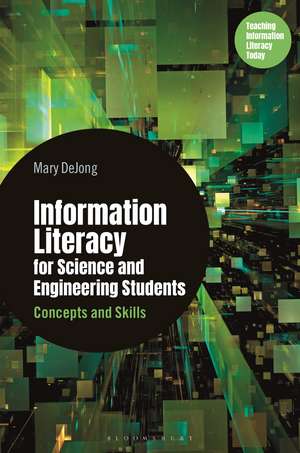
Information Literacy for Science and Engineering Students: Concepts and Skills: Libraries Unlimited Series for Teaching Information Literacy Today
Autor Mary DeJongen Limba Engleză Hardback – 19 sep 2024
Considerăm că Information Literacy for Science and Engineering Students aduce o perspectivă proaspătă și necesară prin transformarea alfabetizării informaționale dintr-un concept abstract într-un set de competențe aplicate, adaptate rigoriilor academice și profesionale din STEM. Spre deosebire de manualele generale de biblioteconomie, lucrarea scrisă de Mary DeJong se concentrează pe mecanismele specifice prin care informația este „ambalată” și distribuită în mediile tehnice, oferind soluții pentru decodarea problemelor informaționale din lumea reală.
Reținem organizarea extrem de metodică a volumului, structurat în șase părți care ghidează cititorul de la înțelegerea funcțiilor surselor — inclusiv a celor nișate, precum brevetele, standardele și codurile (capitolul 13) — până la execuția unor căutări complexe în baze de date. Această progresie este esențială pentru studenții care se confruntă cu prima lor lucrare de cercetare, dar și pentru inginerii practicieni care trebuie să gestioneze fluxuri enorme de date tehnice. Cartea funcționează ca o alternativă aplicată la Science and Technology Resources de James E. Bobick pentru cursurile de biblioteconomie și știința informației, având avantajul unui ton mai accesibil și al unei structuri orientate spre fluxul de lucru al cercetătorului modern.
Un element distinctiv este abordarea practică a bazei de date (Partea a V-a și a VI-a), unde accentul nu cade doar pe interfață, ci pe logica din spatele înregistrărilor și pe identificarea cuvintelor-cheie relevante. Deși este o lucrare tehnică, stilul narativ este surprinzător de dinamic, facilitând asimilarea unor concepte dificile despre sursele primare și secundare sau etica citării. În contextul actual, unde volumul de informație digitală crește exponențial, acest manual devine un instrument indispensabil pentru navigarea ecosistemului informațional științific.



Preț: 632.60 lei
Preț vechi: 932.83 lei
-32%
Carte disponibilă
Livrare economică 30 octombrie-13 noiembrie
Specificații
Pagini: 344
Ilustrații: 138 b&w
Dimensiuni: 164 x 238 x 24 mm
Greutate: 0.68 kg
Editura: Bloomsbury Publishing
Colecția Bloomsbury Libraries Unlimited
Seria Libraries Unlimited Series for Teaching Information Literacy Today
Locul publicării:New York, United States
V-ar putea interesa
-
 The Information-Literate HistorianJenny L. PresnellPreț: 478.21 lei
 -
 Preț: 181.32 lei
 -
 Preț: 172.36 lei
 -
 The Craft of Research, Fifth EditionWayne C. BoothPreț: 112.29 lei
 -
 Kirton, B: Brilliant DissertationBill KirtonPreț: 93.27 lei
 -
 Understanding and Addressing Misinformation About ScienceBoard On Science EducationPreț: 211.24 lei
 -
 -30%Preț: 87.20 lei124.75 lei
 -
 -9%Preț: 515.99 lei567.02 lei
 -
 Reading and Making NotesJeanne Godfrey-21%Preț: 57.40 lei72.47 lei
 -
 Doing Your Literature ReviewVanessa van der Ham-12%Preț: 56.99 lei64.46 lei
 -
 Writing for Science StudentsJennifer Boyle-15%Preț: 123.20 lei145.72 lei
 -
 How to Read a PaperTrisha M Greenhalgh-5%Preț: 324.81 lei341.90 lei
 -
 Preț: 233.21 lei
 -
 -17%Preț: 386.76 lei466.40 lei
 -
 The Essential Guide to Doing Your Research ProjectZina O'LearyPreț: 310.17 lei
 -
 Original Inquiry: A Guide to Research for UndergraduatesMatthew James Vechinski-22%Preț: 246.90 lei315.89 lei
 -
 Information Science: History, Ideas, ApplicationsMichael Seadle-19%Preț: 494.38 lei610.34 lei
 -
 Preț: 97.90 lei
 -
 Research Methods in InformationAlison Jane Pickard-19%Preț: 558.33 lei689.30 lei
 -
 Statistics for ScientistsUmberto Michelucci-20%Preț: 275.88 lei344.84 lei
De ce să citești această carte
Această lucrare este esențială pentru studenții și profesioniștii din STEM care doresc să își eficientizeze procesul de documentare. Cititorul câștigă abilitatea de a evalua critic sursele și de a utiliza baze de date complexe pentru cercetare sau publicare. Este un ghid practic care transformă căutarea de informații dintr-o sarcină consumatoare de timp într-un proces riguros și strategic, fiind ideal pentru pregătirea tezelor de doctorat sau a proiectelor inginerești de anvergură.
Descriere
Beginning with a strong foundation in the utility, structure, and packaging of information, this useful handbook helps students and working professionals decode real-world information literacy problems. Mary DeJong provides a compelling context and rationale for the skills scientists and engineers need to succeed in challenging careers that rely on the successful discovering and sharing of complex information. Students will appreciate the in-depth information on sources, especially those needed for research assignments, and scientists and engineers who write for publication will benefit from chapters on searching databases and organizing and citing sources. Written with science and engineering students and professionals in mind, this book is thorough, well-paced, engaging, and even funny.
Cuprins
1 Information Literacy: What It Is and Why It Matters
Part 2: Sources: Their Functions, Distinctions, and Where To Find Them
2 Information Is Documented in Sources
3 Books
4 Newspapers and Other News Sources
5 Magazines
6 Journals and Journal Articles
7 Research Articles
8 Review Articles
9 Conference Proceedings and Conference Papers
10 Dissertations and Theses
11 Websites
12 Data
13 Patents, Standards, and Codes
Part III: Important Qualities of Sources
14 Scholarly Sources
15 Popular Sources
16 Primary and Secondary Sources
17 Credible Sources
Part IV: Understanding the Sources You Need for Research Assignments
18 Decoding Your Research Assignment Instructions
19 Choosing a Topic that Matches Source Requirements
PART V: All About Databases
20 Types of Databases
21 Database Records
22 Database Search Features
23 Choosing the Best Databases
Part VI: Searching Databases for Sources
24 Identifying Keywords to Search
25 Conducting Comprehensive Searches
26 Search Techniques
Part VII: Organizing Your Sources
27 Managing Source Records
28 Accessing Full-Text Sources
Part VIII: Citing Your Sources
29 The Importance of Citing Sources
30 Incorporating Sources into Your Writing
31 Formatting Citations
Appendix A. Get Help with Your Research
Appendix B. Scholarly Metrics
Appendix C. Open Access and the Open Science Movement
Appendix D. Social Networking for Scientists and Engineers
Index
Recenzii
Mary DeJong's outstanding and engaging book reinforces the essential idea that students of every rank have work to do-work they very much need to do, regardless of their backgrounds-in strategizing their way forward as citizens of the world. Information literacy serves as a beacon to guide students, giving them tools to tell truth from falsehood with wisdom and grace: as DeJong shows, an increasingly essential skill in today's complicated information world.
Information Literacy for Science and Engineering Students: Concepts and Skills by Mary DeJong is a well-written guide aimed at science and engineering students and professionals that will help them build their research skills and navigate the complex information ecosystem. This guide will assist readers in improving their proficiency in understanding various types of sources, evaluating their credibility, and mastering the organization and citation of sources. Mary's work will improve the work of scientists and engineers by giving them a strong foundation in the management and evaluation of numerous and complex information sources. With the help of witty illustrations, this book will keep readers engaged in improving their information literacy skills, to ultimately become more proficient and skillful researchers.
This book is for scientists and engineers who want a deep dive on information literacy and all the ways it is crucial for discovery of knowledge. These skills are essential for college and graduate students, both in their academic lives and throughout their careers. This book is like carrying around your own personal science librarian!