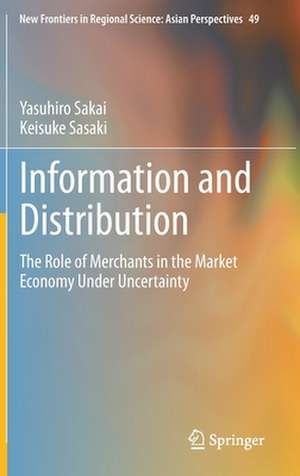
Information and Distribution: New Frontiers in Regional Science: Asian Perspectives, cartea 49
Autor Yasuhiro Sakai, Keisuke Sasakien Limba Engleză Hardback – 30 apr 2021
In a historical perspective, the merchants of Ohmi, the former name of Shiga Prefecture in western Japan, are known to have put great faith in the principles of Sampo Yoshi or the all-around advantages of trading. It is hoped that the results presented in this book will provide some solid ground for such an old principle that can be seen in a new light. Applications to regional and many related problems are also discussed here.
A distribution system is broadly defined as the systematic mechanisms and structures that regulate business operations, and its function is to maximize corporate value. Some of the following functions have previously been identified as distinguishing features of the Japanese distribution system compared with distribution systems in Europe and the United States: not only transactions, transportation, and storage, but also information, risk-bearing functions, and other characteristics. This book provides an overview of the distribution system in Japan, including changes that its practice have undergone and its current state; identifies current problems; and considers how these problems should be addressed.
Din seria New Frontiers in Regional Science: Asian Perspectives
- 15%
 Preț: 673.76 lei
- 18%
 Preț: 757.54 lei
- 15%
 Preț: 669.40 lei
- 18%
 Preț: 828.54 lei
- 18%
 Preț: 755.41 lei
- 24%
 Preț: 716.95 lei
- 18%
 Preț: 750.28 lei
- 18%
 Preț: 757.54 lei
- 15%
 Preț: 717.85 lei
- 15%
 Preț: 663.97 lei
- 15%
 Preț: 738.04 lei
- 15%
 Preț: 746.34 lei
- 18%
 Preț: 814.75 lei
- 15%
 Preț: 665.96 lei
- 15%
 Preț: 719.60 lei
- 15%
 Preț: 724.23 lei
- 18%
 Preț: 929.88 lei
- 15%
 Preț: 665.89 lei
-
 Preț: 408.70 lei
- 18%
 Preț: 924.36 lei
-
 Preț: 382.37 lei
- 24%
 Preț: 671.11 lei
- 18%
 Preț: 933.05 lei
- 15%
 Preț: 739.99 lei
- 15%
 Preț: 723.33 lei
- 18%
 Preț: 1291.16 lei
- 15%
 Preț: 667.41 lei
- 18%
 Preț: 813.53 lei
- 15%
 Preț: 661.90 lei
-
 Preț: 347.34 lei
- 18%
 Preț: 1073.84 lei
- 18%
 Preț: 696.78 lei
Preț: 755.13 lei
Preț vechi: 920.89 lei
-18%
Puncte Express: 1133
Carte tipărită la comandă
Livrare economică 09-23 decembrie
Livrare prin curier în România Termenul estimat este afișat lângă disponibilitate.
Transport gratuit pentru acest produs Plată online sau ramburs, în funcție de opțiunile comenzii.
Retur gratuit în 14 zile Comandă securizată și suport în română.
Specificații
ISBN-13: 9789811001000
ISBN-10: 9811001006
Pagini: 224
Ilustrații: XV, 206 p. 53 illus., 3 illus. in color.
Dimensiuni: 160 x 241 x 18 mm
Greutate: 0.45 kg
Ediția:1st ed. 2021
Editura: Springer
Colecția New Frontiers in Regional Science: Asian Perspectives
Seria New Frontiers in Regional Science: Asian Perspectives
Locul publicării:Singapore, Singapore
V-ar putea interesa
-
 The Euro Crisis and Its AftermathJean Pisani-Ferry-22%Preț: 213.23 lei274.34 lei
-
 Why Nations FailDaron AcemogluPreț: 133.20 lei
-
 The Economics of EnoughDiane CoylePreț: 191.23 lei
-
 The Cancer Stage of Capitalism: From Crisis to CureJohn McMurtryPreț: 266.44 lei
-
 Preț: 219.60 lei
-
 The Implosion of CapitalismSamir AminPreț: 203.25 lei
-
 Politics in the Age of AusterityWolfgang StreeckPreț: 258.33 lei
-
 FREE MARKET REVOLUTIONYaron BrookPreț: 130.28 lei
-
 Preț: 401.17 lei
-
 Preț: 412.14 lei
-
 Gross Domestic Problem: The Politics Behind the World's Most Powerful NumberLorenzo FioramontiPreț: 122.89 lei
-
 -9%Preț: 679.24 lei746.42 lei
Public țintă
ResearchCuprins
Part I.- Chap. 1 Information and Distribution: The Role of Merchants in the Market Economy with Demand Risk (by Sakai).- Chap. 2 Risk Aversion and Information Transmission (by Sakai).- Chap. 3 Alternative Leader-Follower Models and Distribution Systems (by Sasaki).- Chap. 4 Import Traders and Distribution Channel Choice (by Sasaki).- Chap. 5 Information Sharing as Cause Relations in Marketing (by Sasaki).- Chap. 6 Distribution Systems and Informational Goods with Network Externality (by Sasaki).- Part II.- Chap. 7 The Value of Information in Duopoly (by Sakai).- Chap. 8 Information Sharing in Oligopoly: Private Risks and Oligopoly Models (by Sakai).- Chap. 9 Risk Aversion and Information Transmission: Risks and Duopoly Models (by Sakai).- Chap. 10 Non-Profit Firms, Information and Vertical Restraints (by Sasaki).
Notă biografică
Yasuhiro Sakai was born in Osaka, Japan. After graduating from Kobe University, he continued his graduate study at University of Rochester, on the shore of Lake Ontario, U.S.A. He received his Ph.D. from University of Rochester, with Professor Lionel W. McKenzie being his academic advisor. While he was teaching Microeconomics and General Equilibrium Theory at University of Pittsburgh, he happened to get good advice from Professor Oskar Morgenstern, a pioneer of Game Theory. After his rather long stay in the United States, he returned to Japan, the Land of the Rising Sun, and extended his research area to Applied Economics including Regional Science and Economics of Uncertainty. He got teaching jobs at so many universities and institutions such as Hiroshima University, University of Tsukuba, Shiga University, and Ryukoku University. He served as President of Japanese Regional Economic Association, receiving Society Award for Outstanding Achievement from that association. He was also appointed as Member of Science Counsel of Japan.
Textul de pe ultima copertă
The purpose of this book is to discuss the relationship between information and distribution, with special reference to the role of the merchant in a market economy under conditions of risk and uncertainty. By working with simple models of the market economy and conducting a sequence of comparative analyses, the authors shed new light on an important yet rather neglected area in economics.
In a historical perspective, the merchants of Ohmi, the former name of Shiga Prefecture in western Japan, are known to have put great faith in the principles of Sampo Yoshi or the all-around advantages of trading. It is hoped that the results presented in this book will provide some solid ground for such an old principle that can be seen in a new light. Applications to regional and many related problems are also discussed here.
A distribution system is broadly defined as the systematic mechanisms and structures that regulate business operations, and its function isto maximize corporate value. Some of the following functions have previously been identified as distinguishing features of the Japanese distribution system compared with distribution systems in Europe and the United States: not only transactions, transportation, and storage, but also information, risk-bearing functions, and other characteristics. This book provides an overview of the distribution system in Japan, including changes that its practice have undergone and its current state; identifies current problems; and considers how these problems should be addressed.
Caracteristici
Provides an overview of the relation between information and distribution in historical and theoretical perspectives, following the John Hicks doctrine that History and Theory should be the inseparable parts of the whole structure. Provides a variety of applied models that include not only a transaction function but also an information, risk-bearing function as distinguishing features of modern distribution systems today. Identifies the distinguishing features of the Japanese distribution system, as exemplified by the Ohmi merchants, compared with distribution systems in Europe and the United States.