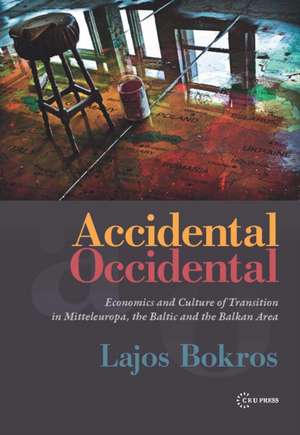
Accidental Occidental: Economics and Culture of Transition in Mitteleuropa, the Baltic and the Balkan Area
Autor Lajos Bokrosen Limba Engleză Hardback – 2013
Subliniem necesitatea unei analize riguroase a peisajului economic actual din Europa Centrală și de Est, într-un context global marcat de instabilitate și de reevaluarea fundamentelor democratice. Accidental Occidental nu este doar o cronică istorică a prăbușirii sistemului de comandă, ci o pledoarie asumată pentru superioritatea capitalismului de piață. Remarcăm faptul că Lajos Bokros refuză o abordare triumfalistă; autorul recunoaște vulnerabilitatea instituțiilor liberale și complexitatea culturală care însoțește reformele economice în Balcani și statele baltice.
Abordarea sa diferă de volumul Liberalism and the Economic Order de Ellen Frankel Paul prin accentul pus pe dimensiunea politică activă și pe apărarea civilizației occidentale, fiind mai puțin abstractă și mai mult ancorată în realitatea dureroasă a proceselor de tranziție. Dacă Adam Przeworski în Democracy and the Market analizează tranzițiile comparând Europa de Est cu America Latină sub aspectul raționalității, Bokros preferă o focalizare regională, investigând cum cultura specifică a „Mitteleuropa” influențează succesul sau eșecul pieței libere.
Suntem de părere că această lucrare reprezintă o evoluție firească față de cercetările sale anterioare, precum Socialism—The Tragedy of an Idea, unde demonta pilonii proprietății de stat. În acest volum, progresia este clară: după ce stabilește natura comunismului în capitolul introductiv, autorul trece la mecanismele tranziției din secolul XX, culminând cu provocările specifice secolului XXI. Această structură logică permite cititorului să înțeleagă nu doar cum a fost construit capitalismul, ci și de ce supraviețuirea sa nu trebuie privită ca un dat istoric.
Preț: 679.24 lei
Preț vechi: 746.42 lei
-9%
Carte disponibilă
Livrare economică 16-30 noiembrie
Specificații
ISBN-10: 6155225249
Pagini: 204
Dimensiuni: 152 x 229 x 18 mm
Greutate: 0.54 kg
Ediția:1
Editura: Amsterdam University Press
Colecția Central European University Press
Locul publicării:Oxford, United Kingdom
V-ar putea interesa
-
 The Third PillarRaghuram RajanPreț: 108.24 lei
 -
 The Great TransformationKarl Polanyi-29%Preț: 66.40 lei93.83 lei
 -
 Sale Of The Century: The Inside Story of the Second Russian RevolutionChrystia Freeland-27%Preț: 78.47 lei107.41 lei
 -
 Capitalism, AloneBranko MilanovicPreț: 116.42 lei
 -
 CapitalismSven BeckertPreț: 349.29 lei
 -
 Capitalist Diversity on Europe`s PeripheryDorothee BohlePreț: 301.72 lei
 -
 East Central Europe since 1989: Politics, Culture, and SocietySabrina P. RametPreț: 359.46 lei
 -
 In the Storms of TransformationUlf BrunnbauerPreț: 244.07 lei
 -
 Cultural CapitalismBradley A. GorskiPreț: 438.71 lei
 -
 How to Slay a Dragon - Building a New Russia After PutinMikhail KhodorkovskyPreț: 143.28 lei
 -
 The Republic of InnovationAndrea Lorenzo CapusselaPreț: 140.60 lei
 -
 The World Under CapitalismBranko MilanovicPreț: 220.19 lei
 -
 -27%Preț: 1273.31 lei1735.77 lei
 -
 What Went Wrong With CapitalismRuchir SharmaPreț: 93.80 lei
 -
 The Capitalist ManifestoJohan Norberg-30%Preț: 65.09 lei93.44 lei
 -
 Zero SumCharles Hecker-19%Preț: 180.71 lei224.39 lei
 -
 -21%Preț: 185.94 lei236.66 lei
 -
 Preț: 186.79 lei
Public țintă
AcademicDe ce să citești această carte
Recomandăm această carte economiștilor și cercetătorilor care doresc o înțelegere profundă a legăturii dintre cultura politică și succesul economic. Cititorul va câștiga o perspectivă autoritară asupra motivelor pentru care tranziția în Europa de Est a fost un proces „curajos și dureros”, obținând argumente solide pentru apărarea valorilor occidentale într-un climat politic tot mai fragmentat.
Despre autor
Lajos Bokros este un economist reputat, recunoscut pentru expertiza sa în politică economică și sisteme de tranziție. Lucrările sale, precum Financial Transition in Europe and Central Asia, demonstrează o capacitate remarcabilă de a plasa economiile în tranziție în contextul piețelor financiare globale. Prin experiența sa academică și implicarea în dezbaterea publică despre eșecul socialismului ca sistem de comandă, Bokros s-a impus ca o voce critică și analitică fundamentală pentru spațiul central și est-european, analizând constant intersecția dintre proprietatea de stat, planificarea centralizată și libertatea individuală.