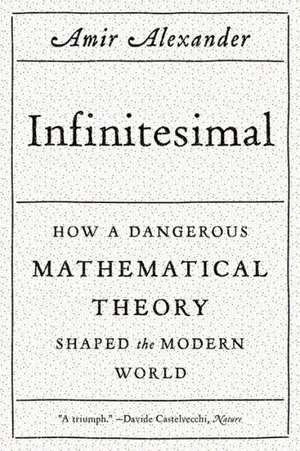
Infinitesimal
Autor Amir Alexanderen Limba Engleză Paperback – 12 mai 2015
În lucrarea Infinitesimal, Amir Alexander explorează un moment de cotitură în istoria ideilor: ziua de 10 august 1632, când ordinul iezuit a interzis oficial predarea conceptului de infinitezimal. Această ediție analizează cum o dispută aparent abstractă despre compoziția liniei continue a devenit un câmp de bătălie între viziunea unei lumi imuabile, controlate de autoritate, și cea a unei realități dinamice, bazate pe progres științific. Remarcăm modul în care autorul transformă istoria matematicii într-o narațiune politică și socială tensionată, demonstrând că acceptarea „infinitului mic” nu a fost doar o victorie tehnică, ci una a libertății de gândire. Recomandăm acest volum ca o alternativă istorică la Infinite Powers de Steven Strogatz pentru cursurile de istoria științei; în timp ce Strogatz se concentrează pe mecanica și utilitatea calculului, Infinitesimal aduce avantajul unei analize profunde a rezistenței instituționale și a contextului religios care aproape a sufocat inovația. Cartea se înscrie organic în opera lui Amir Alexander, continuând temele explorate în Geometrical Landscapes. Dacă în lucrarea anterioară autorul analiza modul în care explorările geografice au modelat limbajul matematic, aici el extinde perspectiva către bătălia ideologică dintre tradiție și modernitate, oferind o explicație fascinantă pentru mutarea centrului de greutate intelectual din Italia către Anglia lui Newton și a Societății Regale.
Preț: 114.85 lei
Carte disponibilă
Livrare economică 05-19 noiembrie
Specificații
ISBN-10: 0374534993
Pagini: 368
Dimensiuni: 141 x 211 x 27 mm
Greutate: 0.32 kg
Editura: Farrar, Straus and Giroux
V-ar putea interesa
-
 The Secret of the Golden FlowerThomas ClearyPreț: 85.51 lei
 -
 A Harlot's ProgressDavid Dabydeen-56%Preț: 52.06 lei119.01 lei
 -
 The Age of EarthquakesDouglas CouplandPreț: 106.59 lei
 -
 Zero: The Biography of a Dangerous IdeaCharles Seife-19%Preț: 63.44 lei78.59 lei
 -
 Proof!Amir AlexanderPreț: 156.90 lei
 -
 If Not, WinterSapphoPreț: 113.15 lei
 -
 Duel at DawnAmir AlexanderPreț: 205.16 lei
 -
 -19%Preț: 480.46 lei593.16 lei
 -
 -24%Preț: 98.80 lei130.69 lei
 -
 -29%Preț: 77.69 lei108.82 lei
 -
 Shunga + BijingaBob BentleyPreț: 150.55 lei
 -
 Novels in Three LinesFelix FeneonPreț: 107.34 lei
 -
 Walker, S: Titillation - The Vintage Pulp Magazine Pin-Up ArStephen James WalkerPreț: 312.03 lei
 -
 The Fashion Doll: From Bébé Jumeau to BarbieJuliette PeersPreț: 251.02 lei
 -
 Flametti, or the Dandyism of the PoorHugo BallPreț: 105.96 lei
 -
 -18%Preț: 204.23 lei250.49 lei
 -
 Uhlenbeck, C: Japanese Erotic FantasiesChris Uhlenbeck-19%Preț: 702.91 lei867.79 lei
De ce să citești această carte
Această carte este esențială pentru oricine dorește să înțeleagă rădăcinile politice ale matematicii moderne. Cititorul va descoperi cum o simplă idee geometrică a dărâmat dogme și a pavat drumul către democrație și tehnologie. Este o lectură captivantă care demonstrează că știința nu evoluează în vid, ci este rezultatul unor lupte sociale intense între conservatorism și dorința de schimbare.
Despre autor
Amir Alexander este un istoric recunoscut, specializat în istoria științei, și predă în prezent la UCLA. Opera sa se concentrează pe intersecția dintre matematică, cultură și narativă istorică. Pe lângă Infinitesimal, a publicat lucrări de referință precum Geometrical Landscapes, unde explorează legătura dintre matematică și epoca marilor descoperiri, și Duel at Dawn, o analiză a modului în care matematicienii au fost percepuți ca eroi romantici. Contribuțiile sale au fost publicate în jurnale de prestigiu precum Nature și The Guardian, consolidându-i reputația de fin observator al evoluției intelectuale a Occidentului.
Descriere scurtă
On August 10, 1632, five men in flowing black robes convened in a somber Roman palazzo to pass judgment on a deceptively simple proposition: that a continuous line is composed of distinct and infinitely tiny parts. With the stroke of a pen the Jesuit fathers banned the doctrine of infinitesimals, announcing that it could never be taught or even mentioned. The concept was deemed dangerous and subversive, a threat to the belief that the world was an orderly place, governed by a strict and unchanging set of rules. If infinitesimals were ever accepted, the Jesuits feared, the entire world would be plunged into chaos.
In "Infinitesimal," the award-winning historian Amir Alexander exposes the deep-seated reasons behind the rulings of the Jesuits and shows how the doctrine persisted, becoming the foundation of calculus and much of modern mathematics and technology. Indeed, not everyone agreed with the Jesuits. Philosophers, scientists, and mathematicians across Europe embraced infinitesimals as the key to scientific progress, freedom of thought, and a more tolerant society. As Alexander reveals, it wasn't long before the two camps set off on a war that pitted Europe's forces of hierarchy and order against those of pluralism and change.
The story takes us from the bloody battlefields of Europe's religious wars and the English Civil War and into the lives of the greatest mathematicians and philosophers of the day, including Galileo and Isaac Newton, Cardinal Bellarmine and Thomas Hobbes, and Christopher Clavius and John Wallis. In Italy, the defeat of the infinitely small signaled an end to that land's reign as the cultural heart of Europe, and in England, the triumph of infinitesimals helped launch the island nation on a course that would make it the world's first modern state.
From the imperial cities of Germany to the green hills of Surrey, from the papal palace in Rome to the halls of the Royal Society of London, Alexander demonstrates how a disagreement over a mathematical concept became a contest over the heavens and the earth. The legitimacy of popes and kings, as well as our beliefs in human liberty and progressive science, were at stake-the soul of the modern world hinged on the infinitesimal.
Descriere
On August 10, 1632, five leading Jesuits convened in a sombre Roman palazzo to pass judgment on a simple idea: that a continuous line is composed of distinct and limitlessly tiny parts. The doctrine would become the foundation of calculus, but on that fateful day the judges ruled that it was forbidden. With the stroke of a pen they set off a war for the soul of the modern world.
Amir Alexander takes us from the bloody religious strife of the sixteenth century to the battlefields of the English civil war and the fierce confrontations between leading thinkers like Galileo and Hobbes. The legitimacy of popes and kings, as well as our modern beliefs in human liberty and progressive science, hung in the balance; the answer hinged on the infinitesimal.
Pulsing with drama and excitement, Infinitesimal will forever change the way you look at a simple line.