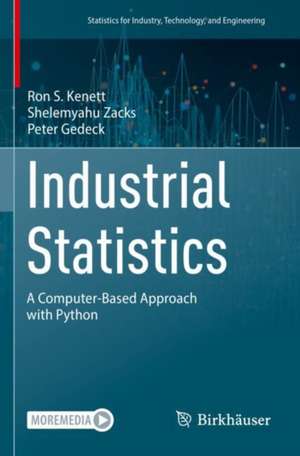
Industrial Statistics: Statistics for Industry, Technology, and Engineering
Autor Ron S. Kenett, Shelemyahu Zacks, Peter Gedecken Limba Engleză Paperback – 19 iun 2024
Ecosistemul acestei lucrări este construit în jurul limbajului Python, utilizând pachetul dedicat mistat pentru a transforma conceptele teoretice în aplicații industriale imediate. Observăm o tranziție clară de la metodele statistice tradiționale către paradigmele moderne ale Industriei 4.0, volumul integrând biblioteci și fluxuri de lucru esențiale pentru analiza datelor în inginerie. Găsim în această carte un echilibru tehnic între rigoarea matematică și execuția software, fiind acoperite instrumente pentru controlul proceselor, analiza fiabilității și experimente computerizate.
Structura este organizată logic pentru a susține un parcurs de învățare de unul sau două semestre. Primele capitole pun bazele controlului statistic al proceselor (SPC), evoluând rapid spre tehnici multivariate și Design of Experiments (DoE). Reținem includerea unor teme de actualitate precum „digital twins” și „cyber manufacturing”, care fac legătura între statistica clasică și sistemele de producție digitalizate. Spre deosebire de Industrial Statistics with Minitab de XX Tort–Martorell, care se bazează pe o interfață grafică proprietară, lucrarea de față prioritizează programarea, oferind cititorului flexibilitatea codului sursă.
Cititorul care a aplicat deja conceptele fundamentale din Modern Statistics de Ron S. Kenett va găsi aici o continuare firească, orientată spre mediul de producție și inginerie. Dacă lucrarea anterioară a autorului, Process Improvement and CMMI® for Systems and Software, se concentra pe managementul proceselor, acest nou titlu din seria Statistics for Industry, Technology, and Engineering oferă instrumentarul cantitativ necesar pentru validarea și optimizarea acestora prin date.

Preț: 680.36 lei
Preț vechi: 850.46 lei
-20%
Carte tipărită la comandă
Livrare economică 23-30 noiembrie
Specificații
ISBN-10: 3031284844
Pagini: 496
Ilustrații: XXIII, 472 p. 1 illus.
Dimensiuni: 155 x 235 x 25 mm
Greutate: 0.84 kg
Ediția:2023
Editura: birkhäuser
Colecția Statistics for Industry, Technology, and Engineering
Seria Statistics for Industry, Technology, and Engineering
Locul publicării:Cham, Switzerland
V-ar putea interesa
-
 Reproducible Research with R and RStudioChristopher Gandrud-20%Preț: 1463.71 lei1829.65 lei
 -
 Stochastic Visibility in Random FieldsShelemyahu Zacks-18%Preț: 744.20 lei907.56 lei
 -
 Process Improvement and CMMI for Systems and SoftwareRon S. Kenett-20%Preț: 1059.15 lei1323.94 lei
 -
 MATLAB® for Engineers ExplainedFredrik Gustafsson-20%Preț: 346.10 lei432.62 lei
 -
 Introduction to Reliability AnalysisShelemyahu Zacks-15%Preț: 556.24 lei654.40 lei
 -
 Prediction Theory for Finite PopulationsHeleno BolfarinePreț: 368.45 lei
 -
 Multivariate Statistical Quality Control Using REdgar Santos-Fernández-20%Preț: 355.31 lei444.14 lei
 -
 Fast Compact Algorithms and Software for Spline SmoothingHoward L. WeinertPreț: 258.61 lei
 -
 Bayesian Networks in RRadhakrishnan Nagarajan-20%Preț: 508.01 lei635.02 lei
 -
 Seamless R and C++ Integration with RcppDirk Eddelbuettel-20%Preț: 561.37 lei701.71 lei
 -
 -20%Preț: 374.28 lei467.85 lei
 -
 The Career of a Research StatisticianShelemyahu ZacksPreț: 404.57 lei
 -
 Modern StatisticsRon S. Kenett-20%Preț: 719.28 lei899.10 lei
 -
 Sample Path Analysis and Distributions of Boundary Crossing TimesShelemyahu ZacksPreț: 343.82 lei
 -
 Maple V für das IngenieurstudiumArnold Krawietz-20%Preț: 326.67 lei408.34 lei
 -
 -20%Preț: 423.31 lei529.14 lei
 -
 MuPAD TutorialJürgen Gerhard-38%Preț: 421.74 lei680.92 lei
 -
 Computer Algebra HandbookJohannes Grabmeier-20%Preț: 958.85 lei1198.57 lei
De ce să citești această carte
Recomandăm această carte inginerilor și oamenilor de știință care doresc să treacă de la analize statice la fluxuri de lucru automatizate în Python. Cititorul câștigă acces la un pachet software dedicat și învață să implementeze tehnologii critice precum monitorizarea proceselor și predicția fiabilității. Este o resursă practică pentru cei care activează în domenii tehnice și au nevoie de metode statistice robuste, adaptate erei digitale.
Despre autor
Ron S. Kenett, Shelemyahu Zacks și Peter Gedeck sunt experți recunoscuți în domeniul statisticii aplicate, cu o experiență vastă atât în mediul academic, cât și în cercetarea industrială. Ron S. Kenett este cunoscut pentru abordările sale inovatoare în îmbunătățirea proceselor și managementul calității, fiind autorul unor lucrări de referință despre CMMI și analiza datelor. Peter Gedeck contribuie prin expertiza sa în dezvoltarea de soluții software, fiind cel care a creat infrastructura Python (pachetul mistat) ce însoțește textele lor teoretice, facilitând astfel tranziția disciplinelor tehnice către modern analytics.