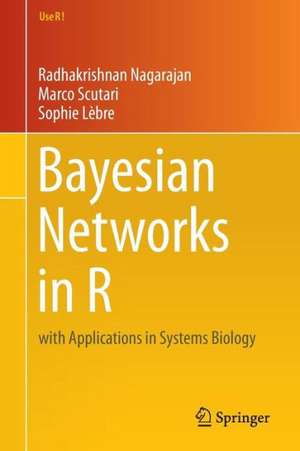
Bayesian Networks in R: Use R!, cartea 48
Autor Radhakrishnan Nagarajan, Marco Scutari, Sophie Lèbreen Limba Engleză Paperback – 27 apr 2013
Observăm că autorii Radhakrishnan Nagarajan și Marco Scutari aduc în prim-plan o experiență practică vastă în dezvoltarea de algoritmi, Marco Scutari fiind recunoscut pentru contribuțiile sale esențiale la ecosistemul R prin pachete dedicate învățării structurale. În cadrul volumului Bayesian Networks in R, aceștia reușesc să transforme teoria abstractă a grafurilor probabilistice în instrumente de lucru concrete pentru cercetători.
Ne-a atras atenția modul în care textul este structurat pentru a asigura o progresie logică a dificultății. Lucrarea debutează cu fundamentarea rețelelor bayesiene în absența datelor temporale, trecând ulterior la analiza seriilor de timp, un aspect critic în biologia sistemelor. Un element distinctiv al acestei ediții din seria Use R! este capitolul dedicat calculului paralel, o necesitate tehnică atunci când operăm cu seturi de date moleculare masive (high-throughput). Complementar volumului Probabilistic Modeling in Bioinformatics and Medical Informatics, care oferă o introducere metodologică vastă, Bayesian Networks in R acoperă zona de implementare efectivă și optimizare a codului în R, oferind soluții directe pentru validarea asociațiilor moleculare.
Fiecare capitol integrează exerciții practice, transformând lectura dintr-una pasivă într-un proces de învățare activ. Ritmul este susținut de exemple de cod care demonstrează cum rețelele bayesiene pot descoperi noi conexiuni între molecule, nu doar să le confirme pe cele existente. Structura narativă a cărții este tehnică și aplicată, fiind orientată spre rezolvarea problemelor de inferență și modelare a căilor de semnalizare, oferind astfel un cadru de lucru complet pentru mediul de cercetare modern.
Din seria Use R!
-
 Preț: 478.57 lei
 - 19%
 Preț: 694.93 lei
 - 20%
 Preț: 403.62 lei
 - 20%
 Preț: 545.75 lei
 - 15%
 Preț: 520.40 lei
 - 15%
 Preț: 471.74 lei
 - 18%
 Preț: 814.78 lei
 - 15%
 Preț: 579.56 lei
 - 15%
 Preț: 523.50 lei
 - 15%
 Preț: 525.61 lei
 -
 Preț: 505.55 lei
 - 15%
 Preț: 479.76 lei
 - 20%
 Preț: 545.89 lei
 - 15%
 Preț: 475.10 lei
 - 15%
 Preț: 568.99 lei
 - 20%
 Preț: 590.39 lei
 - 20%
 Preț: 567.01 lei
 - 15%
 Preț: 654.31 lei
 - 15%
 Preț: 500.61 lei
 - 17%
 Preț: 576.38 lei
 - 15%
 Preț: 595.29 lei
 - 19%
 Preț: 560.69 lei
 - 18%
 Preț: 753.00 lei
 - 15%
 Preț: 500.25 lei
 - 15%
 Preț: 515.55 lei
 - 15%
 Preț: 472.79 lei
 - 20%
 Preț: 554.58 lei
 -
 Preț: 488.06 lei
 - 15%
 Preț: 591.49 lei
 - 5%
 Preț: 451.36 lei
 - 18%
 Preț: 752.87 lei
 - 20%
 Preț: 547.47 lei
 - 20%
 Preț: 390.82 lei
 - 15%
 Preț: 727.73 lei
 - 5%
 Preț: 597.09 lei
 - 5%
 Preț: 572.19 lei
 - 20%
 Preț: 593.47 lei
 - 5%
 Preț: 781.71 lei
 - 15%
 Preț: 587.03 lei
 - 15%
 Preț: 474.92 lei
 -
 Preț: 391.23 lei
 -
 Preț: 373.60 lei
 - 15%
 Preț: 702.45 lei
 -
 Preț: 473.32 lei
 - 20%
 Preț: 475.82 lei
 - 18%
 Preț: 862.37 lei
Preț: 508.01 lei
Preț vechi: 635.02 lei
-20%
Carte tipărită la comandă
Livrare economică 03-17 decembrie
Specificații
ISBN-10: 1461464455
Pagini: 172
Ilustrații: XIII, 157 p. 36 illus.
Dimensiuni: 155 x 235 x 10 mm
Greutate: 0.27 kg
Ediția:2013
Editura: Springer
Colecția Use R!
Seria Use R!
Locul publicării:New York, NY, United States
V-ar putea interesa
-
 Computational Intelligence in Healthcare ApplicationsRajeev Agrawal-28%Preț: 839.26 lei1161.12 lei
 -
 Reproducible Research with R and RStudioChristopher Gandrud-20%Preț: 1463.71 lei1829.65 lei
 -
 Nonparametric Statistical Methods Using RJohn KlokePreț: 336.23 lei
 -
 R Graphics, Third EditionPaul Murrell-20%Preț: 400.89 lei501.11 lei
 -
 Blockchain Chicken FarmXiaowei WangPreț: 93.56 lei
 -
 Computational Statistics Handbook with MATLABWendy L. Martinez-20%Preț: 414.75 lei518.44 lei
 -
 Spatio-Temporal Statistics with RChristopher K. Wikle-8%Preț: 443.45 lei482.01 lei
 -
 Modern Optimization with RPaulo Cortez-20%Preț: 590.39 lei737.98 lei
 -
 The Signed Distance Measure in Fuzzy Statistical AnalysisRédina Berkachy-20%Preț: 856.23 lei1070.30 lei
 -
 R kompaktDaniel Wollschläger-20%Preț: 244.85 lei306.07 lei
 -
 Statistik angewandt mit dem R CommanderFranz Kronthaler-20%Preț: 352.74 lei440.93 lei
 -
 Statistics Applied With ExcelFranz Kronthaler-20%Preț: 583.84 lei729.79 lei
 -
 Statistical Signal ProcessingSwagata Nandi-20%Preț: 547.12 lei683.90 lei
Public țintă
ResearchDe ce să citești această carte
Recomandăm această carte cercetătorilor care doresc să treacă de la teoria statistică la implementarea riguroasă în R. Veți câștiga abilitatea de a modela interacțiuni biologice complexe și de a utiliza calculul paralel pentru eficientizarea analizelor. Este un ghid esențial pentru cei care lucrează cu date high-throughput și au nevoie de un instrumentar validat pentru inferența rețelelor de reglementare.
Despre autor
Autorii sunt experți recunoscuți în statistica computațională și bioinformatică. Marco Scutari este un cercetător influent, cunoscut în comunitatea R ca autor al pachetului bnlearn, un standard în învățarea rețelelor bayesiene. Radhakrishnan Nagarajan și Sophie Lèbre completează echipa cu o expertiză profundă în biologia sistemelor și modelarea seriilor temporale. Împreună, aceștia au creat o punte între informatică și științele vieții, concentrându-se pe aplicabilitatea metodelor bayesiene în analiza datelor genomice și proteomice complexe.
Descriere scurtă
Cuprins
Recenzii
Notă biografică
Dr. Nagarajan is an Associate Professor in the Division of Biomedical Informatics, Department of Biostatistics at the College of Public Health, University of Kentucky, Lexington, USA. His areas of research falls under evidence-based science that demands knowledge discovery from high-dimensional molecular and observational healthcare data sets using a combination of statistical algorithms, machine learning and network science approaches.
Contact: Division of Biomedical Informatics/Department of Biostatistics, College of Public Health, University of Kentucky, 725 Rose Street, MDS 230F, Lexington, KY 40536-0082.
Marco Scutari, Ph.D.
Dr. Scutari studied Statistics and Computer Science at the University of Padova, Italy. He earned his Ph.D. in Statistics in Padova under the guidance of Prof. A. Brogini, studying graphical model learning. He is now Research Associate at the Genetics Institute, University College London (UCL). His research focuses on the theoretical properties of Bayesian networks and their applications to biological data, and he is the author and maintainer of the bnlearn R package.
Contact: Genetics Institute, University College London Darwin Building, Room 212 London, WC1E 6BT United Kingdom.
Sophie Lèbre, Ph.D.
Dr. Lèbre is a Lecturer in the Department of Computer Science at the University of Strasbourg, France.
She originally earned her Ph.D. in Applied Mathematics at the University of Evry-val-d'Essone (France) under the guidance of Prof. B. Prum. Her research focuses on graphical modeling and dynamic Bayesian network inference, devoted to recovering genetic interaction networks from post genomic data. She is the author and maintainer of the G1DBN and the ARTIVA R packages for dynamic Bayesian network inference.
Contact: LSIIT, Equipe BFO, Pôle API, Bd Sébastien Brant - BP 10413, F -67412 Illkirch CEDEX, France.
Contact: Division of Biomedical Informatics/Department of Biostatistics, College of Public Health, University of Kentucky, 725 Rose Street, MDS 230F, Lexington, KY 40536-0082.