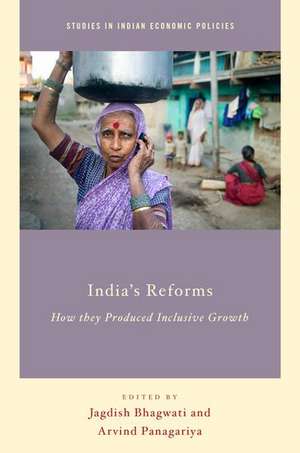
India's Reforms: How they Produced Inclusive Growth: Studies in Indian Economic Policies
Editat de Jagdish Bhagwati, Arvind Panagariyaen Limba Engleză Hardback – 31 mai 2012
Preț: 506.87 lei
Preț vechi: 706.95 lei
-28%
Puncte Express: 760
Carte tipărită la comandă
Livrare economică 27 noiembrie-02 decembrie
Livrare prin curier în România Termenul estimat este afișat lângă disponibilitate.
Transport gratuit pentru acest produs Plată online sau ramburs, în funcție de opțiunile comenzii.
Retur gratuit în 14 zile Comandă securizată și suport în română.
Specificații
ISBN-13: 9780199915187
ISBN-10: 0199915180
Pagini: 312
Ilustrații: 35 illustrations
Dimensiuni: 236 x 163 x 20 mm
Greutate: 0.59 kg
Editura: Oxford University Press
Colecția OUP USA
Seria Studies in Indian Economic Policies
Locul publicării:New York, United States
ISBN-10: 0199915180
Pagini: 312
Ilustrații: 35 illustrations
Dimensiuni: 236 x 163 x 20 mm
Greutate: 0.59 kg
Editura: Oxford University Press
Colecția OUP USA
Seria Studies in Indian Economic Policies
Locul publicării:New York, United States
V-ar putea interesa
-
 The Third PillarRaghuram RajanPreț: 106.35 lei
 -
 An Uncertain GloryAmartya Sen-18%Preț: 78.08 lei94.73 lei
 -
 Growth and Development Planning in IndiaK. L. Datta-30%Preț: 388.50 lei551.80 lei
 -
 International Trade and Investment Behaviour of FirmsMurali PatibandlaPreț: 263.04 lei
 -
 -15%Preț: 81.90 lei96.61 lei
 -
 -23%Preț: 886.99 lei1151.94 lei
 -
 -18%Preț: 308.24 lei373.63 lei
 -
 -18%Preț: 301.78 lei370.21 lei
 -
 -32%Preț: 656.92 lei966.77 lei
 -
 Preț: 338.54 lei
 -
 -25%Preț: 146.39 lei194.19 lei
 -
 Changing IndiaManmohan Singh-32%Preț: 3342.89 lei4925.68 lei
 -
 Preț: 230.03 lei
 -
 The Great Global TransformationBranko MilanovicPreț: 191.67 lei
 -
 -8%Preț: 449.76 lei488.87 lei
 -
 Trade Reforms, Poverty and Inequality in BangladeshBodrun Nahar-27%Preț: 1332.33 lei1814.11 lei
 -
 The Billionaire RajJames CrabtreePreț: 72.57 lei
 -
 Bad SamaritansHa-Joon Chang-18%Preț: 70.97 lei86.78 lei
 -
 India's Trade PolicyArvind PanagariyaPreț: 128.27 lei
 -
 -15%Preț: 668.15 lei786.07 lei
Recenzii
a major empirical contribution.
Notă biografică
Jagdish Bhagwati, University Professor at Columbia University and Senior Fellow in International Economics at the Council on Foreign Relations, is a prominent economist. He has made pioneering contributions to the study of development, globalization, international trade, foreign aid, and immigration. He also writes frequently for leading media worldwide. He has served in many advisory roles, including at the GATT as Economic Policy Adviser to Director General Arthur Dunkel and at the UN to Secretary General Kofi Annan on Globalization and on NEPAD Process in Africa. He works with many NGOs, including Human Rights Watch.Arvind Panagariya is Professor of Economics & Jagdish Bhagwati Professor of Indian Political Economy at Columbia University and a Non-resident Senior Fellow at the Brookings Institution. He has written and edited ten books.