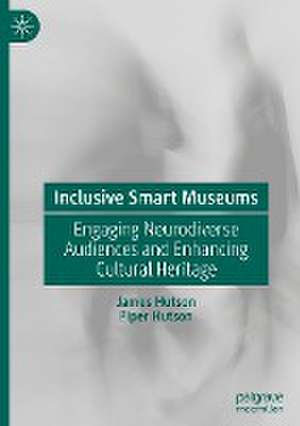
Inclusive Smart Museums: Engaging Neurodiverse Audiences and Enhancing Cultural Heritage
Autor James Hutson, Piper Hutsonen Limba Engleză Hardback – 5 ian 2024
The book highlights the importance of preserving and enhancing cultural heritage by incorporating immersive technologies and inclusive practices that cater to the needs of neurodiverse audiences. It emphasizes the need for museums and heritage sites to be more inclusive and accessible for neurodivergent individuals, showcasing best practices and innovative techniques to engage this audience effectively.
| Toate formatele și edițiile | Preț | Express |
|---|---|---|
| Paperback (1) | 681.32 lei 38-44 zile | |
| Palgrave MacMillan – 6 ian 2025 | 681.32 lei 38-44 zile | |
| Hardback (2) | 671.63 lei 6-8 săpt. | |
| Springer Nature Switzerland – 5 ian 2024 | 671.63 lei 6-8 săpt. | |
| Springer Nature Switzerland – 14 apr 2024 | 596.76 lei Precomandă |
Preț: 671.63 lei
Preț vechi: 790.15 lei
-15%
Puncte Express: 1007
Preț estimativ în valută:
118.76€ • 136.22$ • 102.67£
118.76€ • 136.22$ • 102.67£
Carte tipărită la comandă
Livrare economică 29 aprilie-13 mai
Specificații
ISBN-13: 9783031436147
ISBN-10: 3031436148
Pagini: 248
Ilustrații: XVI, 248 p. 31 illus. in color.
Dimensiuni: 148 x 210 x 22 mm
Greutate: 0.47 kg
Ediția:1st ed. 2024
Editura: Springer Nature Switzerland
Colecția Palgrave Macmillan
Locul publicării:Cham, Switzerland
ISBN-10: 3031436148
Pagini: 248
Ilustrații: XVI, 248 p. 31 illus. in color.
Dimensiuni: 148 x 210 x 22 mm
Greutate: 0.47 kg
Ediția:1st ed. 2024
Editura: Springer Nature Switzerland
Colecția Palgrave Macmillan
Locul publicării:Cham, Switzerland
Cuprins
Chapter 1: I Introduction.- Chapter 2: Storytelling.- Chapter 3: Inclusivity & Environment.- Chapter 4: Gamification.- Chapter 5: Immersive Technologies.- Chapter 6: Conclusion: Future Directions for Neuro-Inclusivity in Museums and Heritage Sites.
Notă biografică
James Hutson is Professor and Department Head of Art History and Visual Culture, and Lead XR Disruptor, at Lindenwood University, USA.
Piper Hutson is a Corporate Art Curator and Adjunct Professor at Lindenwood University, USA.
Piper Hutson is a Corporate Art Curator and Adjunct Professor at Lindenwood University, USA.
Textul de pe ultima copertă
James Hutson is Professor and Department Head of Art History and Visual Culture, and Lead XR Disruptor, at Lindenwood University, USA.
Piper Hutson is a Corporate Art Curator and Adjunct Professor at Lindenwood University, USA.
Piper Hutson is a Corporate Art Curator and Adjunct Professor at Lindenwood University, USA.
This book delves into the significant and timely intersection of cultural heritage, neurodiversity, and smart museums, exploring how various immersive techniques can create more inclusive and engaging heritage experiences for neurodiverse audiences. By focusing on these three aspects, the book aims to contribute significantly to the fields of cultural heritage, neuro-inclusivity, and smart museums, offering practical solutions and examples for heritage professionals and researchers.
The book highlights the importance of preserving and enhancing cultural heritage by incorporating immersive technologies and inclusive practices that cater to the needs of neurodiverse audiences. It emphasizes theneed for museums and heritage sites to be more inclusive and accessible for neurodivergent individuals, showcasing best practices and innovative techniques to engage this audience effectively.
Caracteristici
Explores the intersection between neurodiversity, technology, and cultural heritage Focuses on the use of emerging technologies, such as digital storytelling, gamification, and extended reality Offers actionable guidance, case studies, and examples to inspire to support neurodivergent visitors
Descriere
Descriere de la o altă ediție sau format:
This book delves into the significant and timely intersection of cultural heritage, neurodiversity, and smart museums, exploring how various immersive techniques can create more inclusive and engaging heritage experiences for neurodiverse audiences.
This book delves into the significant and timely intersection of cultural heritage, neurodiversity, and smart museums, exploring how various immersive techniques can create more inclusive and engaging heritage experiences for neurodiverse audiences.