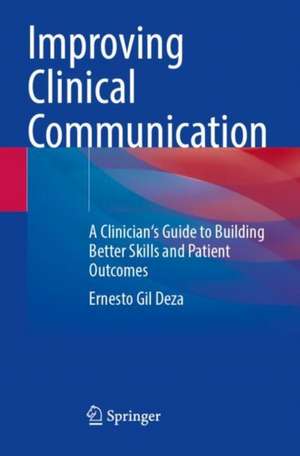
Improving Clinical Communication
Autor Ernesto Gil Dezaen Limba Engleză Paperback – 17 iul 2025
În volumul Improving Clinical Communication, Ernesto Gil Deza propune o abordare clinică și pragmatică a unui domeniu adesea neglijat în programa universitară: arta comunicării ca instrument terapeutic. Notăm cu interes faptul că această ediție publicată de Springer depășește granițele tehnicilor clasice de interviu, integrând protocoale actualizate pentru realitățile medicale moderne, precum telemedicina și experiența comunicării virtuale dobândită în timpul pandemiei. Credem că valoarea adăugată a acestui text rezidă în recunoașterea cuvântului ca entitate cu efect placebo și în analiza impactului empatiei asupra satisfacției pacientului.
Structura lucrării este riguros organizată, pornind de la fundamentele istorice și evoluția limbajului medical, trecând prin distincția crucială între informație și comunicare, și culminând cu strategii specifice de comunicare non-verbală. Acolo unde Clinical Communication Skills for Medicine de Margaret Lloyd oferă un ghid esențial pentru abilitățile centrate pe pacient, volumul de față aprofundează nișe specifice și sensibile, cum ar fi nevoile de comunicare în îngrijirea pacienților LGBTQ și utilizarea comunicării ca barieră împotriva epuizării profesionale (burnout).
Recomandăm parcurgerea capitolului final, care îndeamnă fiecare clinician să își construiască un „kit personal”, o selecție subiectivă de metafore și silențiumuri adaptate stilului propriu de practică. Este o resursă care transformă comunicarea dintr-o soft skill într-o competență clinică măsurabilă, esențială pentru orice profesionist din sănătate care dorește să optimizeze relația medic-pacient în contextul digital actual.
Preț: 716.54 lei
Preț vechi: 754.26 lei
-5%
Carte disponibilă
Livrare economică 04-11 mai
Livrare express 24-30 aprilie pentru 73.05 lei
Specificații
ISBN-10: 3031624483
Pagini: 352
Dimensiuni: 155 x 235 x 18 mm
Greutate: 0.6 kg
Editura: Springer
V-ar putea interesa
-
 It's Probably NothingNaga Munchetty-5%Preț: 143.75 lei151.32 lei
 -
 Physician Communication: Connecting with Patients, Peers, and the PublicTerry L. Schraeder-28%Preț: 275.54 lei382.64 lei
 -
 -27%Preț: 294.74 lei405.13 lei
 -
 Interpersonal Relationships: Professional Communication Skills for NursesKathleen Underman Boggs-25%Preț: 401.90 lei536.88 lei
 -
 -31%Preț: 381.66 lei555.30 lei
 -
 -31%Preț: 225.51 lei324.83 lei
 -
 Effective Communication Skills for Health ProfessionalsPhilip Burnard-5%Preț: 471.47 lei496.29 lei
 -
 Kumar and Clark's Clinical MedicineDavid Randall-27%Preț: 456.34 lei627.74 leiRecomandat
 -
 Medical Ethics, Law and Communication at a GlancePatrick Davey-5%Preț: 300.13 lei315.93 lei
 -
 Clinical Communication Skills for MedicineMargaret Lloyd-5%Preț: 237.60 lei250.11 lei
 -
 Communication Skills for PhysiotherapistsVincent Kortleve-35%Preț: 179.81 lei277.14 lei
 -
 Stories in Health CommunicationGjyn O'Toole-33%Preț: 244.33 lei362.66 lei
 -
 -29%Preț: 301.94 lei426.98 lei
 -
 Medical Student Survival SkillsPhilip Jevon-5%Preț: 228.69 lei240.73 lei
 -
 Insight and Action for Better Patient Care: Clinical Pearls and StrategiesRene Revis Shingles-29%Preț: 350.03 lei493.35 lei
 -
 Magic in Practice Second EditionGarner ThomsonPreț: 234.24 lei
 -
 -5%Preț: 200.69 lei211.26 lei
 -
 How To Talk To Absolutely AnyoneMark RhodesPreț: 103.11 lei
 -
 -5%Preț: 256.25 lei269.74 lei
 -
 -23%Preț: 338.54 lei437.83 lei
De ce să citești această carte
Această carte se adresează medicilor și studenților care doresc să transforme interacțiunea cu pacientul într-un act terapeutic eficient. Cititorul câștigă strategii concrete pentru gestionarea consultațiilor la distanță prin telemedicină și învață cum o comunicare corectă poate preveni burnout-ul medical. Este un instrument practic pentru a trece de la simpla transmitere de informații la o comunicare empatică, adaptată nevoilor diverse ale pacienților moderni.
Despre autor
Ernesto Gil Deza este un specialist recunoscut în domeniul oncologiei și al comunicării medicale, aducând în Improving Clinical Communication o experiență vastă acumulată în practica clinică și în mediul academic. Autorul se concentrează pe dimensiunea umanistă a medicinii, explorând modul în care limbajul și empatia influențează rezultatele clinice. Expertiza sa este reflectată în modul în care abordează teme complexe, de la bioetica îngrijirii grupurilor vulnerabile până la adaptarea tehnologică a profesiei medicale, oferind soluții bazate pe dovezi pentru îmbunătățirea relației dintre personalul sanitar și societate.
Descriere scurtă
Chapters cover the possible therapeutic origin of the human word, the placebo effect of the medical word, the distinction between information and communication, and the importance of empathy while communicating with patients. An overview of the medical words throughout history up to our current practice is presented. In addition, the content helps to develop a strategy for nonverbal communication and to analyse the impact of empathy on communication and patient satisfaction. Current topics such as special needs for LGBTQ patient care, telehealth and virtual communication are also featured in this book.
Knowing how to communicate is healthy not only for the patient but also for the doctor. Therefore, the prevention of medical burnout through adequate communication, both in routine practice, and with patients with special needs, as well as in telemedicine is also discussed.
Finally, the author addresses a personal and non-transferable task: each individual must build their own toolbox for communication - the stories, the anecdotes, the metaphors, the silences with which each of the readers will use to communicate with their patients.
The aim of this book is to bridge a gap between the graduate and postgraduate training for dealing with information and problems in communicating during clinical practice. Since it is never too late to acquire or improve our communication skills, this work will be a useful and valuable resource for any health professional interested in the subject.