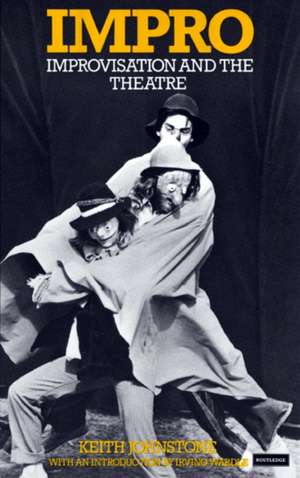
Impro: Improvisation and the Theatre
Autor Keith Johnstoneen Limba Engleză Paperback – 7 ian 1987
Preț: 328.36 lei
Puncte Express: 493
Carte disponibilă
Livrare economică 16-30 noiembrie
Livrare prin curier în România Termenul estimat este afișat lângă disponibilitate.
Transport gratuit de la 400.00 lei Plată online sau ramburs, în funcție de opțiunile comenzii.
Retur gratuit în 14 zile Comandă securizată și suport în română.
Specificații
ISBN-13: 9780878301171
ISBN-10: 0878301178
Pagini: 208
Dimensiuni: 133 x 203 x 12 mm
Greutate: 0.16 kg
Ediția:1
Editura: Taylor & Francis
Colecția Routledge
Locul publicării:Oxford, United Kingdom
ISBN-10: 0878301178
Pagini: 208
Dimensiuni: 133 x 203 x 12 mm
Greutate: 0.16 kg
Ediția:1
Editura: Taylor & Francis
Colecția Routledge
Locul publicării:Oxford, United Kingdom
V-ar putea interesa
-
 The Ultimate Hitchhiker's Guide to the GalaxyDouglas AdamsPreț: 166.40 lei
 -
 -15%Preț: 50.67 lei59.36 lei
 -
 Impro for StorytellersKeith JohnstonePreț: 123.35 lei
 -
 -15%Preț: 66.26 lei77.91 lei
 -
 Preț: 195.85 lei
 -
 -17%Preț: 207.47 lei250.72 lei
 -
 -8%Preț: 170.64 lei185.61 lei
 -
 Improvisation Starters Revised and Expanded EditionPhilip BernardiPreț: 145.25 lei
 -
 The Ultimate Hitchhiker's Guide to the GalaxyDouglas Adams-37%Preț: 87.10 lei139.26 lei
 -
 Drama Games & Improvs: Games for the Classroom & BeyondJustine JonesPreț: 150.55 lei
 -
 The Principles of MovementKeith Bain-20%Preț: 131.54 lei165.17 lei
 -
 The Life And Times Of The Thunderbolt KidBill Bryson-18%Preț: 65.31 lei79.70 lei
 -
 -49%Preț: 47.06 lei92.93 lei
 -
 In the Realm of Hungry GhostsGabor Maté-32%Preț: 73.94 lei108.44 lei
 -
 An Attitude for ActingAndrew TidmarshPreț: 103.05 lei
 -
 The Golden Rules of ActingAndy NymanPreț: 57.02 lei
 -
 The Viewpoints BookAnne BogartPreț: 108.14 lei
 -
 Improv Beyond RulesAdam MeggidoPreț: 115.03 lei
 -
 The Improvisation GameChris JohnstonPreț: 99.40 lei
 -
![Tackling Text [And Subtext]: A Step-By-Step Guide for Actors](https://i4.books-express.ro/bt/9781854597991/tackling-text-and-subtext-a-step-by-step-guide-for-actors.jpg) Tackling Text [And Subtext]: A Step-By-Step Guide for ActorsBarbara HousemanPreț: 113.80 lei
Tackling Text [And Subtext]: A Step-By-Step Guide for ActorsBarbara HousemanPreț: 113.80 lei -
 Confessions of an Advertising ManDavid Ogilvy-18%Preț: 88.22 lei108.16 lei
Public țintă
Professional Practice & DevelopmentCuprins
Notes on Myself Status Spontaneity Narrative Skills Masks and Trance Appendix
Recenzii
"Impro ought to be required reading not only for theatre people generally but also for teachers, educators, and students of all kinds and persuassions. Readers of this book are not going to agree with everything in it; but if they are not challenged by it, if they do not ultimately succumb to its wisdom and whimsicality, they are in a very sad state indeed . . . .Johnstone seeks to liberate the imagination, to cultivate in the adult the creative power of the child . . . .Deserves to be widely read and tested in the classroom and rehearsal hall . . .Full of excellent good sense, actual observations and inspired assetions." -- CHOICE: Books for College Libraries
Descriere
Descriere de la o altă ediție sau format:
In this landmark work Keith Johnstone provides a revelatory guide to rediscovering and unlocking the imagination. Admired for its clarity and zest, Impro lays bare the techniques and exercises used to foster spontaneity and narrative skill for actors. These techniques and exercises were evolved in the actors' studio, when he was Associate Director of the Royal Court and then in demonstrations to schools and colleges and ultimately in the founding of a company of performers called The Theatre Machine.
Divided into four sections, 'Status', 'Spontaneity', 'Narrative Skills' and 'Masks and Trance', arranged more or less in the order a group might approach them, the book sets out the specific approaches which Johnstone has himself found most useful and most stimulating. The result is a fascinating exploration of the nature of spontaneous creativity.
'If teachers were honoured in the British theatre along-side directors, designers and playwrights, Keith Johnstone would be as familiar a name as are those of . . . Jocelyn Herbert, Edward Bond and other young talents who were drawn to the great lodestone of the Royal Court Theatre in the late 1950s. As head of the script department, Johnstone played a crucial part in the development of the 'writers' theatre.' Irving Wardle
In this landmark work Keith Johnstone provides a revelatory guide to rediscovering and unlocking the imagination. Admired for its clarity and zest, Impro lays bare the techniques and exercises used to foster spontaneity and narrative skill for actors. These techniques and exercises were evolved in the actors' studio, when he was Associate Director of the Royal Court and then in demonstrations to schools and colleges and ultimately in the founding of a company of performers called The Theatre Machine.
Divided into four sections, 'Status', 'Spontaneity', 'Narrative Skills' and 'Masks and Trance', arranged more or less in the order a group might approach them, the book sets out the specific approaches which Johnstone has himself found most useful and most stimulating. The result is a fascinating exploration of the nature of spontaneous creativity.
'If teachers were honoured in the British theatre along-side directors, designers and playwrights, Keith Johnstone would be as familiar a name as are those of . . . Jocelyn Herbert, Edward Bond and other young talents who were drawn to the great lodestone of the Royal Court Theatre in the late 1950s. As head of the script department, Johnstone played a crucial part in the development of the 'writers' theatre.' Irving Wardle