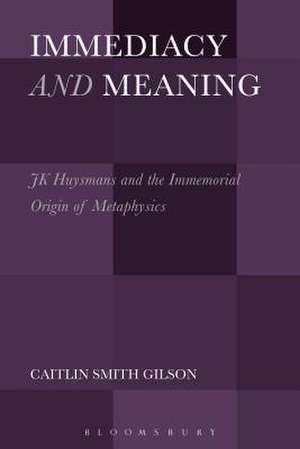
Immediacy and Meaning: J. K. Huysmans and the Immemorial Origin of Metaphysics
Autor Dr. Caitlin Smith Gilsonen Limba Engleză Paperback – 23 aug 2018
Preț: 266.26 lei
Preț vechi: 348.04 lei
-23%
Puncte Express: 399
Carte tipărită la comandă
Livrare economică 05-19 decembrie
Livrare prin curier în România Termenul estimat este afișat lângă disponibilitate.
Transport gratuit de la 400.00 lei Plată online sau ramburs, în funcție de opțiunile comenzii.
Retur gratuit în 14 zile Comandă securizată și suport în română.
Specificații
ISBN-13: 9781501344671
ISBN-10: 1501344676
Pagini: 328
Ilustrații: 1 b/w illustration
Dimensiuni: 152 x 229 mm
Greutate: 0.44 kg
Ediția:NIPPOD
Editura: Bloomsbury Publishing
Colecția Bloomsbury Academic
Locul publicării:New York, United States
ISBN-10: 1501344676
Pagini: 328
Ilustrații: 1 b/w illustration
Dimensiuni: 152 x 229 mm
Greutate: 0.44 kg
Ediția:NIPPOD
Editura: Bloomsbury Publishing
Colecția Bloomsbury Academic
Locul publicării:New York, United States
V-ar putea interesa
-
 The Quest for MeaningTariq RamadanPreț: 78.53 lei
 -
 Religion for AtheistsAlain de Botton-18%Preț: 76.83 lei93.96 lei
 -
 The Justification of Science and the Rationality of Religious BeliefMichael C. Banner-18%Preț: 321.61 lei393.14 lei
 -
 Molinism: The Contemporary DebateKen Perszyk-31%Preț: 663.27 lei954.52 lei
 -
 -12%Preț: 303.47 lei343.45 lei
 -
 Oxford Studies in Philosophy of Religion Volume 3Jonathan L. Kvanvig-10%Preț: 377.97 lei420.88 lei
 -
 Probability in the Philosophy of ReligionJake Chandler-31%Preț: 679.35 lei978.47 lei
 -
 Freedom, God, and WorldsMichael J. Almeida-30%Preț: 621.11 lei887.46 lei
 -
 -30%Preț: 681.90 lei976.30 lei
 -
 -8%Preț: 293.73 lei319.77 lei
 -
 The Predicament of Belief: Science, Philosophy, and FaithPhilip Clayton-12%Preț: 266.37 lei301.05 lei
 -
 The Power of God: by Thomas AquinasRichard J. Regan-20%Preț: 399.52 lei499.34 lei
 -
 Preț: 408.25 lei
 -
 -25%Preț: 1169.06 lei1550.90 lei
 -
 God's Final Victory: A Comparative Philosophical Case for UniversalismProfessor John Kronen-25%Preț: 278.18 lei369.61 lei
Cuprins
Preface: Stating the Problem of Metaphysics
Acknowledgments
Prologue: En Route to Memory
Part I: St. Thomas and the Paradox of Mediation and Intentionality
Part II: Re-Approaching Immediacy
Part III: Efficacious Prayer, Suffering and Self-Presence
Epilogue: Heaven: They Do Things Differently There
Bibliography
Index
Acknowledgments
Prologue: En Route to Memory
Part I: St. Thomas and the Paradox of Mediation and Intentionality
Part II: Re-Approaching Immediacy
Part III: Efficacious Prayer, Suffering and Self-Presence
Epilogue: Heaven: They Do Things Differently There
Bibliography
Index
Recenzii
The title does not do justice to this book's rich, eclectic contents; it manages to contain at once an analysis of J. K. Huysmans's Durtal tetralogy, a philosophical inquiry into the nature of human knowledge and freedom, a theological exploration of prayer and suffering, and a florilegium of passages from various poets, mystics, and philosophers in and outside the Catholic tradition.
Gilson is without a doubt one of the most remarkable, creative and enticing voices writing today within the tradition of the Continental religious turn of an expressly Christian vision and vintage ... Gilson's unique polyphonic and dramatically literary voice further demands comparison with the beautifully wounded speech of Jean-Louis Chrétien and before him, Max Picard ... A profound metaphysics of prayer which takes us upon a meditative pilgrimage to the Absolute.
Smith Gilson is an emerging Catholic intellectual working at the intersection of philosophy, theology, and literature. This book brings to our philosophical and theological attention the later work of Huysmans and uses it as a platform for insightful reflections on origin, time, and narrative, as well as deep engagement with both the classical and modern philosophical traditions. At its deepest, however, it is a reflection on experience and what exceeds it.
Incorporating an impressive array of works of poetry, prose, philosophy, and theology, this book is no mere work of scholarship. Rather, it is a unique and powerful philosophical meditation upon what it means to be human. It claims that to be human is to be responsive, and thus to bear the responsibility for our knowing, our freedom, and our person. Thus, Gilson proposes that we rethink the notion of the human knower as subject. We are responsive as knowers and agents because we are originally the other to the primal Being and Knower. Thus we are not, as philosophy commonly assumes, primarily the knowing subject, but rather we are a dative of manifestation and we are such because we are primarily datives of love. The work begins by explaining the distortion in our knowledge caused by our necessarily mediated knowing and speaking, and promises the way for us to find our meaning in the unmediated by way of a profound interpretation of memory. Immediacy and Meaning thus claims to retrieve 'the specific anthropology of our own memorial-as-immemorial Other.' The theme of this and her previous three books interpenetrate each other and recur in various and ever interesting degrees of dialogue: God and man, time and eternity, faith and reason, universal and particular, nature and grace, immediacy and meaning, and Truth and Being. To quote another Gilson: 'To introduce others to some important aspects of metaphysical being is no common gift.'
Gilson is without a doubt one of the most remarkable, creative and enticing voices writing today within the tradition of the Continental religious turn of an expressly Christian vision and vintage ... Gilson's unique polyphonic and dramatically literary voice further demands comparison with the beautifully wounded speech of Jean-Louis Chrétien and before him, Max Picard ... A profound metaphysics of prayer which takes us upon a meditative pilgrimage to the Absolute.
Smith Gilson is an emerging Catholic intellectual working at the intersection of philosophy, theology, and literature. This book brings to our philosophical and theological attention the later work of Huysmans and uses it as a platform for insightful reflections on origin, time, and narrative, as well as deep engagement with both the classical and modern philosophical traditions. At its deepest, however, it is a reflection on experience and what exceeds it.
Incorporating an impressive array of works of poetry, prose, philosophy, and theology, this book is no mere work of scholarship. Rather, it is a unique and powerful philosophical meditation upon what it means to be human. It claims that to be human is to be responsive, and thus to bear the responsibility for our knowing, our freedom, and our person. Thus, Gilson proposes that we rethink the notion of the human knower as subject. We are responsive as knowers and agents because we are originally the other to the primal Being and Knower. Thus we are not, as philosophy commonly assumes, primarily the knowing subject, but rather we are a dative of manifestation and we are such because we are primarily datives of love. The work begins by explaining the distortion in our knowledge caused by our necessarily mediated knowing and speaking, and promises the way for us to find our meaning in the unmediated by way of a profound interpretation of memory. Immediacy and Meaning thus claims to retrieve 'the specific anthropology of our own memorial-as-immemorial Other.' The theme of this and her previous three books interpenetrate each other and recur in various and ever interesting degrees of dialogue: God and man, time and eternity, faith and reason, universal and particular, nature and grace, immediacy and meaning, and Truth and Being. To quote another Gilson: 'To introduce others to some important aspects of metaphysical being is no common gift.'