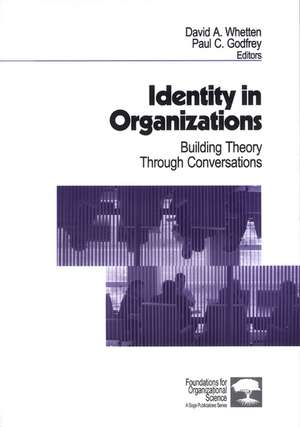
Identity in Organizations: Building Theory Through Conversations: Foundations for Organizational Science
Editat de David A. Whetten, Paul Godfreyen Limba Engleză Paperback – 10 sep 1998
| Toate formatele și edițiile | Preț | Express |
|---|---|---|
| Paperback (1) | 974.81 lei 43-57 zile | |
| SAGE Publications – 10 sep 1998 | 974.81 lei 43-57 zile | |
| Hardback (1) | 1588.61 lei 43-57 zile | |
| SAGE Publications – 10 sep 1998 | 1588.61 lei 43-57 zile |
Din seria Foundations for Organizational Science
- 18%
 Preț: 970.91 lei
 - 11%
 Preț: 605.92 lei
 - 9%
 Preț: 1101.50 lei
 - 18%
 Preț: 1144.90 lei
 - 18%
 Preț: 963.39 lei
 - 18%
 Preț: 821.58 lei
 - 15%
 Preț: 637.36 lei
 - 18%
 Preț: 964.58 lei
 - 18%
 Preț: 824.61 lei
 - 15%
 Preț: 639.68 lei
 - 18%
 Preț: 826.55 lei
 - 18%
 Preț: 828.34 lei
 - 18%
 Preț: 971.36 lei
 - 18%
 Preț: 969.41 lei
 - 18%
 Preț: 966.10 lei
 - 18%
 Preț: 983.65 lei
 - 18%
 Preț: 830.59 lei
 - 18%
 Preț: 824.13 lei
 - 18%
 Preț: 821.74 lei
 - 18%
 Preț: 826.68 lei
 - 15%
 Preț: 401.65 lei
Preț: 974.81 lei
Preț vechi: 1188.80 lei
-18%
Puncte Express: 1462
Preț estimativ în valută:
172.38€ • 197.67$ • 148.98£
172.38€ • 197.67$ • 148.98£
Carte tipărită la comandă
Livrare economică 27 aprilie-11 mai
Specificații
ISBN-13: 9780761909484
ISBN-10: 0761909486
Pagini: 320
Ilustrații: black & white illustrations
Dimensiuni: 178 x 254 x 20 mm
Greutate: 0.68 kg
Ediția:New.
Editura: SAGE Publications
Colecția Sage Publications, Inc
Seria Foundations for Organizational Science
Locul publicării:Thousand Oaks, United States
ISBN-10: 0761909486
Pagini: 320
Ilustrații: black & white illustrations
Dimensiuni: 178 x 254 x 20 mm
Greutate: 0.68 kg
Ediția:New.
Editura: SAGE Publications
Colecția Sage Publications, Inc
Seria Foundations for Organizational Science
Locul publicării:Thousand Oaks, United States
V-ar putea interesa
-
 Everybody MattersBob Chapman-20%Preț: 59.70 lei75.08 lei
 -
 -18%Preț: 826.55 lei1007.99 lei
 -
 Strategic Human Resource DevelopmentJames Grieves-15%Preț: 450.25 lei529.70 lei
 -
 Experiencing Human Resource ManagementChristopher Mabey-15%Preț: 451.96 lei531.71 lei
 -
 -27%Preț: 64.40 lei88.42 lei
 -
 Health and Safety at Work for Dummies, UK EditionRrc International-5%Preț: 134.89 lei141.99 lei
 -
 Clash of the GenerationsValerie M GrubbPreț: 162.97 lei
 -
 Preț: 116.11 lei
 -
 Managing the MillennialsChip EspinozaPreț: 153.18 lei
 -
 Management and Leadership DevelopmentChristopher Mabey-15%Preț: 498.76 lei586.77 lei
 -
 -29%Preț: 43.29 lei60.82 lei
 -
 Scaling TeamsAlexander GrossePreț: 212.14 lei
 -
 HBR Guide to Delivering Effective FeedbackHarvard Business ReviewPreț: 110.18 lei
Recenzii
"The content of the book, conservational style, and the pushes to extract research questions are motivating."
Cuprins
Preface - David Whetten
Why Organizational Identity and Why Conversations?
The Definition and MetaDefinition of Identity - Stuart Albert
PART ONE: WHAT DOES ORGANIZATIONAL IDENTITY MEAN?
From Individual to Organizational Identity - Dennis Gioia
The Identity of Organizations - Dennis Gioia et al
PART TWO: WHAT DOES IDENTITY IMPLY FOR STRATEGY?
Organizational Identity within the Strategic Management Conversation - Larry Stimpert, Yolanda Sarason and Loren Gustafson
Contributions and Assumptions
A Strategy Conversation on the Topic of Organization Identity - Rhonda Reger et al
PART THREE: HOW DO PEOPLE IDENTIFY WITH ORGANIZATIONS?
To Be or Not To Be - Michael Pratt
Central Questions in Organizational Identification
Identification with Organizations - Blake Ashforth et al
Epilogue - Paul C Godfrey et al
What Does the Concept of Identity Add to Organization Science?
Postscript - Paul C Godfrey
Observations on Conversation as a Theory-Building Methodology
Why Organizational Identity and Why Conversations?
The Definition and MetaDefinition of Identity - Stuart Albert
PART ONE: WHAT DOES ORGANIZATIONAL IDENTITY MEAN?
From Individual to Organizational Identity - Dennis Gioia
The Identity of Organizations - Dennis Gioia et al
PART TWO: WHAT DOES IDENTITY IMPLY FOR STRATEGY?
Organizational Identity within the Strategic Management Conversation - Larry Stimpert, Yolanda Sarason and Loren Gustafson
Contributions and Assumptions
A Strategy Conversation on the Topic of Organization Identity - Rhonda Reger et al
PART THREE: HOW DO PEOPLE IDENTIFY WITH ORGANIZATIONS?
To Be or Not To Be - Michael Pratt
Central Questions in Organizational Identification
Identification with Organizations - Blake Ashforth et al
Epilogue - Paul C Godfrey et al
What Does the Concept of Identity Add to Organization Science?
Postscript - Paul C Godfrey
Observations on Conversation as a Theory-Building Methodology
Descriere
This investigation of the fundamental character of organizational identity and identification with an organization is arranged in the form of a provocative discussion between key scholars.
The book focuses on three different paradigmatic views of identity: functionalist, interpretive and postmodern. Similarities and distinctions among these ways of understanding are explored, and numerous theoretical and practical insights are gained. The book concludes with a discussion of the relevance of identity as a construct in organizational study, and observations on conversation and theory building.