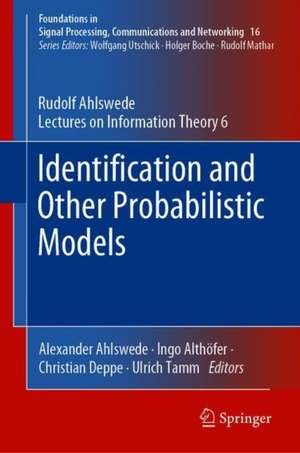
Identification and Other Probabilistic Models: Foundations in Signal Processing, Communications and Networking, cartea 16
Autor Rudolf Ahlswede Editat de Alexander Ahlswede, Ingo Althöfer, Christian Deppe, Ulrich Tammen Limba Engleză Hardback – 23 iun 2021
Subliniem apariția acestui al șaselea volum, Identification and Other Probabilistic Models, o lucrare monumentală ce sistematizează viziunea lui Rudolf Ahlswede asupra Teoriei Identificării. Structura materialului este organizată riguros în șapte părți, pornind de la fundamentele identificării prin canale (Partea I) și evoluând spre o teorie generală a transferului de informație (Partea II). Metodologia expusă marchează trecerea de la paradigma clasică a lui Shannon — unde scopul este reconstrucția mesajului — la o abordare „Post-Shannon”, în care decodorul trebuie doar să determine dacă un mesaj specific a fost trimis. Notăm cu interes includerea unor secțiuni avansate despre entropia de identificare și testarea ipotezelor, care extind aplicabilitatea teoriei spre algoritmi de verificare mult mai eficienți din punctul de vedere al resurselor computaționale. Această ediție din 2021 integrează rezultate care demonstrează o proprietate remarcabilă a codurilor de identificare: dimensiunea acestora crește dublu exponențial în raport cu lungimea blocului, un contrast fascinant față de limitele exponențiale standard. Lucrarea completează perspectiva oferită de Storing and Transmitting Data, adăugând un nivel de complexitate conceptuală ce transcende simpla stocare. Dacă primele volume ale seriei, precum Transmitting and Gaining Data, se concentrau pe calculul capacității canalelor și bazele riguroase ale școlii germane de informatică, prezentul volum deschide direcții noi de cercetare prin explorarea structurilor matematice inerente comunicării generalizate. Textul este echilibrat între rigoarea matematică necesară studenților la doctorat și perspectivele de inginerie aplicată, fiind îmbogățit de un index de notații esențial pentru navigarea prin densitatea teoretică a celor peste 700 de pagini.
Din seria Foundations in Signal Processing, Communications and Networking
- 15%
 Preț: 647.30 lei
 -
 Preț: 398.76 lei
 -
 Preț: 409.22 lei
 - 15%
 Preț: 653.43 lei
 - 23%
 Preț: 727.90 lei
 - 15%
 Preț: 668.09 lei
 - 15%
 Preț: 665.52 lei
 - 15%
 Preț: 622.91 lei
 - 20%
 Preț: 621.00 lei
 - 15%
 Preț: 513.43 lei
 - 15%
 Preț: 652.10 lei
 - 15%
 Preț: 620.93 lei
 - 15%
 Preț: 613.99 lei
 - 15%
 Preț: 620.69 lei
 - 38%
 Preț: 568.03 lei
 - 15%
 Preț: 621.11 lei
Preț: 987.09 lei
Preț vechi: 1281.94 lei
-23%
Carte tipărită la comandă
Livrare economică 16-21 noiembrie
Specificații
ISBN-10: 3030650707
Pagini: 748
Ilustrații: XXII, 724 p. 36 illus.
Dimensiuni: 160 x 241 x 43 mm
Greutate: 1.41 kg
Ediția:1st edition 2021
Editura: Springer
Colecția Foundations in Signal Processing, Communications and Networking
Seria Foundations in Signal Processing, Communications and Networking
Locul publicării:Cham, Switzerland
V-ar putea interesa
-
 The InformationJames GleickPreț: 108.66 lei
 -
 Computer Networks: A Systems ApproachLarry L. Peterson-41%Preț: 558.53 lei941.05 lei
 -
 -20%Preț: 212.82 lei266.02 lei
 -
 Concrete MathematicsRonald Graham-20%Preț: 558.72 lei698.40 lei
 -
 The Winner's CurseRichard H. ThalerPreț: 224.53 lei
 -
 The Mathematical Theory of CommunicationClaude E ShannonPreț: 170.77 lei
 -
 Algorithms UnlockedThomas H. Cormen-26%Preț: 189.43 lei256.67 lei
 -
 -19%Preț: 430.60 lei531.60 lei
 -
 An Introduction to IdentificationJ P NortonPreț: 97.09 lei
 -
 Probability Theory for Quantitative ScientistsLuca LeuzziPreț: 505.18 lei
 -
 Sipser, M: Introduction to the Theory of ComputationMichael (Massachusetts Institute of Technology) Sipser-25%Preț: 599.79 lei801.72 lei
 -
 -9%Preț: 653.11 lei717.70 lei
 -
 Coding For Dummies, All New EditionPaul McFedries-20%Preț: 116.94 lei146.18 lei
 -
 Preț: 123.51 lei
 -
 Quantum Computation and Quantum InformationJ. M. Landsberg-9%Preț: 637.48 lei700.53 lei
 -
 The Dark Forest Theory of the InternetBogna KoniorPreț: 86.64 lei
 -
 AlgospeakAdam AleksicPreț: 121.84 leiRecomandat
 -
 Preț: 231.78 lei
 -
 Statistics for ScientistsUmberto Michelucci-20%Preț: 275.88 lei344.84 lei
 -
 Communication Principles for Data ScienceChangho Suh-20%Preț: 404.53 lei505.66 lei
De ce să citești această carte
Această lucrare este esențială pentru cercetătorii din matematică aplicată și informatică teoretică care doresc să stăpânească Teoria Identificării. Cititorul câștigă acces la o resursă academică rară ce explică de ce codurile de identificare sunt mai eficiente în sisteme de verificare și securitate. Este un instrument fundamental pentru elaborarea tezelor de doctorat, oferind nu doar soluții, ci și numeroase conjecturi care pot fundamenta programe întregi de cercetare.
Despre autor
Rudolf Ahlswede (1938–2010), profesor emerit la Universitatea din Bielefeld, a fost o figură proeminentă a matematicii mondiale, laureat al premiului Claude-Elwood-Shannon în 2006. Expert de talie internațională în combinatorică și teoria numerelor, Ahlswede a redefinit fundamentele comunicării prin conceptul de „Teorie Generală a Transferului de Informație”. Cariera sa a fost marcată de distincții prestigioase, precum premiul Humboldt-Japan și doctoratul onorific al Academiei Ruse de Științe, lăsând în urmă o moștenire intelectuală vastă care continuă să influențeze informatica teoretică și fizica prin această serie de prelegeri postume.
Cuprins
Recenzii
Notă biografică
Textul de pe ultima copertă
Rudolf Ahlswede wrote:
It seems that the whole body of present day Information Theory will undergo serious revisions and some dramatic expansions. In this book we will open several directions of future research and start the mathematical description of communication models in great generality. For some specific problems we provide solutions or ideas for their solutions.
The lectures presented in this work, which consists of 10 volumes, are suitable for graduate students in Mathematics, and also for those working in Theoretical Computer Science, Physics, and Electrical Engineering with a background in basic Mathematics. The lectures can be used as the basis for courses or to supplement courses in many ways. Ph.D. students will also find research problems, often with conjectures, that offer potential subjects for a thesis. More advanced researchers may find questions which form the basis of entire research programs.
The book also contains an afterword by Gunter Dueck.