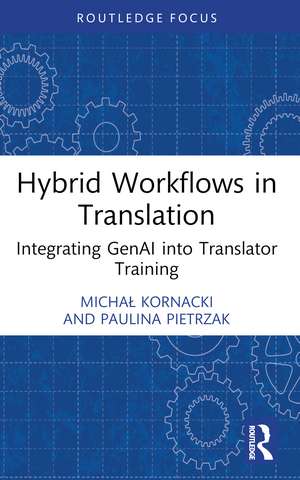
Hybrid Workflows in Translation: Integrating GenAI into Translator Training: Routledge Focus on Translation and Interpreting Studies
Autor Michał Kornacki, Paulina Pietrzaken Limba Engleză Paperback – 30 ian 2026
The book covers a range of AI applications, including AI-powered features within Translation Management Systems, AI-based machine translation, AI-assisted translation, language generation modules and language checking tools. The volume puts the focus on using AI in translation responsibly and effectively, but also on ways to support students and practitioners in their professional development through easing technological anxieties and building digital resilience.
This book will be of interest to students, scholars and practitioners in translation and interpreting studies, as well as key stakeholders in the language services industry.
Preț: 205.81 lei
Puncte Express: 309
Carte tipărită la comandă
Livrare economică 26 noiembrie-10 decembrie
Livrare prin curier în România Termenul estimat este afișat lângă disponibilitate.
Transport gratuit de la 400.00 lei Plată online sau ramburs, în funcție de opțiunile comenzii.
Retur gratuit în 14 zile Comandă securizată și suport în română.
Specificații
ISBN-13: 9781032862095
ISBN-10: 1032862092
Pagini: 160
Ilustrații: 24
Dimensiuni: 138 x 216 mm
Greutate: 0.3 kg
Ediția:1
Editura: Taylor & Francis
Colecția Routledge
Seria Routledge Focus on Translation and Interpreting Studies
Locul publicării:Oxford, United Kingdom
ISBN-10: 1032862092
Pagini: 160
Ilustrații: 24
Dimensiuni: 138 x 216 mm
Greutate: 0.3 kg
Ediția:1
Editura: Taylor & Francis
Colecția Routledge
Seria Routledge Focus on Translation and Interpreting Studies
Locul publicării:Oxford, United Kingdom
Public țintă
PostgraduateNotă biografică
Michał Kornacki is Assistant Professor at the Institute of English Studies at the University of Łódź, Poland.
Paulina Pietrzak is Associate Professor at the Institute of English Studies at the University of Łódź, Poland.
Paulina Pietrzak is Associate Professor at the Institute of English Studies at the University of Łódź, Poland.
Cuprins
Contents
List of Figures
List of Tables
Introduction
Chapter 1: (R)evolution of translation technology
1.1. History and evolution of translation tools
1.1.1. Machine translation
1.1.2. Computer-assisted translation (CAT) tools
1.1.3. Translation management systems
1.1.4. Writing assistants and checking tools
1.1.5. Generative artificial intelligence in translation
1.2. The current state of translation technology
1.3. Stages of AI development
Chapter 2: Translator-AI interaction
2.1. Augmented translation
2.2. Hybrid workflows in translation
2.3. The impact of technology on translator profession: new avenues and new anxieties
2.4. Ethical considerations in AI-assisted language service provision
Chapter 3: Translators as AI-assisted language specialists
3.1. Translators’ new roles and status
3.2. Future translator expertise: what is missing?
3.3. Technical skills for hybrid workflows
3.4. From anxiety to digital resilience
3.5. Personal resources and metacognitive capacity
3.6. The translator’s self-concept in AI interactions
Chapter 4: Attitudes towards AI in translation: an academic exploration
4.1. Research design
4.2. Limitations of the study
4.3. Data analysis
4.3.1. Findings on the use of AI technologies in translation
4.3.2. Perspectives on GenAI integration in translator education
4.3.3. Risks associated with using GenAI tools in translator training
4.4. Summary of the findings: challenges and lessons learned
Chapter 5. Implications for translator training
5.1. To teach or not to teach?
5.2. What’s in it for translation students?
5.3. Suggested ways of introducing AI-assisted translation practice
5.3.1. Exercises in AI-assisted translation
5.3.2. AI tools for terminology management
5.3.3. AI-assisted quality assessment
5.3.4. AI-generated feedback
5.3.5. Ethical code of conduct in AI use
5.4. Fostering personal resources in translator training
5.4.1. Self-reflection: what am I missing?
5.4.2. Self-efficacy: building digital resilience
5.4.3. Self-concept: reducing technological anxiety
Chapter 6: Final reflections
Appendix
Index
List of Figures
List of Tables
Introduction
Chapter 1: (R)evolution of translation technology
1.1. History and evolution of translation tools
1.1.1. Machine translation
1.1.2. Computer-assisted translation (CAT) tools
1.1.3. Translation management systems
1.1.4. Writing assistants and checking tools
1.1.5. Generative artificial intelligence in translation
1.2. The current state of translation technology
1.3. Stages of AI development
Chapter 2: Translator-AI interaction
2.1. Augmented translation
2.2. Hybrid workflows in translation
2.3. The impact of technology on translator profession: new avenues and new anxieties
2.4. Ethical considerations in AI-assisted language service provision
Chapter 3: Translators as AI-assisted language specialists
3.1. Translators’ new roles and status
3.2. Future translator expertise: what is missing?
3.3. Technical skills for hybrid workflows
3.4. From anxiety to digital resilience
3.5. Personal resources and metacognitive capacity
3.6. The translator’s self-concept in AI interactions
Chapter 4: Attitudes towards AI in translation: an academic exploration
4.1. Research design
4.2. Limitations of the study
4.3. Data analysis
4.3.1. Findings on the use of AI technologies in translation
4.3.2. Perspectives on GenAI integration in translator education
4.3.3. Risks associated with using GenAI tools in translator training
4.4. Summary of the findings: challenges and lessons learned
Chapter 5. Implications for translator training
5.1. To teach or not to teach?
5.2. What’s in it for translation students?
5.3. Suggested ways of introducing AI-assisted translation practice
5.3.1. Exercises in AI-assisted translation
5.3.2. AI tools for terminology management
5.3.3. AI-assisted quality assessment
5.3.4. AI-generated feedback
5.3.5. Ethical code of conduct in AI use
5.4. Fostering personal resources in translator training
5.4.1. Self-reflection: what am I missing?
5.4.2. Self-efficacy: building digital resilience
5.4.3. Self-concept: reducing technological anxiety
Chapter 6: Final reflections
Appendix
Index
Descriere
This concise volume serves as a valuable resource on understanding the integration and impact of generative AI (GenAI) and evolving technologies on translation workflows.