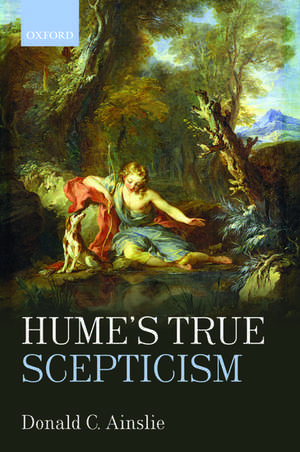
Hume's True Scepticism
Autor Donald C. Ainslieen Limba Engleză Paperback – 12 oct 2017
Preț: 279.59 lei
Preț vechi: 342.50 lei
-18%
Puncte Express: 419
Carte tipărită la comandă
Livrare economică 10-16 decembrie
Livrare prin curier în România Termenul estimat este afișat lângă disponibilitate.
Transport gratuit de la 400.00 lei Plată online sau ramburs, în funcție de opțiunile comenzii.
Retur gratuit în 14 zile Comandă securizată și suport în română.
Specificații
ISBN-13: 9780198801412
ISBN-10: 0198801416
Pagini: 302
Dimensiuni: 156 x 234 x 17 mm
Greutate: 0.46 kg
Editura: OUP OXFORD
Colecția OUP Oxford
Locul publicării:Oxford, United Kingdom
ISBN-10: 0198801416
Pagini: 302
Dimensiuni: 156 x 234 x 17 mm
Greutate: 0.46 kg
Editura: OUP OXFORD
Colecția OUP Oxford
Locul publicării:Oxford, United Kingdom
V-ar putea interesa
-
 Of the Social Contract and Other Political WritingsJean-Jacques Rousseau-29%Preț: 66.97 lei94.16 lei
 -
 Descartes: An Analytic and Historical IntroductionGeorges Dicker-11%Preț: 378.14 lei422.71 lei
 -
 Kant on Practical Justification: Interpretive EssaysMark Timmons-31%Preț: 868.32 lei1259.35 lei
 -
 -31%Preț: 711.52 lei1031.47 lei
 -
 -31%Preț: 789.18 lei1146.49 lei
 -
 Essays on KantHenry E. Allison-10%Preț: 387.95 lei430.67 lei
 -
 On Liberty, Utilitarianism and Other EssaysJohn Stuart Mill-15%Preț: 63.90 lei74.75 lei
 -
 John Locke and Natural PhilosophyPeter R. Anstey-10%Preț: 340.99 lei378.53 lei
 -
 The Kantian Aesthetic: From Knowledge to the Avant-GardePaul Crowther-12%Preț: 309.73 lei351.33 lei
 -
 Inspirations from Kant: EssaysLeslie Stevenson-27%Preț: 480.99 lei661.49 lei
 -
 Preț: 410.29 lei
 -
 Why the World Around You Isn't as It AppearsAlbert LindermanPreț: 116.93 lei
 -
 Kritik der reinen VernunftImmanuel KantPreț: 97.04 lei
 -
 Also sprach ZarathustraFriedrich NietzschePreț: 67.41 lei
Recenzii
elebrated as the winner of the 2016 Journal of the History of Philosophy prize for best book of the year, Ainslie's volume plumbs the depth of Hume's skeptical philosophy in a way that few authors have done, and is deserving of the esteemed accolade.
Donald C. Ainslie's Hume's True Scepticism presents the first book-length treatment of Book 1, Part 4 of the 1739 A Treatise of Human Nature by David Hume (1711-1776). In doing so, the volume represents an important accomplishment, and one can reasonably expect it to become required reading for those wishing to come to terms with Hume's skepticism.
this is one of the very most thought-provoking books yet written on Hume. It challenges many conventional assumptions about Hume, and gives him a new look. It is a look so different from what one is used to that I fear I may have fallen prey to some illusions both in reading Ainslie and in responding to him. I expect many rewarding re-readings and trust that these will correct my errors. Ainslie's is an indispensable contribution to the literature on Hume and on the history of the philosophy of mind and epistemology.
one of the best books written on Hume in a long time . . . there's much to be learned . . . for anyone interested in the foundations of Hume's philosophical project. Indeed, Ainslie's book can also be read as developing a novel Humean view about the nature and limits of philosophy itself. So this book will be of interest, not just to Hume scholars, but to anyone who is attracted to thinking about such meta-philosophical topics in a broadly Humean way. It seems to me a must-read for anyone interested in Hume's scepticism-or, indeed, Hume's philosophy more generally.
Ainslie's book is of tremendous scholarly worth, being valuable both in its own right as a novel and well-defended thesis, and also more instrumentally in offering a sustained and excellent analysis of the winding pathways of Book 1 Part 4.
Donald C. Ainslie's Hume's True Scepticism presents the first book-length treatment of Book 1, Part 4 of the 1739 A Treatise of Human Nature by David Hume (1711-1776). In doing so, the volume represents an important accomplishment, and one can reasonably expect it to become required reading for those wishing to come to terms with Hume's skepticism.
this is one of the very most thought-provoking books yet written on Hume. It challenges many conventional assumptions about Hume, and gives him a new look. It is a look so different from what one is used to that I fear I may have fallen prey to some illusions both in reading Ainslie and in responding to him. I expect many rewarding re-readings and trust that these will correct my errors. Ainslie's is an indispensable contribution to the literature on Hume and on the history of the philosophy of mind and epistemology.
one of the best books written on Hume in a long time . . . there's much to be learned . . . for anyone interested in the foundations of Hume's philosophical project. Indeed, Ainslie's book can also be read as developing a novel Humean view about the nature and limits of philosophy itself. So this book will be of interest, not just to Hume scholars, but to anyone who is attracted to thinking about such meta-philosophical topics in a broadly Humean way. It seems to me a must-read for anyone interested in Hume's scepticism-or, indeed, Hume's philosophy more generally.
Ainslie's book is of tremendous scholarly worth, being valuable both in its own right as a novel and well-defended thesis, and also more instrumentally in offering a sustained and excellent analysis of the winding pathways of Book 1 Part 4.
Notă biografică
Donald Ainslie is a Professor of Philosophy at the University of Toronto, where he also serves as Principal of University College. He is interested in all aspects of Hume's philosophy, as well as in early modern philosophy more broadly; he is the co-editor of the Cambridge Companion to Hume's Treatise. He also teaches and publishes in bioethics.
Cuprins
- Introduction
- 1: Total Scepticism and the Challenge to Reason
- 2: The Phenomenology of Sensory Experience
- 3: Coherence, Constancy, and the Belief in Continuing Objects
- 4: Philosophical Reflections on Sensory Experience
- 5: Ancient Philosophy: Substances and Souls
- 6: Modern Philosophy: Persons and Perceptions
- 7: True Scepticism
- 8: Second Thoughts
- Bibliography