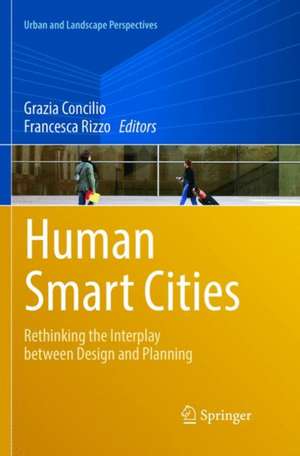
Human Smart Cities: Urban and Landscape Perspectives
Editat de Grazia Concilio, Francesca Rizzoen Limba Engleză Paperback – 31 mai 2018
Editorii Grazia Concilio și Francesca Rizzo, profesori și cercetători recunoscuți în domeniul urbanismului, propun prin Human Smart Cities o reevaluare a conceptului de oraș inteligent, punând accentul pe factorul uman și pe procesele de co-creare. Găsim în această primă ediție publicată de Springer o analiză riguroasă a modului în care designul și planificarea pot colabora pentru a gestiona incertitudinea inerentă transformărilor urbane contemporane. Observăm că autoritatea editorilor este consolidată de experiența lor în proiecte europene de anvergură, abordarea fiind una care depășește simpla implementare tehnologică.
Această lucrare reprezintă o alternativă necesară la Smart Design de Richard Hu pentru cursurile de geografie umană și planificare teritorială, având avantajul de a se concentra pe „Urban Living Labs” și pe mecanismele de guvernanță colaborativă, mai degrabă decât pe dualitățile spațiale tehnologice. În contextul operei editorilor, Human Smart Cities se situează ca un pilon central între Making Strategies in Spatial Planning, care chestiona metodele tradiționale de planificare, și lucrările lor ulterioare, precum The Data Shake, care explorează politici bazate pe date.
Structura volumului urmărește o progresie logică: începe cu necesitatea unor viziuni durabile (Partea I), trece prin complexitatea proceselor de design participativ (Partea II) și inovarea modelelor economice (Partea III), culminând cu experiențe practice în Partea IV. Merită menționat capitolul dedicat grădinilor comunitare din Milano, care demonstrează cum spațiile urbane pot deveni locuri de învățare socială. Textul evită abstractizarea excesivă, oferind instrumente concrete pentru înțelegerea inteligenței civice într-un cadru cultural specific.
Din seria Urban and Landscape Perspectives
- 18%
 Preț: 985.58 lei
 - 15%
 Preț: 670.14 lei
 -
 Preț: 446.91 lei
 - 18%
 Preț: 911.05 lei
 - 15%
 Preț: 617.26 lei
 - 45%
 Preț: 556.39 lei
 - 15%
 Preț: 666.56 lei
 - 15%
 Preț: 665.89 lei
 - 34%
 Preț: 855.61 lei
 - 18%
 Preț: 987.61 lei
 - 15%
 Preț: 672.92 lei
 - 15%
 Preț: 663.03 lei
 - 18%
 Preț: 997.36 lei
 - 15%
 Preț: 615.66 lei
 - 24%
 Preț: 756.84 lei
 - 18%
 Preț: 936.84 lei
 - 18%
 Preț: 978.51 lei
 - 15%
 Preț: 670.93 lei
 - 15%
 Preț: 641.32 lei
 - 18%
 Preț: 953.08 lei
 - 18%
 Preț: 952.86 lei
 - 44%
 Preț: 821.76 lei
 - 18%
 Preț: 956.53 lei
Preț: 634.65 lei
Preț vechi: 835.06 lei
-24%
Carte tipărită la comandă
Livrare economică 02-08 decembrie
Specificații
ISBN-10: 3319814257
Pagini: 276
Ilustrații: XVI, 255 p. 17 illus., 6 illus. in color.
Dimensiuni: 155 x 235 x 15 mm
Greutate: 0.47 kg
Ediția:Softcover reprint of the original 1st edition 2016
Editura: Springer
Colecția Urban and Landscape Perspectives
Seria Urban and Landscape Perspectives
Locul publicării:Cham, Switzerland
V-ar putea interesa
-
 Happy CityCharles MontgomeryPreț: 118.31 lei
 -
 -18%Preț: 962.26 lei1173.49 lei
 -
 China and Orientalism: Western Knowledge Production and the PRCDaniel Vukovich-18%Preț: 1252.01 lei1526.85 lei
 -
 Governing the Fragmented MetropolisChristina D Rosan-11%Preț: 487.66 lei547.93 lei
 -
 Roots for Radicals: Organizing for Power, Action, and JusticeEdward T. Chambers-38%Preț: 242.51 lei388.62 lei
 -
 -15%Preț: 477.28 lei561.50 lei
 -
 Insuring Life: Value, Security and RiskLuis Lobo-GuerreroPreț: 472.05 lei
 -
 Environmental Decision-Making in Context: A ToolboxChad J. McGuire-15%Preț: 619.26 lei728.54 lei
 -
 Preț: 163.84 lei
 -
 AbulecentrismOlurinde LafePreț: 401.98 lei
 -
 Urbanisation, unlimitedJohannes Fiedler-15%Preț: 663.68 lei780.80 lei
 -
 Preț: 467.63 lei
 -
 Complexity, Cognition and the CityJuval Portugali-15%Preț: 645.45 lei759.36 lei
 -
 Preț: 461.53 lei
 -
 Making Strategies in Spatial PlanningMaria Cerreta-18%Preț: 956.53 lei1166.50 lei
De ce să citești această carte
Această carte este esențială pentru urbaniști, decidenți politici și studenți la geografie care doresc să înțeleagă dincolo de mitul tehnologic al orașelor inteligente. Cititorul câștigă o perspectivă aplicată asupra modului în care cetățenii pot deveni co-autori ai serviciilor publice prin Urban Living Labs. Este un ghid teoretic și practic pentru transformarea orașelor în medii reziliente, bazate pe colaborare și incluziune socială.
Despre autor
Grazia Concilio și Francesca Rizzo sunt cadre didactice și cercetători de prestigiu, activitatea lor fiind strâns legată de Politecnico di Milano. Expertiza lor acoperă planificarea spațială, designul de servicii și inovația guvernată de utilizatori. Au coordonat și contribuit la numeroase proiecte de cercetare finanțate de Comisia Europeană, precum PoliVisu și DESIGNSCAPES, concentrându-se pe utilizarea datelor masive și a designului pentru a îmbunătăți politicile publice. Lucrările lor colective, publicate frecvent în seria Urban and Landscape Perspectives, sunt puncte de referință în literatura de specialitate privind guvernanța urbană și designul participativ.
Descriere scurtă
Urban transformation is widely recognized as a complex phenomenon, rich in uncertainty. It is the unpredictable consequence of complex interplay between urban forces (both top-down or bottom-up), urban resources (spatial, social, economic and infrastructural as well as political or cognitive) and transformation opportunities (endogenous or exogenous).
The recent attention to Urban Living Lab and Smart City initiatives is disclosing