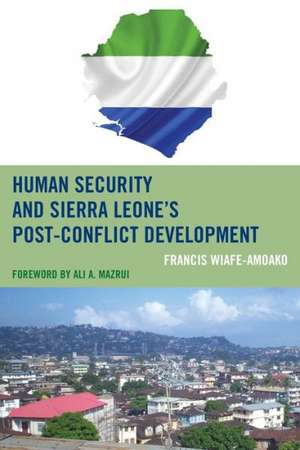
Human Security and Sierra Leone's Post-Conflict Development
Autor Francis Wiafe-Amoakoen Limba Engleză Hardback – 22 iul 2014
| Toate formatele și edițiile | Preț | Express |
|---|---|---|
| Paperback (1) | 304.30 lei 6-8 săpt. | |
| Bloomsbury Publishing – 15 apr 2016 | 304.30 lei 6-8 săpt. | |
| Hardback (1) | 630.88 lei 6-8 săpt. | |
| Bloomsbury Publishing – 22 iul 2014 | 630.88 lei 6-8 săpt. |
Preț: 630.88 lei
Preț vechi: 778.86 lei
-19%
Puncte Express: 946
Preț estimativ în valută:
111.55€ • 129.43$ • 96.53£
111.55€ • 129.43$ • 96.53£
Carte tipărită la comandă
Livrare economică 08-22 mai
Specificații
ISBN-13: 9780739191330
ISBN-10: 0739191330
Pagini: 158
Ilustrații: 5 graphs
Dimensiuni: 157 x 235 x 13 mm
Greutate: 0.38 kg
Editura: Bloomsbury Publishing
ISBN-10: 0739191330
Pagini: 158
Ilustrații: 5 graphs
Dimensiuni: 157 x 235 x 13 mm
Greutate: 0.38 kg
Editura: Bloomsbury Publishing
V-ar putea interesa
-
 Emerging AfricaKingsley Chiedu Moghalu-19%Preț: 62.29 lei76.63 lei
 -
 International Development: Ideas, Experience, and ProspectsBruce Currie-Alder-20%Preț: 409.35 lei513.20 lei
 -
 -18%Preț: 1199.58 lei1462.90 lei
 -
 Understanding Peace: A Comprehensive IntroductionMichael Allen FoxPreț: 455.13 lei
 -
 Planning and Development in Education: African PerspectivesJ. C. S. MusaaziPreț: 449.69 lei
 -
 Preț: 276.70 lei
 -
 Bangladesh: Politics, Economy and Civil SocietyDavid LewisPreț: 232.07 lei
 -
 Understanding Conflict and Conflict AnalysisHo-Won Jeong-15%Preț: 533.13 lei627.22 lei
 -
 -17%Preț: 165.67 lei200.00 lei
 -
 -22%Preț: 130.84 lei167.29 lei
 -
 -23%Preț: 204.76 lei265.62 lei
 -
 -21%Preț: 163.25 lei207.24 lei
 -
 -11%Preț: 133.27 lei150.13 lei
 -
 -6%Preț: 110.09 lei116.74 lei
 -
 -22%Preț: 148.60 lei189.63 lei
 -
 A New Blueprint for a Green EconomyEdward B. BarbierPreț: 385.68 lei
 -
 Spaces of Conflict in Everyday LifeMartin Sökefeld-23%Preț: 221.20 lei287.65 lei
 -
 Innovation in Seed Potato Systems in Eastern AfricaPeter Gildemacher-12%Preț: 176.89 lei201.65 lei
Descriere
Managing post-conflict progress has been an elusive task for policymakers and other stakeholders. This book discusses domestic peace, security, and development in Sierra Leone, and argues for human security as the basis for building a sustainable post-conflict environment.
Cuprins
Foreword by Ali A. Mazrui
Preface
Chapter 1: Introduction
Chapter 2: Human Security and the Conflict Puzzle
Chapter 3: Political and Civil Reforms
Chapter 4: Economic Reforms
Chapter 5: Personal Security Reforms
Chapter 6: Human Security and Sierra Leone's Post-Conflict Reforms
Preface
Chapter 1: Introduction
Chapter 2: Human Security and the Conflict Puzzle
Chapter 3: Political and Civil Reforms
Chapter 4: Economic Reforms
Chapter 5: Personal Security Reforms
Chapter 6: Human Security and Sierra Leone's Post-Conflict Reforms
Recenzii
This compact book focuses on 'human security' as defined in the 1994 UN Development Program report. Wiafe-Amoako concentrates on four of its seven elements, combining them with detailed analysis of post-2002 Sierra Leone legal, economic, and security changes. The country was ripped by civil war during the 1990s, the result of spillover from conflict in neighboring Liberia, blatant ethnic favoritism by Sierra Leone's rulers, inequitable exploitation of the country's mineral resources, and the like. More than two million people were displaced. Reestablishing basic security and restarting development proved difficult in the face of multiple challenges. This book is organized into six chapters. The author first puts human security into the 'conflict puzzle.' He then concentrates on political and civil reforms, economic reforms, and personal security reforms. The concluding chapter looks broadly at human security in light of post-conflict policy changes. Wiafe-Amoako interviewed approximately 100 government officials, primarily in the capital and provinces affected by the civil war, in addition to examining statutory changes. . . .Overall, a good summary of recent changes. Summing Up: Recommended. Upper-division undergraduate and graduate collections.
Human Security and Sierra Leone's Post-Conflict Development is an empirically grounded and theoretically sophisticated analysis of the political predicament of an African state, Sierra Leone. Although the book is primarily about Sierra Leone, the analyses in it also heavily draw upon the experiences of other post-colonial African states. Dr. Wiafe-Amoako sees ensuring 'human security' as the key for overcoming the challenges faced in Africa by fragile states as well as by those in the post-conflict phase. A new paradigm of thought in our quest for solutions to an old problem, this is a timely book and a must-read for policy-makers and Africanists alike.
In its country profile, the British Broadcasting Corporation noted that Sierra Leone 'emerged from a decade of civil war' which did not only cause the death of thousands of its people, but also a war which was marked with a 'lasting feature . of atrocities committed by rebels, whose trademark was to hack off the hands or the feet of its victims.' It is in this regard that I view Francis Wiafe-Amoako's Human Security and Sierra Leone's Post-Conflict Development as one of a kind. Even though there are many books and articles which have dealt with post-conflict reconstruction in Africa, none of them has so particularly focused on human security. Of all of a conflict-ridden country's resources, human resources are the key victim. This is because conflict does not only cause death and incapacitation of people, it also devastates the trust environment, the key mechanism of social capital. This is often to a point where even when open hostility is declared to be over, a sense of fear and insecurity continues to loom over the area concerned, making it difficult for survivors to return home to resume normal life. I thus recommend Human Security and Sierra Leone's Post-Conflict Development to government officials and their development partners as well as college and graduate instructors and students with an interest in Sierra Leone in particular and Africa in general.
Human Security and Sierra Leone's Post-Conflict Development is an empirically grounded and theoretically sophisticated analysis of the political predicament of an African state, Sierra Leone. Although the book is primarily about Sierra Leone, the analyses in it also heavily draw upon the experiences of other post-colonial African states. Dr. Wiafe-Amoako sees ensuring 'human security' as the key for overcoming the challenges faced in Africa by fragile states as well as by those in the post-conflict phase. A new paradigm of thought in our quest for solutions to an old problem, this is a timely book and a must-read for policy-makers and Africanists alike.
In its country profile, the British Broadcasting Corporation noted that Sierra Leone 'emerged from a decade of civil war' which did not only cause the death of thousands of its people, but also a war which was marked with a 'lasting feature . of atrocities committed by rebels, whose trademark was to hack off the hands or the feet of its victims.' It is in this regard that I view Francis Wiafe-Amoako's Human Security and Sierra Leone's Post-Conflict Development as one of a kind. Even though there are many books and articles which have dealt with post-conflict reconstruction in Africa, none of them has so particularly focused on human security. Of all of a conflict-ridden country's resources, human resources are the key victim. This is because conflict does not only cause death and incapacitation of people, it also devastates the trust environment, the key mechanism of social capital. This is often to a point where even when open hostility is declared to be over, a sense of fear and insecurity continues to loom over the area concerned, making it difficult for survivors to return home to resume normal life. I thus recommend Human Security and Sierra Leone's Post-Conflict Development to government officials and their development partners as well as college and graduate instructors and students with an interest in Sierra Leone in particular and Africa in general.