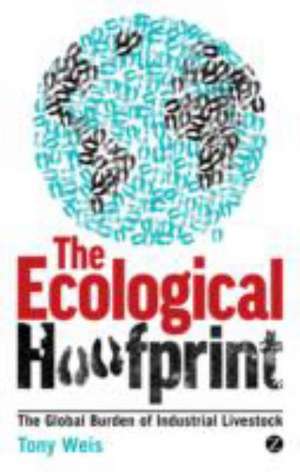
The Ecological Hoofprint: The Global Burden of Industrial Livestock
Autor Tony Weisen Limba Engleză Paperback – 14 noi 2013
Following his previous ground-breaking book The Global Food Economy, Tony Weis explains clearly why the growth and industrialization of livestock production is a central part of the accelerating biophysical contradictions of industrial capitalist agriculture.
The Ecological Hoofprint provides a rigorous and eye-opening way of understanding what this system means for the health of the planet, how it contributes to worsening human inequality, and how it constitutes a profound but invisible aspect of the violence of everyday life.
Preț: 139.76 lei
Preț vechi: 175.55 lei
-20%
Puncte Express: 210
Carte tipărită la comandă
Livrare economică 04-18 decembrie
Livrare prin curier în România Termenul estimat este afișat lângă disponibilitate.
Transport gratuit de la 400.00 lei Plată online sau ramburs, în funcție de opțiunile comenzii.
Retur gratuit în 14 zile Comandă securizată și suport în română.
Specificații
ISBN-13: 9781780320960
ISBN-10: 1780320965
Pagini: 202
Ilustrații: figures
Dimensiuni: 138 x 214 x 14 mm
Greutate: 0.27 kg
Editura: Bloomsbury Publishing
Colecția Zed Books
Locul publicării:London, United Kingdom
ISBN-10: 1780320965
Pagini: 202
Ilustrații: figures
Dimensiuni: 138 x 214 x 14 mm
Greutate: 0.27 kg
Editura: Bloomsbury Publishing
Colecția Zed Books
Locul publicării:London, United Kingdom
V-ar putea interesa
-
 Billion Dollar BurgerChase Purdy-27%Preț: 52.25 lei71.18 lei
 -
 Preț: 191.66 lei
 -
 The Omnivore's DilemmaMichael PollanPreț: 73.29 lei
 -
 Just Earth: How a Fairer World Will Save the PlanetTony Juniper-25%Preț: 92.78 lei123.79 lei
 -
 Farmageddon: The True Cost of Cheap MeatPhilip Lymbery-34%Preț: 71.91 lei108.70 lei
 -
 -26%Preț: 68.68 lei92.66 lei
 -
 -22%Preț: 75.98 lei97.66 lei
 -
 Food 3eJennifer ClappPreț: 157.31 lei
 -
 Capitalism at the LimitUlrich BrandPreț: 159.60 lei
 -
 A Foodie's Guide to CapitalismEric Holt-GiménezPreț: 145.72 lei
 -
 -18%Preț: 111.99 lei137.10 lei
 -
 -24%Preț: 156.38 lei206.16 lei
 -
 Grass-Fed Beef for a Post-Pandemic WorldRidge Shinn-20%Preț: 113.94 lei142.06 lei
 -
 Clearing the AirHannah RitchiePreț: 121.89 lei
 -
 The Future of AgricultureSarah BearchellPreț: 71.26 lei
 -
 The Age of ExtractionTim WuPreț: 107.73 lei
 -
 Nature, Culture, and InequalityThomas PikettyPreț: 93.66 lei
 -
 -17%Preț: 121.49 lei146.13 leiRecomandat
Cuprins
Introduction: meatification and why it matters
1. Contextualizing the hoofprint: global environmental change and inequality
2. The uneven geography of meat
3. The industrial grain-oilseed-livestock complex
4. Confronting the ecological hoofprint: towards a more sustainable, just, and humane world
1. Contextualizing the hoofprint: global environmental change and inequality
2. The uneven geography of meat
3. The industrial grain-oilseed-livestock complex
4. Confronting the ecological hoofprint: towards a more sustainable, just, and humane world
Recenzii
Weis delivers a penetrating and systematic structural analysis of the global industrial feeds-livestock complex that reveals the extent to which Earth's resources are subsumed to the logic of cheap meat production. Insightful, accessible, compelling, this is a must read for scholars and students of the food system.
With Tony Weis's powerful insights, we see that humanity's sudden, catastrophic shift to meat-centric farming and eating - killing us and our planet - is neither inevitable nor progress. We learn we have real choice. Packed with startling facts and framed in a compelling narrative, The Ecological Hoofprint is a mighty motivator. Bravo!
A must read if you want to understand the scale, inefficiency, and wide-ranging impact of the rapid meatification of diets since the mid-twentieth century. The number of slaughtered animals, the author notes, has rocketed from 8 billion to 64 billion in fifty years. The dynamic driving this ecologically damaging change, rightly argues Tony Weis, is an industrial grain-oilseed-livestock complex driven by the demands of capitalism to seek new means of increasing returns, which involves totally reorganizing nature.
Weis provides an intellectually compelling argument against the industrial farming of livestock. While recognizing that increasing meat consumption is often viewed favorably - as evidence of the globalization of the Western diet - he carefully details the costs for human health, the environment, and the industrially reared animals. Weis calls for an urgent reappraisal of factory farming as a first step in reducing the ecological hoofprint on planet meat. It's a great book!
In The Ecological Hoofprint Weis puts meat at the centre of global problems like climate change, poverty, workers' rights, and speciesism. Anyone seeking a just and sustainable world needs to consider his compelling argument that radical change must start by combating the meatification of the human diet.
With the metaphor of the ecological hoofprint Tony Weis sounds a clear warning about the perils of the rising global consumption of meat. The powerful message of this book is that ascending the animal protein ladder is a formula for deepening social inequalities and compounding ecological risk. With compelling detail the author demonstrates that meatification is an inefficient and potentially catastrophic use of planetary resources. This didactic book provides an unforgettable perspective on the illusion of identifying animal protein consumption with modern progress.
Tony Weis has a mind that spans a multitude of disciplines, from philosophy to international political economy, from ecology to biology. In The Ecological Hoofprint, he brings these considerable skills to craft a concise, readable, and important reading of today's meatified world. It's an analysis that couldn't be more timely nor more urgent.
With Tony Weis's powerful insights, we see that humanity's sudden, catastrophic shift to meat-centric farming and eating - killing us and our planet - is neither inevitable nor progress. We learn we have real choice. Packed with startling facts and framed in a compelling narrative, The Ecological Hoofprint is a mighty motivator. Bravo!
A must read if you want to understand the scale, inefficiency, and wide-ranging impact of the rapid meatification of diets since the mid-twentieth century. The number of slaughtered animals, the author notes, has rocketed from 8 billion to 64 billion in fifty years. The dynamic driving this ecologically damaging change, rightly argues Tony Weis, is an industrial grain-oilseed-livestock complex driven by the demands of capitalism to seek new means of increasing returns, which involves totally reorganizing nature.
Weis provides an intellectually compelling argument against the industrial farming of livestock. While recognizing that increasing meat consumption is often viewed favorably - as evidence of the globalization of the Western diet - he carefully details the costs for human health, the environment, and the industrially reared animals. Weis calls for an urgent reappraisal of factory farming as a first step in reducing the ecological hoofprint on planet meat. It's a great book!
In The Ecological Hoofprint Weis puts meat at the centre of global problems like climate change, poverty, workers' rights, and speciesism. Anyone seeking a just and sustainable world needs to consider his compelling argument that radical change must start by combating the meatification of the human diet.
With the metaphor of the ecological hoofprint Tony Weis sounds a clear warning about the perils of the rising global consumption of meat. The powerful message of this book is that ascending the animal protein ladder is a formula for deepening social inequalities and compounding ecological risk. With compelling detail the author demonstrates that meatification is an inefficient and potentially catastrophic use of planetary resources. This didactic book provides an unforgettable perspective on the illusion of identifying animal protein consumption with modern progress.
Tony Weis has a mind that spans a multitude of disciplines, from philosophy to international political economy, from ecology to biology. In The Ecological Hoofprint, he brings these considerable skills to craft a concise, readable, and important reading of today's meatified world. It's an analysis that couldn't be more timely nor more urgent.
Notă biografică
Tony Weis (Ph.D., Queen's University) is Assistant Professor of Geography, University of Western Ontario, Canada. His research is principally interested in examining how global agrarian change is interacting with the spatial marginality of small farmers, related social and environmental problems, and struggles for land reform. He has published in various journals, including the Journal of Peasant Studies, Capital and Class, the Journal of Agrarian Change, Capital, Nature, Socialism, and Global Environmental Change.