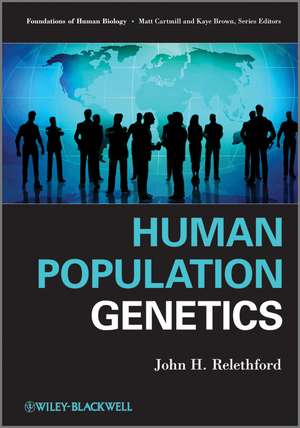
Human Population Genetics
Autor John H. Relethforden Limba Engleză Paperback – 15 mar 2012
Preț: 535.99 lei
Preț vechi: 696.08 lei
-23%
Puncte Express: 804
Carte tipărită la comandă
Livrare economică 26 noiembrie-10 decembrie
Livrare prin curier în România Termenul estimat este afișat lângă disponibilitate.
Transport gratuit pentru acest produs Plată online sau ramburs, în funcție de opțiunile comenzii.
Retur gratuit în 14 zile Comandă securizată și suport în română.
Specificații
ISBN-13: 9780470464670
ISBN-10: 0470464674
Pagini: 310
Dimensiuni: 178 x 254 x 17 mm
Greutate: 0.59 kg
Editura: Wiley
Locul publicării:Hoboken, United States
ISBN-10: 0470464674
Pagini: 310
Dimensiuni: 178 x 254 x 17 mm
Greutate: 0.59 kg
Editura: Wiley
Locul publicării:Hoboken, United States
V-ar putea interesa
-
 Material Culture and Mass ConsumptionDaniel MillerPreț: 398.32 lei
 -
 Preț: 437.45 lei
 -
 Reflections of Our Past: How Human History Is Revealed in Our GenesJohn H. RelethfordPreț: 372.87 lei
 -
 Concise Reader in Sociological TheoryMichele DillonPreț: 344.28 lei
 -
 The Magic in the Christmas Bubble Teens Against Bullying Age 5-25Michelle Elaine FaulknerPreț: 187.50 lei
 -
 Preț: 48.43 lei
 -
 Peppy's StoryLeah Shopland TaylorPreț: 223.09 lei
 -
 Preț: 317.44 lei
 -
 Cat Burglars and CarouselsJanice HallmarkPreț: 58.77 lei
 -
 Preț: 56.93 lei
 -
 Who Are You?: DonnaDonna RobbinsPreț: 130.94 lei
 -
 Terminologia de RelacionAnthony L JohnsonPreț: 207.78 lei
 -
 That Foster ThingJerri Foster SchmidtPreț: 81.63 lei
 -
 Desire to ChangePatricia KeithPreț: 63.83 lei
 -
 Imperfect FamilyLeyland A. KingPreț: 138.18 lei
 -
 How to Prevent Food PoisoningElizabeth ScottPreț: 97.06 lei
 -
 The Family Guide to Preventing and Treating 100 Infectious IllnessesPhyllis StoffmanPreț: 182.41 lei
 -
 Eating Right from 8 to 18Sandra K. NissenbergPreț: 167.03 lei
 -
 Thin for GoodFred PescatorePreț: 198.00 lei
 -
 Real World, Real ChallengesSarah Sifers-19%Preț: 711.37 lei878.23 lei
 -
 The Relationship TrajectoryJacob Jantzer-19%Preț: 539.43 lei665.96 lei
 -
 Critical Kinship StudiesCharlotte Kroløkke-23%Preț: 355.11 lei463.48 lei
 -
 Der Bosporus-KurierMarc WeiherhofPreț: 144.81 lei
Public țintă
Advanced Undergraduate and Graduate Students interesting in the mechanisms of human microevolution.Notă biografică
Dr. John H. Relethford (Distinguished Teaching Professor) is a biological anthropologist who received his Ph.D. in anthropology in 1980 from the State University of New York at Albany. Dr. Relethford's major interests are in the fields of anthropological genetics, human variation, and modern human origins. Much of his research has focused on the reconstruction of history from patterns of modern biological variation. His past work has also included studies of migration, quantitative genetics, child growth, epidemiology, and aging. His current work focuses on two topics, the evolutionary history of Irish populations and the origin of modern humans.
Cuprins
Foreword vii
Preface ix
1 Genetic, Mathematical, and Anthropological Background 1
I. The Scope of Population Genetics 2
II. Genetics Background 5
III. Principles of Probability 14
IV. The Anthropological Connection 17
V. A Closing Thought 21
2 Hardy-Weinberg Equilibrium 23
I. Genotype and Allele Frequencies 24
II. What is Hardy-Weinberg Equilibrium? 30
III. The Mathematics of Hardy-Weinberg Equilibrium 31
IV. Using Hardy-Weinberg Equilibrium 37
V. Extensions of Hardy-Weinberg Equilibrium 40
VI. Hardy-Weinberg Equilibrium and Evolution 44
VII. Summary 45
3 Inbreeding 49
I. Quantifying Inbreeding 51
II. Population Genetics and Inbreeding 62
III. Inbreeding in Human Populations 65
IV. Summary 75
4 Mutation 77
I. The Nature of Mutations 77
II. Models of Mutation 81
III. Mutational History and Anthropological Questions 88
IV. Summary 96
5 Genetic Drift 101
I. What is Genetic Drift? 102
II. Genetic Drift and Population Size 112
III. Effects on Genetic Variation 120
IV. Mutation and Genetic Drift 121
V. Coalescent Theory 125
VI. Summary 131
6 Models of Natural Selection 139
I. How Does Natural Selection Work? 140
II. A General Model of Natural Selection 145
III. Types of Natural Selection 147
IV. Other Aspects of Selection 160
V. Summary 167
7 Natural Selection in Human Populations 181
I. Case Studies of Natural Selection in Human Populations 182
II. Are Humans Still EvolVIng? 198
III. Summary 203
8 Gene Flow 205
I. The Evolutionary Impact of Gene Flow 206
II. Models of Gene Flow 208
III. Gene Flow and Genetic Drift 213
IV. Estimating Admixture in Human Populations 226
V. Summary 230
9 Human Population Structure and History 237
I. Case Studies of Human Population Structure 238
II. The Origin of Modern Humans 242
III. Case Studies of Population Origins 247
IV. Summary 255
Glossary 257
References 267
Index 279
Preface ix
1 Genetic, Mathematical, and Anthropological Background 1
I. The Scope of Population Genetics 2
II. Genetics Background 5
III. Principles of Probability 14
IV. The Anthropological Connection 17
V. A Closing Thought 21
2 Hardy-Weinberg Equilibrium 23
I. Genotype and Allele Frequencies 24
II. What is Hardy-Weinberg Equilibrium? 30
III. The Mathematics of Hardy-Weinberg Equilibrium 31
IV. Using Hardy-Weinberg Equilibrium 37
V. Extensions of Hardy-Weinberg Equilibrium 40
VI. Hardy-Weinberg Equilibrium and Evolution 44
VII. Summary 45
3 Inbreeding 49
I. Quantifying Inbreeding 51
II. Population Genetics and Inbreeding 62
III. Inbreeding in Human Populations 65
IV. Summary 75
4 Mutation 77
I. The Nature of Mutations 77
II. Models of Mutation 81
III. Mutational History and Anthropological Questions 88
IV. Summary 96
5 Genetic Drift 101
I. What is Genetic Drift? 102
II. Genetic Drift and Population Size 112
III. Effects on Genetic Variation 120
IV. Mutation and Genetic Drift 121
V. Coalescent Theory 125
VI. Summary 131
6 Models of Natural Selection 139
I. How Does Natural Selection Work? 140
II. A General Model of Natural Selection 145
III. Types of Natural Selection 147
IV. Other Aspects of Selection 160
V. Summary 167
7 Natural Selection in Human Populations 181
I. Case Studies of Natural Selection in Human Populations 182
II. Are Humans Still EvolVIng? 198
III. Summary 203
8 Gene Flow 205
I. The Evolutionary Impact of Gene Flow 206
II. Models of Gene Flow 208
III. Gene Flow and Genetic Drift 213
IV. Estimating Admixture in Human Populations 226
V. Summary 230
9 Human Population Structure and History 237
I. Case Studies of Human Population Structure 238
II. The Origin of Modern Humans 242
III. Case Studies of Population Origins 247
IV. Summary 255
Glossary 257
References 267
Index 279