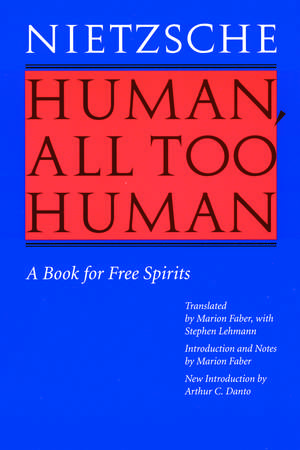
Human, All Too Human: A Book for Free Spirits (Revised Edition)
Autor Friedrich Nietzsche Traducere de Marion Faber, Stephen Lehmann Introducere de Arthur C. Dantoen Limba Engleză Paperback – dec 1996
This English translation—the first since 1909—restores Human, All Too Human to its proper central position in the Nietzsche canon. First published in 1878, the book marks the philosophical coming of age of Friedrich Nietzsche. In it he rejects the romanticism of his early work, influenced by Wagner and Schopenhauer, and looks to enlightened reason and science. The "Free Spirit" enters, untrammeled by all accepted conventions, a precursor of Zarathustra. The result is 638 stunning aphorisms about everything under and above the sun.
| Toate formatele și edițiile | Preț | Express |
|---|---|---|
| Paperback (8) | 48.22 lei 3-5 săpt. | |
| – | 48.22 lei 3-5 săpt. | |
| – | 57.53 lei 3-5 săpt. | |
| Penguin Books – 28 sep 1994 | 75.62 lei 3-5 săpt. | +10.89 lei 7-13 zile |
| BISON BOOKS – dec 1996 | 114.70 lei 3-5 săpt. | |
| – | 49.64 lei 6-8 săpt. | |
| Lector House – 24 iun 2019 | 62.26 lei 6-8 săpt. | |
| Bibliotech Press – 22 feb 2020 | 89.19 lei 6-8 săpt. | |
| The Big Nest – 17 iul 2018 | 127.39 lei 6-8 săpt. |
Preț: 114.70 lei
Nou
Puncte Express: 172
Preț estimativ în valută:
20.30€ • 23.80$ • 17.82£
20.30€ • 23.80$ • 17.82£
Carte disponibilă
Livrare economică 17-31 ianuarie 26
Preluare comenzi: 021 569.72.76
Specificații
ISBN-13: 9780803283688
ISBN-10: 0803283687
Pagini: 275
Dimensiuni: 140 x 216 x 15 mm
Greutate: 0.34 kg
Ediția:Revised
Editura: BISON BOOKS
Colecția Bison Books
Locul publicării:United States
ISBN-10: 0803283687
Pagini: 275
Dimensiuni: 140 x 216 x 15 mm
Greutate: 0.34 kg
Ediția:Revised
Editura: BISON BOOKS
Colecția Bison Books
Locul publicării:United States
V-ar putea interesa
-
 Beyond Good and Evil: Prelude to a Philosophy of the FutureFriedrich Nietzsche-21%Preț: 58.85 lei74.69 lei
 -
 -31%Preț: 355.84 lei515.30 lei
 -
 -41%Preț: 2162.07 lei3681.48 lei
 -
 John Dewey: Critical AssessmentsJim Tiles-39%Preț: 5510.84 lei8991.34 lei
 -
 Wittgenstein Reads WeiningerDavid G. Stern-11%Preț: 563.87 lei633.57 lei
 -
 Searle and Foucault on TruthC. G. Prado-11%Preț: 527.58 lei592.80 lei
 -
 After BothamAllisa Charles-FindleyPreț: 113.90 lei
 -
 The Historical PivotWilliam Andrew BehunPreț: 188.52 lei
 -
 Beyond the SecularAndrea Cassatella-19%Preț: 566.22 lei699.03 lei
 -
 Critiques of TheologyYotam Hotam-19%Preț: 563.10 lei695.19 lei
 -
 Fragility and TranscendenceJeffrey Bloechl-15%Preț: 535.16 lei629.60 lei
 -
 Dialogue and AntithesisYong Joon ChoiPreț: 272.72 lei
 -
 Hegel, Marx, NietzscheHenri LefebvrePreț: 158.06 lei
 -
 Der rote FadenOliver PrechtPreț: 186.56 lei
 -
 Posthuman?Torsten CressPreț: 380.16 lei
 -
 -11%Preț: 608.77 lei684.00 lei
 -
 -15%Preț: 610.96 lei718.77 lei
Notă biografică
Introducing this New Bison Books edition is Arthur C. Danto, Johnsonian Professor Emeritus of Philosophy at Columbia University and the author of many books, including Nietzsche as Philosopher.
Descriere
Descriere de la o altă ediție sau format:
A series of 638 aphorisms and discourses on subjects ranging from art, arrogance and boredom to passion, science, vanity, women and youth. Nietzsche himself described this work as "the monument of a crisis", since it was written at a time of major upheaval in his life.
A series of 638 aphorisms and discourses on subjects ranging from art, arrogance and boredom to passion, science, vanity, women and youth. Nietzsche himself described this work as "the monument of a crisis", since it was written at a time of major upheaval in his life.