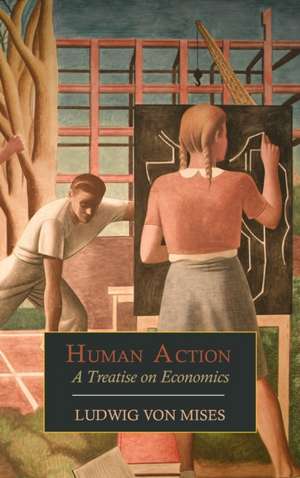
Human Action
Autor Ludwig Von Misesen Limba Engleză Hardback – 8 oct 2021
Structurată ca un tratat monumental în patru volume, această lucrare propune un parcurs riguros de la fundamentele acțiunii individuale până la cele mai complexe mecanisme ale pieței globale. Notăm cu interes că HUMAN ACTION nu este doar un text de economie politică, ci o expunere a praxeologiei — știința acțiunii umane. Reținem că, pentru Ludwig Von Mises, fenomenele economice precum prețurile, cererea și oferta nu sunt cifre abstracte, ci rezultate directe ale alegerilor conștiente făcute de indivizi care urmăresc scopuri specifice în condiții de incertitudine. Ca și Jesús Huerta De Soto în Lectures in Austrian Economics, Volume I, autorul distilează experiență reală în principii acționabile, demonstrând că piața este un proces dinamic susținut de antreprenoriat și judecăți de valoare subiective. În contextul operei sale, această carte reprezintă punctul culminant al gândirii miseiene; dacă în The Theory of Money and Credit s-a concentrat pe protecția libertăților civile prin monedă solidă, iar în LIBERALISM a definit proprietatea privată ca pilon social, HUMAN ACTION sintetizează aceste teme într-o teorie universală. Găsim aici o critică autoritară a intervenționismului statal, Mises demonstrând de ce încercările de a egala forțat circumstanțele umane sunt contraproductive pentru civilizație. Stilul este dens, academic și intransigent, fiind o lectură esențială pentru înțelegerea rădăcinilor libertății economice moderne.
Preț: 518.84 lei
Carte tipărită la comandă
Livrare economică 02-08 decembrie
Specificații
ISBN-10: 1684226066
Pagini: 908
Dimensiuni: 161 x 240 x 57 mm
Greutate: 1.63 kg
Editura: Martino Fine Books
V-ar putea interesa
-
 Capitalism, Socialism, and DemocracyJoseph A. SchumpeterPreț: 115.46 lei
 -
 AntifragileNassim Nicholas Taleb-27%Preț: 79.51 lei108.96 lei
 -
 Radical Enlightenment: Philosophy and the Making of Modernity 1650-1750Jonathan I. Israel-19%Preț: 439.17 lei543.19 lei
 -
 Reflections on the Revolution in FranceEdmund Burke-17%Preț: 60.21 lei72.56 lei
 -
 -19%Preț: 542.36 lei665.81 lei
 -
 -10%Preț: 241.64 lei267.61 lei
 -
 Ideas Have Consequences: Expanded EditionRichard M. WeaverPreț: 174.94 lei
 -
 Natural Right and HistoryLeo StraussPreț: 147.89 lei
 -
 The Power of Now: (20th Anniversary Edition)Eckhart TollePreț: 106.49 lei
 -
 -18%Preț: 134.35 lei164.10 lei
 -
 The RepublicPlatoPreț: 47.83 lei
 -
 The Genealogy of MoralsFriedrich Nietzsche-19%Preț: 34.51 lei42.76 lei
 -
 The Federalist PapersAlexander HamiltonPreț: 54.36 lei
 -
 Preț: 106.40 lei
 -
 The Death of MoneyJames Rickards-30%Preț: 65.26 lei93.53 lei
 -
 A Monetary History of the United States, 1867-1960Milton Friedman-14%Preț: 462.34 lei537.61 lei
 -
 Theory & History: An Interpretation of Social & Economic EvolutionLudwig von Mises-13%Preț: 81.74 lei94.16 lei
 -
 Liberalism: The Classical TraditionLudwig von Mises-15%Preț: 78.84 lei92.45 lei
 -
 SocialismLudwig Von Mises-7%Preț: 93.37 lei100.72 lei
 -
 Preț: 123.09 lei
 -
 The Conservative Mind, from Burke to SantayanaRussell KirkPreț: 137.13 lei
 -
 After VirtueProfessor Alasdair MacIntyre-13%Preț: 171.37 lei197.15 lei
 -
 Decline and Fall of the Roman Empire: Vols 1-3Edward Gibbon-16%Preț: 402.74 lei479.43 lei
 -
 -15%Preț: 410.18 lei482.49 lei
 -
 Sigmund Freud - Gesammelte WerkeSigmund FreudPreț: 155.97 lei
De ce să citești această carte
Această carte este destinată cercetătorilor și profesioniștilor care doresc să înțeleagă economia dincolo de modelele matematice rigide. Cititorul va câștiga o perspectivă profundă asupra modului în care libertatea individuală generează cooperare socială și prosperitate. Este argumentul definitiv pentru piața liberă, oferind instrumente logice imbatabile împotriva planificării centralizate.
Despre autor
Ludwig von Mises (1881-1973) a fost figura centrală a Școlii Austriece de Economie în secolul XX. Doctor în drept și economie al Universității din Viena, a fondat Institutul Austriac pentru Cercetarea Ciclurilor Economice în 1926. Cariera sa a traversat continente, de la Camera de Comerț din Viena și Institutul de Studii Internaționale din Geneva, până la New York University, unde a activat ca profesor vizitator după emigrarea în SUA în 1940. Mentor pentru generații de economiști și prieten intelectual al lui Ayn Rand, Mises a rămas un apărător neclintit al liberalismului clasic în fața ascensiunii colectivismului.
Descriere
2012 Reprint of 1949 Edition. Exact facsimile of the original edition, not reproduced with Optical Recognition Software. "Human Action: A Treatise on Economics" is the first comprehensive treatise on economics written by a leading member of the modern Austrian school of economics. Von Mises contribution was very simple, yet at the same time extremely profound: he pointed out that the whole economy is the result of what individuals do. Individuals act, choose, cooperate, compete, and trade with one another. In this way Mises explained how complex market phenomena develop. Mises did not simply describe economic phenomena - prices, wages, interest rates, money, monopoly and even the trade cycle - he explained them as the outcomes of countless conscious, purposive actions, choices, and preferences of individuals, each of whom was trying as best as he or she could under the circumstances to attain various wants and ends and to avoid undesired consequences. Hence the title Mises chose for his economic treatise, "Human Action."