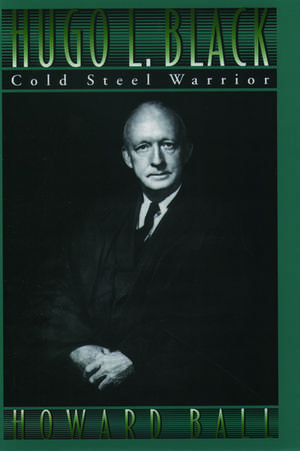
Hugo L. Black: Cold Steel Warrior
Editat de Howard Ballen Limba Engleză Hardback – 12 dec 1996
Imaginați-vă un judecător al Curții Supreme care, în mijlocul unei discuții cu demnitari sau studenți, scoate brusc din buzunarul hainei o copie ferfelițită a Constituției și începe să citească pasaje cu o voce înaltă, plină de pasiune. Aceasta este imaginea centrală pe care Howard Ball o construiește în Hugo L. Black: Cold Steel Warrior, o biografie ce explorează paradoxurile unei figuri monumentale a dreptului american. Relația dintre autor și subiect este una de o rigoare documentară excepțională: Ball nu se mulțumește cu analiza deciziilor juridice, ci pătrunde în arhivele personale de la Library of Congress și în amintirile intime ale familiei și colegilor pentru a înțelege cum un fost membru al Ku Klux Klan a ajuns să semneze unele dintre cele mai progresiste decizii împotriva segregării.
Observăm în paginile acestei lucrări publicate de Oxford University Press transformarea unui politician abil din Alabama — care păstra într-un seif numele tuturor susținătorilor săi — într-un „războinic de oțel” al libertăților civile. Stilul narativ este cinematic, purtându-ne din culisele administratiei Roosevelt, unde Black a fost unul dintre puținii aliați ai președintelui în încercarea de a reforma Curtea, până la momentele tensionate din cazul Pentagon Papers. Cine a apreciat portretul din Hugo Black of Alabama va găsi aici aceeași profunzime biografică, însă Howard Ball extinde perspectiva asupra întregii cariere de treizeci și patru de ani la Curtea Supremă. Dacă în Becoming Justice Blackmun urmărim o transformare personală lentă, în cazul lui Black asistăm la o luptă constantă între trecutul său controversat și interpretarea literală, aproape religioasă, a textului constituțional. Găsim aici nu doar o biografie, ci o cronică a secolului XX american, marcată de figuri precum Earl Warren sau Thurgood Marshall, văzute prin ochii unui om care a refuzat să fie definit de greșelile tinereții sale.
Preț: 321.41 lei
Preț vechi: 367.99 lei
-13%
Carte tipărită la comandă
Livrare economică 05-16 iunie
Specificații
ISBN-10: 0195078144
Pagini: 328
Ilustrații: 8 pp plates
Dimensiuni: 163 x 237 x 27 mm
Greutate: 0.63 kg
Ediția:New.
Editura: Oxford University Press
Colecția OUP USA
Locul publicării:New York, United States
V-ar putea interesa
-
 -35%Preț: 405.69 lei620.63 lei
 -
 -23%Preț: 346.71 lei448.18 lei
 -
 The European Union and its Court of JusticeAnthony Arnull-22%Preț: 475.16 lei605.83 lei
 -
 Judging StatutesRobert KatzmannPreț: 282.83 lei
 -
 The Manual on International Courts and TribunalsRuth Mackenzie-34%Preț: 909.62 lei1369.57 lei
 -
 International ProsecutorsLuc Reydams-27%Preț: 1001.89 lei1363.68 lei
 -
 -21%Preț: 304.82 lei387.79 lei
 -
 Reason and Imagination: The Selected Correspondence of Learned HandConstance Jordan-11%Preț: 392.47 lei440.98 lei
 -
 Disorder in the CourtCharles M. SevillaPreț: 76.65 lei
 -
 Law and DisorderCharles M SevillaPreț: 77.84 lei
 -
 -28%Preț: 63.74 lei88.61 lei
 -
 Preț: 193.41 lei
 -
 -29%Preț: 407.96 lei578.52 lei
De ce să citești această carte
Recomandăm această biografie cititorilor interesați de istoria dreptului și de evoluția politică a Statelor Unite. Este o lecție fascinantă despre cum convingerile umane se pot schimba radical sub influența responsabilității publice. Veți câștiga o înțelegere profundă a modului în care Constituția americană a fost apărată în momente de criză, de la McCarthyism până la lupta pentru libertatea presei, prin portretul unui judecător care a transformat „oțelul” caracterului său în scut pentru libertate.