
Hubbard, J: Problem Solving & Programming Concepts
Autor Jim Hubbarden Limba Engleză Paperback – 19 mai 2011
Diferențiind-se clar de documentația oficială a oricărui limbaj de programare prin focalizarea pe logică, nu pe sintaxă, Hubbard, J: Problem Solving & Programming Concepts propune o metodologie de lucru universală. Apreciem în mod deosebit modul în care autorii Jim Hubbard și Maureen Sprankle elimină barierele tehnice inițiale, demonstrând că fundamentul programării rezidă în capacitatea de a descompune o problemă complexă în pași executabili. Abordarea diferă de Starting Out with Programming Logic and Design prin faptul că este mai puțin abstractă și mai mult aplicabilă în scenarii cotidiene, ghidând cititorul de la logica de zi cu zi la cea computațională.
Subliniem structura progresivă a celor 524 de pagini, organizată în unități tematice care acoperă de la constante, variabile și tipuri de date, până la utilizarea Unified Modeling Language (UML) pentru planificarea soluțiilor. Reținem că această a 9-a ediție nu se limitează la teorie; cuprinsul indică o trecere riguroasă prin ciclul de dezvoltare software, incluzând testarea și codarea efectivă. Interesant este contextul autorului: deși în lucrări precum Lives Turned Upside Down sau Shooting Back from the Heart acesta explorează teme sociale profunde, în acest volum tehnic păstrează aceeași claritate a comunicării, transformând un subiect tehnic arid într-un proces logic accesibil.
Spre deosebire de Julia - Bit by Bit, care se ancorează într-un limbaj modern specific, lucrarea de față rămâne un instrument educațional agnostic, esențial pentru formarea unei gândiri algoritmice corecte înainte de a scrie prima linie de cod în C++, Java sau Python.
Preț: 641.01 lei
Preț vechi: 754.13 lei
-15%
Carte disponibilă
Livrare economică 26 mai-09 iunie
Livrare express 12-16 mai pentru 54.77 lei
Specificații
ISBN-10: 0273752219
Pagini: 524
Ilustrații: Illustrations
Dimensiuni: 212 x 277 x 29 mm
Greutate: 1.13 kg
Ediția:9 ed
Editura: Prentice Hall
V-ar putea interesa
-
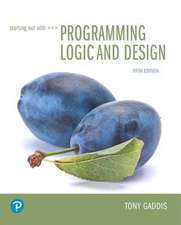 Starting Out with Programming Logic and DesignTony Gaddis-15%Preț: 973.70 lei1145.53 lei
 -
 -20%Preț: 202.33 lei252.91 lei
 -
 Absolute Beginner's Guide to AlgorithmsKirupa Chinnathambi-20%Preț: 194.49 lei243.12 lei
 -
 AlgorithmsRobert Sedgewick-20%Preț: 526.25 lei657.81 lei
 -
 Programming Language PragmaticsMichael Scott-41%Preț: 456.61 lei770.02 lei
 -
 Programming ChallengesSteven S Skiena-20%Preț: 473.55 lei591.94 lei
 -
 Just Enough Programming Logic and DesignJoyce Farrell-26%Preț: 627.26 lei843.78 lei
 -
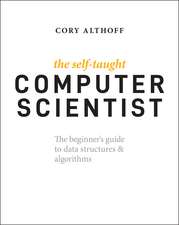 The Self-Taught Computer ScientistCory Althoff-20%Preț: 148.07 lei185.09 lei
 -
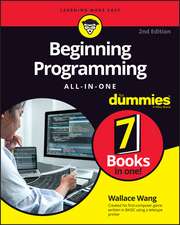 Beginning Programming All-in-One For DummiesWallace Wang-20%Preț: 189.23 lei236.54 lei
 -
 -20%Preț: 551.20 lei689.01 lei
 -
 Programming Logic and Design, IntroductoryJoyce Farrell-20%Preț: 498.79 lei623.49 lei
 -
 Coding for Dummies, All New EditionPaul McFedries-20%Preț: 133.99 lei167.49 lei
 -
 Advanced Topics in CNoel Kalicharan-20%Preț: 359.54 lei449.43 lei
 -
 Click, Connect, Compute: Computer Science EssentialsDr Dharini Balasubramaniam-38%Preț: 48.72 lei78.90 lei
 -
 -38%Preț: 168.25 lei269.37 lei
 -
 How to Think Like a CoderJim Christian-9%Preț: 85.65 lei93.89 lei
 -
 'A' Level Computing (5th Edition)Pat Heathcote-20%Preț: 194.63 lei243.28 lei
 -
 The Python WorkbookBen Stephenson-20%Preț: 410.09 lei512.61 lei
De ce să citești această carte
Recomandăm această carte studenților și începătorilor care vor să înțeleagă „de ce”-ul din spatele codului, nu doar „cum”-ul. Cititorul câștigă o fundație solidă în rezolvarea problemelor, învățând să utilizeze instrumente precum UML și diagramele de flux. Este o investiție pe termen lung în cariera de programator, oferind abilități transferabile între orice limbaje de programare viitoare.
Despre autor
Jim Hubbard este un autor cu o perspectivă multidisciplinară, recunoscut atât pentru contribuțiile sale în educația informatică, cât și pentru munca sa de pionierat în fotojurnalismul social. Fondator al proiectului „Shooting Back”, Hubbard a fost lăudat de personalități precum Oprah Winfrey pentru capacitatea sa de a preda tehnici complexe într-un mod care împuternicește individul. În Hubbard, J: Problem Solving & Programming Concepts, el aplică aceeași rigoare și claritate pedagogică, transformând conceptele abstracte de programare în instrumente practice pentru rezolvarea problemelor reale.
Notă biografică
Jim Hubbard is a software architect and the President of Healthware Solutions, LLC. Jim received his M.I.S. degree from Humboldt State University. He has held the position of CIO at Healthware Solutions, LLC. With 26 years of experience in the field of software development and implementation, Jim provides a valuable industry perspective to problem solving and programming.
Cuprins
UNIT ONE INTRODUCTION TO PROBLEM SOLVING AND PROGRAMMING, 1
Chapter 1 General Problem-Solving Concepts 3
Problem Solving in Everyday Life 3
Types of Problems 5
Problem Solving with Computers 6
Difficulties with Problem Solving 6
Summary 7
New Terms 7
Questions 7
Problems 8
Chapter 2 Beginning Problem-Solving Concepts for the Computer 11
Constants and Variables 13
Data Types 16
How the Computer Stores Data 20
Functions 21
Operators 23
Expressions and Equations 27
Summary 34
New Terms 35
Questions 35
Problems 37
Chapter 3 Planning Your Solution 41
Communicating with the Computer 42
Organizing the Solution 43
Introduction to UML (Unified Modeling Language) 55
Using the Tools 59
Testing the Solution 61
Coding the Solution 61
Software Development Cycle 62
Summary 62
New Terms 63
Questions 63
Problems 63
UNIT ONE Supplementary Exercises, 65
UNIT TWO LOGIC STRUCTURES, 69
Chapter 4 An Introduction to Programming Structure 71
Pointers for Structuring a Solution 72
The Modules and Their Functions 74
Cohesion and Coupling 75
Local and Global Variables 77
Parameters 79
Return Values 84
Variable Names and the Data Dictionary 85
The Three Logic Structures 85
Summary 86
New Terms 86
Questions 87
Problems 87
Chapter 5 Problem Solving with the Sequential Logic Structure 89
Algorithm Instructions, Flowchart Symbols 89
The Sequential Logic Structure 92
Solution Development 94
Summary 101
Questions 102
Problems 102
Chapter 6 Problem Solving with Decisions 105
The Decision Logic Structure 106
Multiple If/Then/Else Instructions 108
Using Straight-Through Logic 110
Using Positive Logic 111
Using Negative Logic 115
Logic Conversion 117
Which Decision Logic? 120
Decision Tables 120
Putting It All Together 127
The Case Logic Structure 135
Codes 137
Putting It All Together 138
Another Putting It All Together 140
Summary 141
New Terms 142
Questions 142
Problems 143
Chapter 7 Problem Solving with Loops 149
The Loop Logic Structure 150
lncrementing 151
Accumulating 151
While/WhileEnd 152
Putting It All Together 154
Repeat/Until 154
Putting It All Together 157
Automatic-Counter Loop 159
Putting It All Together 163
Nested Loops 163
Indicators 166
Algorithm Instructions and Flowchart Symbols 167
Recursion 169
Summary 169
New Terms 174
Questions 174
Problems 174
UNIT TWO Supplementary Exercises, 177
UNIT THREE DATA STRUCTURES, 179
Chapter 8 Processing Arrays 181
Arrays 182
One-Dimensional Arrays 184
Putting It All Together 189
Two-Dimensional Arrays 191
Putting It All Together 199
Multidimensional Arrays 208
Table Look-Up Technique 209
The Pointer Technique 213
Putting It All Together 226
Summary 235
New Terms 235
Questions 235
Problems 236
Chapter 9 Sorting, Stacks, and Queues 239
Sorting Techniques 240
Stacks 247
Queues 248
Summary 252
New Terms 252
Questions 252
Problems 253
Chapter 10 File Concepts 255
Beginning File Concepts 256
Records as a Data Structure 256
Primary and Secondary Keys 256
Algorithm Instructions and Flowchart Symbols 256
Systems Flowcharts 259
Designing Records 259
Summary 263
New Terms 263
Questions 263
Problems 263
Descriere scurtă
Revised to reflect the most current issues in the programming industry, this widely adopted text emphasizes that problem solving is the same in all computer languages, regardless of syntax. Sprankle and Hubbard use a generic, non-language-specific approach to present the tools and concepts required when using any programming language to develop computer applications. Designed for students with little or no computer experience - but useful to programmers at any level - the text provides step-by-step progression and consistent in-depth coverage of topics, with detailed explanations and many illustrations.
Instructor Supplements (see resources tab):
Instructor Manual with Solutions and Test Bank
Lecture Power Point Slides
Go to: www.pearsoninternationaleditions.com/sprankle