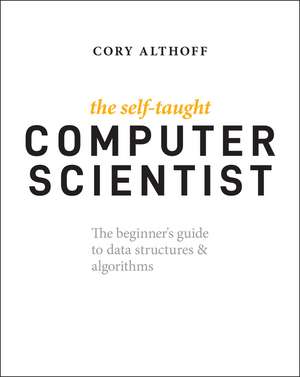
The Self-Taught Computer Scientist
Autor Cory Althoffen Limba Engleză Paperback – 19 oct 2021
Structura progresivă: de la concept la implementare transformă The Self-Taught Computer Scientist într-un instrument de lucru esențial pentru cei care au învățat programare în afara mediului academic. Putem afirma că Cory Althoff a reușit să distileze complexitatea informaticii teoretice în elemente imediat aplicabile. Volumul debutează cu analiza algoritmilor, explicând riguros complexitatea timp (de la Constant la Exponential Time) și spațiu, oferind cititorului vocabularul tehnic necesar pentru a evalua performanța codului scris. Considerăm că forța acestui text rezidă în abordarea practică a structurilor de date. Cuprinsul reflectă o evoluție logică: după stăpânirea recursivității, cititorul trece prin algoritmi de căutare (Linear, Binary) și sortare (Bubble, Insertion, Merge Sort), culminând cu algoritmi dedicați șirurilor de caractere și concepte matematice fundamentale precum sistemul binar și operatorii bitwise. Complementar lui Data Structures & Algorithms in Python, volumul acoperă zona de pregătire psihologică și strategică pentru interviurile tehnice, oferind bucle de feedback și provocări care ancorează teoria în realitatea profesională, în timp ce titlul menționat se concentrează mai strict pe performanța codului Python. Față de Introduction to Algorithms & Data Structures 1, care prezintă conceptele ca instrumente de optimizare generală, The Self-Taught Computer Scientist este mult mai orientat către carieră, fiind scris din perspectiva unui inginer software care s-a confruntat direct cu lacunele teoretice în industria tech. Tonul este pragmatic, evitând demonstrațiile matematice excesive în favoarea înțelegerii mecanismelor care fac un sistem să funcționeze eficient.
Preț: 153.96 lei
Preț vechi: 192.45 lei
-20%
Carte disponibilă
Livrare economică 02-16 septembrie
Livrare express 18-22 august pentru 31.48 lei
Specificații
ISBN-10: 1119724414
Pagini: 224
Dimensiuni: 183 x 232 x 13 mm
Greutate: 0.39 kg
Ediția:1
Editura: Wiley
Locul publicării:Hoboken, United States
V-ar putea interesa
-
 -20%Preț: 206.70 lei258.37 lei
 -
 Using Artificial Intelligence Absolute Beginner's GuideMichael Miller-20%Preț: 189.01 lei236.26 lei
 -
 Absolute Beginner's Guide to AlgorithmsKirupa Chinnathambi-20%Preț: 202.22 lei252.78 lei
 -
 -20%Preț: 315.12 lei393.89 lei
 -
 Algorithms UnlockedThomas H. Cormen-27%Preț: 188.87 lei257.16 lei
 -
 AlgorithmsPanos Louridas-17%Preț: 89.79 lei108.30 lei
 -
 AlgorithmsRobert Sedgewick-20%Preț: 513.56 lei641.96 lei
 -
 Essential AlgorithmsRod Stephens-20%Preț: 318.66 lei398.32 lei
 -
 Algorithms For DummiesJohn Paul Mueller-20%Preț: 140.40 lei175.50 lei
 -
 Coding For Dummies, All New EditionPaul McFedries-20%Preț: 115.67 lei144.59 lei
 -
 Advanced Topics in CNoel Kalicharan-20%Preț: 359.54 lei449.43 lei
 -
 -28%Preț: 64.87 lei90.54 lei
 -
 The CS DetectiveJeremy Kubica-35%Preț: 93.18 lei143.93 lei
 -
 Algorithms and Data Structures in ActionMarcello La Rocca-20%Preț: 396.83 lei496.03 lei
 -
 -37%Preț: 192.17 lei306.52 lei
 -
 Data Structures and Algorithms in JavaScriptFederico Kereki-35%Preț: 299.17 lei461.86 lei
 -
 -35%Preț: 252.08 lei389.39 lei
 -
 -35%Preț: 286.72 lei440.13 lei
 -
 The Algorithm Design ManualSteven S. Skiena-20%Preț: 397.34 lei496.67 lei
De ce să citești această carte
Recomandăm această carte programatorilor autodidacți care doresc să treacă de la scrierea de cod funcțional la înțelegerea profundă a eficienței sistemelor. The Self-Taught Computer Scientist oferă rigoarea unei facultăți de profil într-un format accesibil, fiind un ghid excelent pentru pregătirea interviurilor la companii de top. Veți câștiga încredere în discuțiile tehnice și capacitatea de a alege întotdeauna structura de date optimă pentru proiectele dumneavoastră.