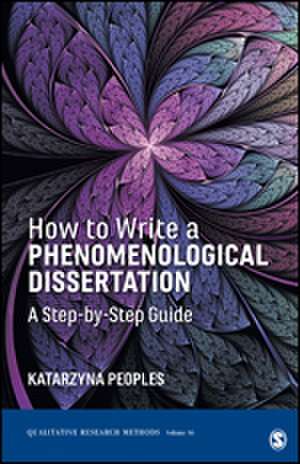
How to Write a Phenomenological Dissertation: A Step-by-Step Guide: Qualitative Research Methods, cartea 56
Autor Katarzyna Peoplesen Limba Engleză Electronic book text – 20 feb 2020
Putem afirma că How to Write a Phenomenological Dissertation reprezintă o resursă esențială prin caracterul său interdisciplinar, adresându-se cercetătorilor din sociologie, psihologie și științele sănătății care utilizează analiza experienței trăite ca fundament empiric. Lucrarea semnată de Katarzyna Peoples reușește să traducă ambiguitatea inerentă fenomenologiei într-un cadru de lucru riguros și predictibil, necesar finalizării unei teze de doctorat. Reținem că, spre deosebire de alte manuale teoretice, acest volum publicat de Sage Publications, Inc funcționează ca un instrument de navigație aplicat, oferind soluții concrete pentru provocările de scriere și structurare.
Cititorii familiarizați cu Writing Phenomenological Research de Hamid H. Kazeroony vor aprecia în acest volum focalizarea sporită pe pragmatismul administrativ al dizertației; în timp ce Kazeroony pune accent pe designul studiului, Katarzyna Peoples prioritizează redactarea efectivă a fiecărei secțiuni, de la formularea problemei la abstract. Această abordare practică este vizibilă și în cealaltă lucrare a autoarei, Using the Socratic Method in Counseling, unde aceasta folosește dialogul structurat pentru rezolvarea problemelor complexe. În volumul de față, autoarea aplică aceeași claritate metodologică pentru a demistifica procesul de cercetare.
Structura cărții urmărește fidel arhitectura unei dizertații standard. Prima parte pregătește terenul prin definirea cadrului teoretic, în timp ce partea a doua ghidează cititorul prin metodologia propriu-zisă, colectarea datelor și analiza software. Un element distinctiv este capitolul final, care încurajează cercetătorul să își dezvolte propria metodă fenomenologică, oferind o perspectivă ce depășește simpla conformitate academică. Recomandăm acest ghid pentru modul în care echilibrează rigoarea științifică cu flexibilitatea necesară explorării experienței umane.
Din seria Qualitative Research Methods
-
 Preț: 378.52 lei
 -
 Preț: 379.22 lei
 -
 Preț: 382.13 lei
 -
 Preț: 138.39 lei
 -
 Preț: 341.89 lei
 -
 Preț: 341.71 lei
 -
 Preț: 378.09 lei
 -
 Preț: 379.62 lei
 - nou
 Preț: 137.27 lei
 - nou
 Preț: 137.27 lei
 -
 Preț: 175.73 lei
 - nou
 Preț: 121.88 lei
 - nou
 Preț: 152.65 lei
 -
 Preț: 175.73 lei
 -
 Preț: 175.73 lei
 - nou
 Preț: 144.96 lei
 - nou
 Preț: 121.88 lei
 - nou
 Preț: 144.96 lei
 - nou
 Preț: 144.96 lei
 - nou
 Preț: 152.65 lei
 - nou
 Preț: 144.96 lei
 - nou
 Preț: 144.96 lei
 - nou
 Preț: 144.96 lei
 -
 Preț: 269.02 lei
 -
 Preț: 175.73 lei
 -
 Preț: 152.65 lei
 -
 Preț: 175.73 lei
 -
 Preț: 175.73 lei
 -
 Preț: 175.73 lei
 - nou
 Preț: 144.96 lei
Preț: 175.73 lei
Indisponibil temporar
Specificații
ISBN-10: 1544328370
Pagini: 192
Dimensiuni: 140 x 216 mm
Ediția:First Edition
Editura: SAGE Publications
Colecția Sage Publications, Inc
Seria Qualitative Research Methods
Locul publicării:Thousand Oaks, United States
V-ar putea interesa
-
 Preț: 339.59 lei
 -
 Media Studies: Ethnomethodological ApproachesPaul L. Jalbert-34%Preț: 445.28 lei673.69 lei
 -
 Principles of Statistical Data HandlingFred Davidson-18%Preț: 799.63 lei975.17 lei
 -
 Studying Organizational SymbolismMichael Owen JonesPreț: 318.25 lei
 -
 Evaluative Inquiry for Learning in OrganizationsHallie S. Preskill-18%Preț: 928.58 lei1132.42 lei
 -
 Computer LiteracyIra H. Bernstein-18%Preț: 967.48 lei1179.85 lei
 -
 Social ExperimentsLarry L. Orr-15%Preț: 447.44 lei526.41 lei
 -
 Latent Class Scaling AnalysisC. Mitchell Dayton-5%Preț: 310.68 lei327.03 lei
 -
 Relating Statistics & Experimental DesignIrwin P. LevinPreț: 318.88 lei
 -
 Effect Size for Anova DesignsJose M CortinaPreț: 325.85 lei
 -
 Analyzing Documentary AccountsRandy HodsonPreț: 326.81 lei
 -
 Interaction Effects in Logistic RegressionJames JaccardPreț: 325.75 lei
 -
 Longitudinal ResearchScott MenardPreț: 326.88 lei
 -
 CorrelationPeter Y ChenPreț: 326.88 lei
 -
 Spline Regression ModelsLawrence C. MarshPreț: 325.54 lei
 -
 -18%Preț: 751.13 lei916.01 lei
 -
 Case Study MethodRoger Gomm-15%Preț: 597.99 lei703.52 lei
 -
 Design SensitivityMark W. Lipsey-15%Preț: 612.10 lei720.11 lei
 -
 Time Series Analysis: Regression TechniquesCharles W. OstromPreț: 341.36 lei
 -
 Pooled Time Series AnalysisLois W. SayrsPreț: 325.75 lei
 -
 Sorting DataAnthony Peter MacMillan CoxonPreț: 327.25 lei
 -
 Regression BasicsLeo H. Kahane-15%Preț: 555.36 lei653.36 lei
 -
 Participatory Action ResearchAlice McintyrePreț: 319.18 lei
 -
 -18%Preț: 86.64 lei105.36 lei
De ce să citești această carte
Recomandăm această carte doctoranzilor care se simt blocați de complexitatea fenomenologiei. Cititorul câștigă un parcurs clar, de tip pas-cu-pas, transformând o metodologie abstractă într-un text academic coerent. Este un instrument indispensabil pentru a depăși „paralizia paginii albe” prin tabele de sinteză și liste de verificare ce asigură respectarea standardelor de validitate și etică în cercetarea socială.
Despre autor
Katarzyna Peoples este un expert recunoscut în metodologii de cercetare calitativă, cu o experiență vastă în supervizarea dizertațiilor fenomenologice în cadrul disciplinelor socio-umane. Expertiza sa se extinde și în domeniul consilierii psihologice, fiind co-autoare a unor lucrări care explorează aplicarea metodei socratice în terapie. Această dublă specializare îi permite să abordeze fenomenologia nu doar ca pe un exercițiu filosofic, ci ca pe un instrument practic de înțelegere a subiectivității umane. Prin activitatea sa la Sage Publications, Inc, ea contribuie la formarea noilor generații de cercetători prin resurse pedagogice adaptate cerințelor academice contemporane.
Descriere scurtă
Phenomenology is about personal experience and personal experience varies from researcher to researcher. However, this variation is a big source of confusion for new researchers in the social, behavioral, or health sciences. This brief text is written in a simple, step-by-step fashion to account for this flexibility and variation while also providing structure necessary for a successful dissertation. Broken up into chapters that follow each chapter of the dissertation, this text logically breaks down the various parts of phenomenological research, starting with ensuring phenomenology is the right method for your research, writing the literature review, going through methods and results sections to analysis and discussion. The author, using experience gleaned from supervising phenomenological dissertations for many years, gives time-tested advice on how structure the dissertation to fit into more common frameworks, using checklists and tables throughout. Each chapter includes a list of helpful resources for students to use alongside this book with specific information on methods and research. Unique to this text is a chapter on creating your own phenomenological method which allows students to expand their viewpoints and experiment in future studies after the dissertation.
Recenzii
It seems to make writing a phenomenological study more accessible by offering pathways to students.
It is well-informed, driven by experience and authoritatively written and yet leaves room for others to write their own. It is quite a feat.
While this book conforms with others in the domain of phenomenological research is it superior in many respects; chiefly the author's sound knowledge transfer of philosophy to methods; the fit between conceptual basic assumptions and object of research study; and clarity without sacrificing complexity.
The key strengths are the attempt to provide a systematic understanding of the process from A to Z with a specific focus on phenomenology. This text will be useful and versatile for student locked in to phenomenology.
Cuprins
About the Author
Part I: Before the Dissertation
Chapter 1: How to Begin
What Is Phenomenological Research?
Purpose of This Book
Organization of This Book
Literature Review
Theoretical Framework
References
Part II: Writing the Dissertation
Chapter 2: Introduction and Literature Review
Beginning the Literature Review: What’s Your Topic?
Literature Search Strategy
Create an Outline
Writing the First Dissertation Chapter: The Introduction
Problem Statement
Purpose Statement
Research Questions
Theoretical Framework
Definitions
Assumptions
Delimitations and Limitations
Summary Sections
Completing the Literature Review
References and Suggested Reading
Chapter 3: Methodology
Introduction
Design and Rationale
Researcher Role
Participants
Instrumentation
Procedures
Data Collection
Data Analysis
Using Software
Validity and Reliability
Ethics
Summary
Write the Abstract
References and Resources
Chapter 4: Results
Introduction
Setting
Participant Demographics
Data Collection
Findings
Connecting to the Theoretical Framework
Validity and Reliability
Going Back to Chapter 3
Summary
Appendices
References and Resources
Chapter 5: Discussion
Introduction
Interpretation of Findings: A Dialogue with the Literature
Including Theory Throughout
Limitations
Recommendations for Future Research
Implications
Conclusion
Update the Abstract
Example of Abstract
References and Resources
Part III: After your Dissertation
Chapter 6: Other Phenomenological Methods
Existential Phenomenology
Critical Narrative Analysis (Langdridge)
Dialogal Approach (Halling, Leifer, & Rowe)
Dallas Approach (Garza)
Embodied Life-World Approach (Todres)
Interpretive Phenomenological Analysis (Smith, Flowers, & Larkin)
Life-World Approach (Ashworth)
Lived Experience Human Science Inquiry (van Manen)
Reflective Life-World Approach (Dahlberg)
References
Chapter 7: Creating Your Own Phenomenological Method
Giorgi’s Five Basic Steps
van Manen’s Four Reflections
Results
Participant Demographics
General Description
Reflection
References and Resources
Appendix A: Recruitment Flyer
Appendix B: Screening
Appendix C: Semi-Structured Interview Guide
Appendix D: Consent to Participate
Appendix E: Sample Dissertation Literature Review
Index