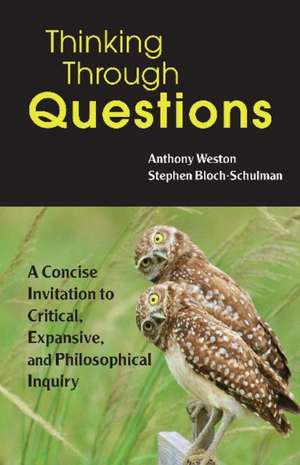
Thinking Through Questions: A Concise Invitation to Critical, Expansive, and Philosophical Inquiry
Autor Anthony Weston, Stephen Bloch-Schulmanen Limba Engleză Paperback – mar 2020
Preț: 86.64 lei
Preț vechi: 105.36 lei
-18%
Puncte Express: 130
Carte disponibilă
Livrare economică 29 octombrie-12 noiembrie
Livrare express 14-20 octombrie pentru 37.61 lei
Livrare prin curier în România Termenul estimat este afișat lângă disponibilitate.
Transport gratuit de la 400.00 lei Plată online sau ramburs, în funcție de opțiunile comenzii.
Retur gratuit în 14 zile Comandă securizată și suport în română.
Specificații
ISBN-13: 9781624668586
ISBN-10: 1624668585
Pagini: 160
Ilustrații: 3 line art, to come
Dimensiuni: 140 x 216 x 12 mm
Greutate: 0.19 kg
Editura: Hackett Publishing Company,Inc
Colecția Hackett Publishing Company, Inc.
Locul publicării:United States
ISBN-10: 1624668585
Pagini: 160
Ilustrații: 3 line art, to come
Dimensiuni: 140 x 216 x 12 mm
Greutate: 0.19 kg
Editura: Hackett Publishing Company,Inc
Colecția Hackett Publishing Company, Inc.
Locul publicării:United States
V-ar putea interesa
Recenzii
"This small book holds big value for teachers of philosophy and teachers of critical thinking in any discipline. If you want your students to be more ‘curious, critical, exploratory, and creative,’ this book will serve well as a supplementary or core text. It offers appreciation for the power of questioning, opportunities to identify types of questions, and practice in questioning skills. The authors, both recognized as master teachers, bring their own considerable pedagogical experience and engaging style to encouraging better questioning in all of us."
—Donna Engelmann, Alverno College
"Highly accessible, Thinking Through Questions guides students to greater freedom regarding how, why, when, and when not to ask or answer critical, expansive, and philosophical questions. It is an especially good choice for courses where critical thinking figures prominently, both because of its content and because of the practice exercises it contains. But more fundamentally, this book leaves readers more able to resist coercive questions, reconfigure false dilemmas, question more creatively, and diagnose embedded philosophical and other assumptions. It teaches how to profitably answer questions, do valuable things with questions other than answer them, ask better questions, and liberate oneself from cognitive traps many questions set."
—David Concepción, professor of philosophy, Ball State University
"Thinking Through Questions can be put to many good uses in the classroom. Weston and Bloch-Schulman have done an admirable job of creating a text which embodies a novel approach to the numerous pedagogical situations instructors might find themselves in across the academy, especially in humanities courses and any course centered on critical reasoning and writing."
—Michael Gifford, Arizona State University, in Teaching Philosophy
—Donna Engelmann, Alverno College
"Highly accessible, Thinking Through Questions guides students to greater freedom regarding how, why, when, and when not to ask or answer critical, expansive, and philosophical questions. It is an especially good choice for courses where critical thinking figures prominently, both because of its content and because of the practice exercises it contains. But more fundamentally, this book leaves readers more able to resist coercive questions, reconfigure false dilemmas, question more creatively, and diagnose embedded philosophical and other assumptions. It teaches how to profitably answer questions, do valuable things with questions other than answer them, ask better questions, and liberate oneself from cognitive traps many questions set."
—David Concepción, professor of philosophy, Ball State University
"Thinking Through Questions can be put to many good uses in the classroom. Weston and Bloch-Schulman have done an admirable job of creating a text which embodies a novel approach to the numerous pedagogical situations instructors might find themselves in across the academy, especially in humanities courses and any course centered on critical reasoning and writing."
—Michael Gifford, Arizona State University, in Teaching Philosophy