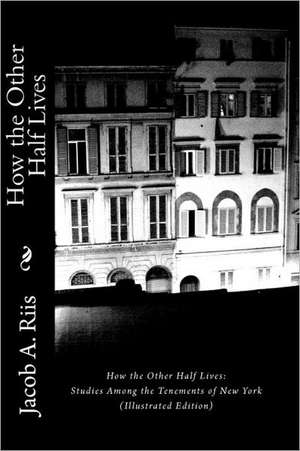
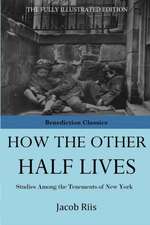
How the Other Half Lives: Studies Among the Tenements of New York (Illustrated Edition)
Autor Jacob A. Riisen Limba Engleză Paperback – 31 iul 2010
Preț: 80.18 lei
Puncte Express: 120
Carte disponibilă
Livrare economică 30 octombrie-13 noiembrie
Livrare prin curier în România Termenul estimat este afișat lângă disponibilitate.
Transport gratuit de la 400.00 lei Plată online sau ramburs, în funcție de opțiunile comenzii.
Retur gratuit în 14 zile Comandă securizată și suport în română.
Specificații
ISBN-13: 9781611040623
ISBN-10: 1611040620
Pagini: 202
Dimensiuni: 152 x 229 x 11 mm
Greutate: 0.28 kg
Editura: Readaclassic.com
ISBN-10: 1611040620
Pagini: 202
Dimensiuni: 152 x 229 x 11 mm
Greutate: 0.28 kg
Editura: Readaclassic.com
V-ar putea interesa
-
 Men Without WomenErnest Hemingway-20%Preț: 50.97 lei63.84 lei
 -
 Nineteen Eighty-Four (1984): 1984George Orwell-27%Preț: 51.63 lei70.82 lei
 -
 The Complete StoriesTruman Capote-26%Preț: 58.12 lei78.09 lei
 -
 Let Us Now Praise Famous MenJames Agee-18%Preț: 87.42 lei107.05 lei
 -
 The Grapes of WrathJohn Steinbeck-25%Preț: 55.19 lei73.18 lei
 -
 Preț: 227.49 lei
 -
 Preț: 424.53 lei
 -
 How the Other Half LivesJacob RiisPreț: 230.30 lei
 -
 Lord of the FliesWilliam GoldingPreț: 69.52 lei
 -
 Preț: 33.08 lei
 -
 The JungleUpton SinclairPreț: 47.16 lei
 -
 The Other AmericaMichael HarringtonPreț: 108.50 lei
 -
 Dear New YorkBrandon StantonPreț: 287.60 lei
 -
 Welcome to the NeighbourhoodJane FallonPreț: 72.27 lei
 -
 Oliver TwistCharles DickensPreț: 52.38 lei
 -
 The Gods of New YorkJonathan MahlerPreț: 138.96 leiRecomandat
 -
 Best Offer WinsMarisa KashinoPreț: 108.52 lei
 -
 Preț: 69.51 lei
 -
 How The Other Half LivesJacob RiisPreț: 82.91 lei
 -
 London Labour and the London PoorHenry MayhewPreț: 47.21 lei
 -
 Great GatsbyF. Scott FitzgeraldPreț: 29.75 lei
 -
 New York: Portrait of a CityReuel Golden-8%Preț: 466.78 lei507.37 lei
 -
 Lewis W. HinePeter WaltherPreț: 165.45 lei
 -
 Preț: 215.56 lei
Cuprins
List of Illustrations Introduction by Luc Sante Suggestions for Further Reading A Note on the Text How the Other Half Lives Preface Introduction
1 Genesis of the Tenement 2 The Awakening 3 The Mixed Crowd 4 The Down Town Back-alleys 5 The Italian in New York 6 The Bend 7 A Raid on the Stale-beer Dives 8 The Cheap Lodging-houses 9 Chinatown 10 Jewtown 11 The Sweaters of Jewtown 12 The Bohemians-Tenement-house Cigarmaking 13 The Color Line in New York 14 The Common Herd 15 The Problem of the Children 16 Waifs of the City's Slums 17 The Street Arab 18 The Reign of Rum 19 The Harvest of Tares 20 The Working Girls of New York 21 Pauperism in the Tenements 22 The Wrecks and the Waste 23 The Man with the Knife 24 What Has Been Done 25 How the Case Stands
Appendix Explanatory Notes
1 Genesis of the Tenement 2 The Awakening 3 The Mixed Crowd 4 The Down Town Back-alleys 5 The Italian in New York 6 The Bend 7 A Raid on the Stale-beer Dives 8 The Cheap Lodging-houses 9 Chinatown 10 Jewtown 11 The Sweaters of Jewtown 12 The Bohemians-Tenement-house Cigarmaking 13 The Color Line in New York 14 The Common Herd 15 The Problem of the Children 16 Waifs of the City's Slums 17 The Street Arab 18 The Reign of Rum 19 The Harvest of Tares 20 The Working Girls of New York 21 Pauperism in the Tenements 22 The Wrecks and the Waste 23 The Man with the Knife 24 What Has Been Done 25 How the Case Stands
Appendix Explanatory Notes
Notă biografică
Jacob August Riis (1849 - 1914) was a Danish-American social reformer, "muckraking" journalist and social documentary photographer. He is known for using his photographic and journalistic talents to help the impoverished in New York City; those impoverished New Yorkers were the subject of most of his prolific writings and photography. He endorsed the implementation of "model tenements" in New York with the help of humanitarian Lawrence Veiller. Additionally, as one of the most famous proponents of the newly practicable casual photography, he is considered one of the fathers of photography due to his very early adoption of flash in photography. While living in New York, Riis experienced poverty and became a police reporter writing about the quality of life in the slums. He attempted to alleviate the bad living conditions of poor people by exposing their living conditions to the middle and upper classes.
Descriere
Descriere de la o altă ediție sau format:
A classic text of sociology and social critism. First published in 1890, this is the author's study of the slums of New York, where Italians, Jews, "Bohemians", Blacks and Chinese struggled against the effects of poverty, alcohol and lack of education. The author's use of photographs to put faces to his stories is recognized as a landmark in photojournalism and as a result of his book, many reforms did take place to assist New York's poor.
A classic text of sociology and social critism. First published in 1890, this is the author's study of the slums of New York, where Italians, Jews, "Bohemians", Blacks and Chinese struggled against the effects of poverty, alcohol and lack of education. The author's use of photographs to put faces to his stories is recognized as a landmark in photojournalism and as a result of his book, many reforms did take place to assist New York's poor.
Textul de pe ultima copertă
In How The Other Half Lives New Yorkers read with horror that three-quarters of the residents of their city were housed in tenements and that in those tenements rents were substantially higher than in better sections of the city. In his book Riis gave a full and detailed picture of what life in those slums was like, how the slums were created, how and why they remained as they were, who was forced to live there, and offered suggestions for easing the lot of the poor.