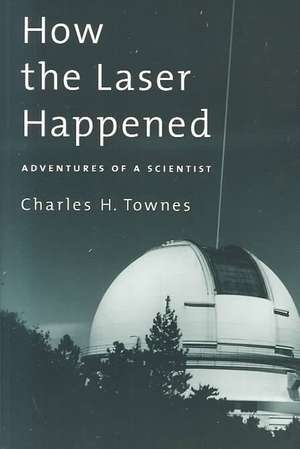
How the Laser Happened: Adventures of a Scientist
Autor Charles H. Townesen Limba Engleză Paperback – 25 apr 2002
Preț: 303.65 lei
Preț vechi: 343.53 lei
-12%
Puncte Express: 455
Carte tipărită la comandă
Livrare economică 10-16 decembrie
Livrare prin curier în România Termenul estimat este afișat lângă disponibilitate.
Transport gratuit de la 400.00 lei Plată online sau ramburs, în funcție de opțiunile comenzii.
Retur gratuit în 14 zile Comandă securizată și suport în română.
Specificații
ISBN-13: 9780195153767
ISBN-10: 0195153766
Pagini: 208
Ilustrații: 14 halftones, 3 line drawings
Dimensiuni: 180 x 214 x 17 mm
Greutate: 0.33 kg
Editura: Oxford University Press
Colecția OUP USA
Locul publicării:New York, United States
ISBN-10: 0195153766
Pagini: 208
Ilustrații: 14 halftones, 3 line drawings
Dimensiuni: 180 x 214 x 17 mm
Greutate: 0.33 kg
Editura: Oxford University Press
Colecția OUP USA
Locul publicării:New York, United States
V-ar putea interesa
-
 Schaum's Outline of Applied Physics, 4edArthur Beiser; Emeritus-22%Preț: 213.45 lei273.60 lei
 -
 An Introduction to Dynamic MeteorologyJames R. Holton-31%Preț: 502.60 lei733.29 lei
 -
 Physics in Biology and MedicinePaul Davidovits-25%Preț: 363.10 lei484.34 lei
 -
 Practical Radiation Protection in HealthcareColin J Martin-11%Preț: 403.03 lei452.85 lei
 -
 Brownian Motion: Fluctuations, Dynamics, and ApplicationsRobert M. Mazo-22%Preț: 518.46 lei660.98 lei
 -
 -18%Preț: 294.52 lei358.59 lei
 -
 -5%Preț: 635.84 lei669.31 lei
 -
 Webb's Physics of Medical ImagingM Flower-5%Preț: 870.60 lei916.42 lei
 -
 The Manga Guide to PhysicsHideo Nitta-18%Preț: 142.04 lei172.75 lei
 -
 Basic Health Physics – Problems and Solutions 2eJJ Bevelacqua-14%Preț: 960.34 lei1116.67 lei
Recenzii
[Townes's] ability to blend past achievements with the present brings a freshness of view in which his obvious excitement with some very recent breakthroughs in science and technology shines through very clearly ... I would recommend the reading of this autobiographical account to non-scientists as well as budding or established scientists.
Filled with personal anecdotes that provide insight into an immensely original thinker and scientist of enormous energy and prolific output....[Includes] a fascinating account of the patent disputes surrounding the maser and laser....[Provides] an inspiring case history of how an outstanding physicist got started and went on to do great science.
An engaging human story, intertwined with a first-hand account of some of the twentieth century's most significant inventions and discoveries. Fine reading for anyone interested in science, scientists, or the roles they play in our fast-changing world.
It's rare that a scientist writes a book about his or her life that accurately reflects the highs and lows of scientific discovery. Such a book is How the Laser Happened by Nobel Laureate Charles Townes ... Townes did not invent the laser but, as a researcher, he certainly left his mark on twentieth century science. And the book certainly leaves the impression that Townes lived the life of a true scientist. Townes was the co-inventor of the maser (microwave amplification by stimulated emission of radiation) with James Gordon, then a post-doctoral student at Columbia University ... But the book is not entirely concerned with the science of maser and laser development. Townes devotes an intriguing chapter to the various battles that were fought over the patents for the maser and the laser ... The book is subtitled, Adventures of a Scientist. Charles Townes' adventures make for a fascinating story of a true scientist.
Filled with personal anecdotes that provide insight into an immensely original thinker and scientist of enormous energy and prolific output....[Includes] a fascinating account of the patent disputes surrounding the maser and laser....[Provides] an inspiring case history of how an outstanding physicist got started and went on to do great science.
An engaging human story, intertwined with a first-hand account of some of the twentieth century's most significant inventions and discoveries. Fine reading for anyone interested in science, scientists, or the roles they play in our fast-changing world.
It's rare that a scientist writes a book about his or her life that accurately reflects the highs and lows of scientific discovery. Such a book is How the Laser Happened by Nobel Laureate Charles Townes ... Townes did not invent the laser but, as a researcher, he certainly left his mark on twentieth century science. And the book certainly leaves the impression that Townes lived the life of a true scientist. Townes was the co-inventor of the maser (microwave amplification by stimulated emission of radiation) with James Gordon, then a post-doctoral student at Columbia University ... But the book is not entirely concerned with the science of maser and laser development. Townes devotes an intriguing chapter to the various battles that were fought over the patents for the maser and the laser ... The book is subtitled, Adventures of a Scientist. Charles Townes' adventures make for a fascinating story of a true scientist.
Notă biografică
Charles Townes is one of the leading figures in twentieth-century physics, intentor of the maser, co-inventor of the laser, and a pioneer in microwave spectroscopy for molecular and nuclear physics and in the use of radio and infrared spectroscopic techniques for astronomy. A Nobel laureate, Townes was also one of the first academic scientists to accept a full-time position advising the Executive Branch during the Cold War, and was founder of the Jasons, an influential group of scientists independently advising the government. He also served on the Board of General Motors.