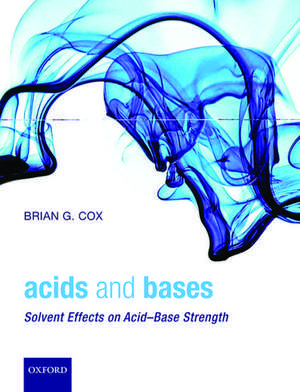
Acids and Bases: Solvent Effects on Acid-Base Strength
Autor Brian G. Coxen Limba Engleză Paperback – 31 ian 2013
Preț: 294.52 lei
Preț vechi: 358.59 lei
-18%
Puncte Express: 442
Carte tipărită la comandă
Livrare economică 20 noiembrie-01 decembrie
Livrare prin curier în România Termenul estimat este afișat lângă disponibilitate.
Transport gratuit de la 400.00 lei Plată online sau ramburs, în funcție de opțiunile comenzii.
Retur gratuit în 14 zile Comandă securizată și suport în română.
Specificații
ISBN-13: 9780199670529
ISBN-10: 0199670528
Pagini: 156
Ilustrații: 54 b/w line illustrations
Dimensiuni: 189 x 245 x 8 mm
Greutate: 0.36 kg
Editura: Oxford University Press
Colecția OUP Oxford
Locul publicării:Oxford, United Kingdom
ISBN-10: 0199670528
Pagini: 156
Ilustrații: 54 b/w line illustrations
Dimensiuni: 189 x 245 x 8 mm
Greutate: 0.36 kg
Editura: Oxford University Press
Colecția OUP Oxford
Locul publicării:Oxford, United Kingdom
V-ar putea interesa
-
 Global Aspects in Gravitation and CosmologyPankaj S. Joshi-28%Preț: 404.36 lei559.18 lei
 -
 Brownian Motion: Fluctuations, Dynamics, and ApplicationsRobert M. Mazo-22%Preț: 518.46 lei660.98 lei
 -
 In Search of Dark MatterKen FreemanPreț: 279.31 lei
 -
 Advanced AstrophysicsNeb Duric-23%Preț: 770.75 lei1000.98 lei
 -
 Gravitational Million-Body ProblemDouglas Heggie-23%Preț: 708.77 lei920.48 lei
 -
 Welcome to the UniverseNeil De Grasse TysonPreț: 294.17 lei
Recenzii
particularly useful to postgraduate and senior researchers who use non-aqueous solvents in their work ... I highly recommend this text.
Acidbase equilibria are intimately coupled to many of the processes involved in synthetic and analytical chemistry, including reaction rates and selectivity, solubility and partition equilibria, catalytic cycles and chromatographic retention times. These equilibria are extraordinarily sensitive to the nature of the solvent, with some equilibrium constants changing by as much as 1010 on transfer from water to aprotic solvents. This book, by a practitioner with a lifetimes experience in the area, dissects a complex subject and provides a clear discussion of the several interacting factors that determine ionisation behaviour. It will be an invaluable resource to scientists involved with chemistry in non-aqueous solvents.
Acid-base equilibria are one of the most important chemical reactions - affecting living systems through to industrial processes. This book covers everything any scientist would like to know about this topic from structural and solvent effects to the practical determination of dissociation constants. Cox follows his mentor R.P. Bell in presenting a lucid and well-written comprehensive text. Highly recommended.
Acidbase equilibria are intimately coupled to many of the processes involved in synthetic and analytical chemistry, including reaction rates and selectivity, solubility and partition equilibria, catalytic cycles and chromatographic retention times. These equilibria are extraordinarily sensitive to the nature of the solvent, with some equilibrium constants changing by as much as 1010 on transfer from water to aprotic solvents. This book, by a practitioner with a lifetimes experience in the area, dissects a complex subject and provides a clear discussion of the several interacting factors that determine ionisation behaviour. It will be an invaluable resource to scientists involved with chemistry in non-aqueous solvents.
Acid-base equilibria are one of the most important chemical reactions - affecting living systems through to industrial processes. This book covers everything any scientist would like to know about this topic from structural and solvent effects to the practical determination of dissociation constants. Cox follows his mentor R.P. Bell in presenting a lucid and well-written comprehensive text. Highly recommended.
Notă biografică
Dr Brian G. Cox was educated at the University of Melbourne, followed by academic research or teaching posts at the Australian National University, the University of Stirling, Cornell University, and the Max-Planck Institut für biophys. Chemie, Göttingen. He subsequently held industrial positions of Corporate Research Associate with ICI and Syngenta, and Associate Principal Scientist and Consultant with AstraZeneca. In addition, he has held Visiting Professorships at the Universities of Surrey, St Andrews, Bologna, and Chieti, and University College, Dublin, and most recently acted as Senior Advisor in Chemistry at the Institute of Chemical and Engineering Science in Singapore.