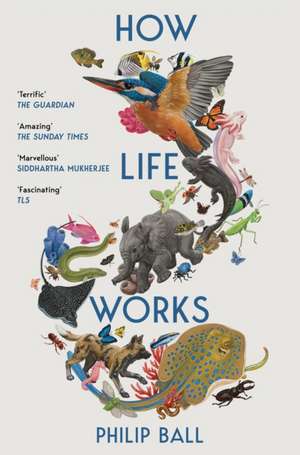
How Life Works
Autor Philip Ballen Limba Engleză Paperback – 6 mar 2025 – vârsta de la 18 ani
În peisajul academic actual, How Life Works se poziționează ca o lucrare fundamentală pentru studenții și specialiștii din științele vieții, propunând o schimbare de paradigmă în biologia teoretică și aplicată. Autorul, Philip Ball, demonstrează că viziunea tradițională — care reduce organismul la o mașinărie guvernată strict de instrucțiunile genetice — este incompletă. Remarcăm efortul autorului de a deconstrui metafora genomului ca „proiect de construcție”, oferind în schimb o perspectivă sistemică în care viața emerge din interacțiunile complexe dintre rețelele de proteine, celule și țesuturi. Textul extinde cadrul conceptual propus de The Music of Life de Denis Noble, integrând date recente din biologia sintetică și medicina regenerativă. În timp ce Noble punea bazele fiziologice ale unei viziuni non-reducționiste, Ball merge mai departe, explorând modul în care putem „hăcui” sau redesigna sistemele vii. Această abordare se regăsește și în alte lucrări ale sale, precum The Book of Minds, unde explorează diversitatea proceselor cognitive, sau The Elements, unde analizează structurile fundamentale ale materiei. Aici, însă, accentul cade pe „agenția” biologică — capacitatea organismelor de a-și stabili scopuri și de a lua decizii la nivel celular. Structura volumului este riguros organizată pentru a ghida cititorul de la micro la macro. Capitolele dedicate proteinelor și rețelelor pregătesc terenul pentru discuțiile despre dezvoltarea țesuturilor și organizarea corpului, culminând cu o analiză critică a medicinei moderne în capitolul „Troubleshooting”. How Life Works nu este doar o sinteză a cunoștințelor actuale, ci un manifest pentru o nouă biologie care recunoaște complexitatea și modularitatea vieții.
Preț: 61.11 lei
Preț vechi: 109.09 lei
-44%
Carte disponibilă
Livrare economică 17 noiembrie-01 decembrie
Livrare express 31 octombrie-06 noiembrie pentru 76.23 lei
Specificații
ISBN-10: 1529096006
Pagini: 541
Dimensiuni: 130 x 196 x 34 mm
Greutate: 0.39 kg
Editura: Pan Macmillan
Colecția Picador
V-ar putea interesa
-
 The Demon in the MachinePaul Davies-30%Preț: 64.64 lei92.81 lei
 -
 A World Beyond Physics: The Emergence and Evolution of LifeStuart A. Kauffman-16%Preț: 182.66 lei217.66 lei
 -
 The Music of Life: Biology beyond genesDenis Noble-19%Preț: 68.99 lei85.18 lei
 -
 -13%Preț: 133.78 lei152.99 lei
 -
 -14%Preț: 122.34 lei142.57 lei
 -
 -16%Preț: 80.13 lei95.94 lei
 -
 CreationAdam RutherfordPreț: 78.80 lei
 -
 Life on the EdgeJim Al–khalili-17%Preț: 66.58 lei80.43 lei
 -
 How We Live and Why We DieLewis WolpertPreț: 91.24 lei
 -
 Living Matter - Seeking New Physics in the Biological WorldAlex J. LevinePreț: 257.70 lei
 -
 The Network of Life - A New View of EvolutionDavid P. MindellPreț: 215.12 lei
 -
 Life in SyncPhilippa GanderPreț: 128.57 lei
 -
 From One CellBen StangerPreț: 102.61 lei
 -
 The Master Builder: How the New Science of the Cell is Rewriting the Story of LifeAlfonso Martinez Arias-26%Preț: 68.84 lei93.43 lei
 -
 On the Future of Species: How AI is Authoring LifeAdrian Woolfson-23%Preț: 106.82 lei139.56 lei
 -
 50 Biology Ideas You Really Need to KnowJV Chamary-26%Preț: 52.44 lei71.22 lei
 -
 -18%Preț: 118.47 lei144.67 leiRecomandat
 -
 The Genetic Book of the Dead: A Darwinian ReverieRichard Dawkins-23%Preț: 85.97 lei111.13 lei
 -
 Thinking Small and LargePeter ForbesPreț: 109.04 lei
 -
 -19%Preț: 75.97 lei93.44 lei
De ce să citești această carte
Recomandăm această carte studenților la biologie, medicină și bioinginerie care doresc să depășească modelul determinismului genetic. Cititorul câștigă o înțelegere profundă a modului în care celulele cooperează și se organizează, oferind contextul necesar pentru a înțelege viitorul medicinei regenerative și al biotehnologiei. Este o resursă esențială pentru oricine vrea să vadă dincolo de simplificările manualelor clasice.
Despre autor
Philip Ball este un scriitor de știință distins și editor consultant pentru prestigioasa revistă Nature. Lucrările sale acoperă un spectru larg, de la istoria alchimiei în Alchemy până la fizica sistemelor sociale în Critical Mass, lucrare premiată cu Aventis Prize. Cu un talent remarcabil pentru a face conceptele complexe accesibile, Ball a fost finalist al National Book Critics Circle Award pentru Bright Earth. Experiența sa vastă în comunicarea științifică îi permite să sintetizeze descoperiri de ultimă oră din genetică și biologie celulară într-o narativă coerentă și provocatoare.
Notă biografică
Descriere
Extras
Fundamentally, this new view of biology—which is by no means complete, and indeed is still only nascent—depends on a kind of trust. You could say that genes are able to trust that there are processes beyond their capacity to directly control that will nonetheless allow organisms to grow and thrive and evolve. (Biologists need to develop that trust too.) This way of working appears repeatedly in biology when things get complicated and tasks get hard. When organisms first became multicellular, when they became able to adjust to and exploit the full richness of their surroundings through sensory modalities like vision and smell, when their sensitivity and receptivity to the environment became genuine cognition, it seems that life increasingly relinquished a strategy of prescribing the response of the organism to every stimulus, and instead supplied the basic ingredients for systems that could devise and improvise solutions to living that are emergent, versatile, adaptive, and robust.
The new picture dispels the long-standing idea that living systems must be regarded as machines. There never has been a machine made by humankind that works as cells do. This is not to deny that living things are ultimately made of insensate and indeed inanimate molecules: we need no recourse to the old idea of vitalism, which posited that some fundamental and mysterious force made the difference between living and inert matter. Yet dispensing with the machine view of life allows us to see what it really is that distinguishes it from the inanimate world. The distinction is as fundamental and wondrous as the formation of the universe itself—but more amenable to scientific study, and for that reason probably more tractable.
In particular, life is not to be equated with that special kind of machine, the computer. It is certainly true that life performs kinds of computation, and indeed there are key features of biology that can be fairly well understood using the theory of information developed to describe modern information technologies. What is more, a comparison with machines can sometimes be a useful way of thinking about how parts of the process that is life operates. I will occasionally make such parallels. It is meaningful to say that our cells possess pumps, motors, sensors, storage, and readout devices. That, however, is very different from the modern trend of discussing the fundamental features of living organisms by comparing them to electrical circuits, computers, or factories. No computer today works as cells do, and it is far from clear that they ever will (or that this would be a good way to make a computer anyway). There is so far no technological artifact that provides a good analogy for living systems. These are a different kind of entity, with their own logic, and they have to be their own metaphor.
Cuprins
Chapter 1. The End of the Machine: A New View of Life
Chapter 2. Genes: What DNA Really Does
Chapter 3. RNA and Transcription: Reading the Message
Chapter 4. Proteins: Structure and Unstructure
Chapter 5. Networks: The Webs That Make Us
Chapter 6. Cells: Decisions, Decisions
Chapter 7. Tissues: How to Build, When to Stop
Chapter 8. Bodies: Uncovering the Pattern
Chapter 9. Agency: How Life Gets Goals and Purposes
Chapter 10. Troubleshooting: Rethinking Medicine
Chapter 11. Making and Hacking: Redesigning Life
Epilogue
Acknowledgments
Source Notes
Bibliography
Index