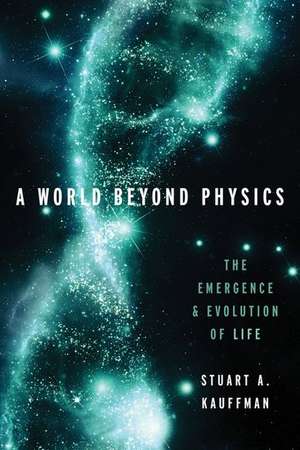
A World Beyond Physics: The Emergence and Evolution of Life
Autor Stuart A. Kauffmanen Limba Engleză Hardback – 27 iun 2019
How did life start? Is the evolution of life describable by any physics-like laws? Stuart Kauffman's latest book offers an explanation-beyond what the laws of physics can explain-of the progression from a complex chemical environment to molecular reproduction, metabolism and to early protocells, and further evolution to what we recognize as life. Among the estimated one hundred billion solar systems in the known universe, evolving life is surely abundant. Thatevolution is a process of "becoming" in each case.
Since Newton, we have turned to physics to assess reality. But physics alone cannot tell us where we came from, how we arrived, and why our world has evolved past the point of unicellular organisms to an extremely complex biosphere. Building on concepts from his work as a complex systems researcher at the Santa Fe Institute, Kauffman focuses in particular on the idea of cells constructing themselves and introduces concepts such as "constraint closure." Living systems are defined by the concept of "organization" which has not been focused on in enough in previous works.
Cells are autopoetic systems that build themselves: they literally construct their own constraints on the release of energy into a few degrees of freedomthat constitutes the very thermodynamic work by which they build their own self creating constraints. Living cells are "machines" that construct and assemble their own working parts. The emergence of such systems-the origin of life problem-was probably a spontaneous phase transition toself-reproduction in complex enough prebiotic systems.
The resulting protocells were capable of Darwin's heritable variation, hence open-ended evolution by natural selection. Evolution propagates this burgeoning organization. Evolving living creatures, by existing, create new niches into which yet further new creatures can emerge.
If life is abundant in the universe, this self-constructing, propagating, exploding diversity takes us beyond physics to biospheres everywhere.
Preț: 182.66 lei
Preț vechi: 217.66 lei
-16%
Carte tipărită la comandă
Livrare economică 04-15 decembrie
Specificații
ISBN-10: 0190871334
Pagini: 164
Ilustrații: 18
Dimensiuni: 213 x 145 x 23 mm
Greutate: 0.3 kg
Editura: Oxford University Press
Colecția OUP USA
Locul publicării:New York, United States
V-ar putea interesa
-
 The Demon in the MachinePaul Davies-30%Preț: 64.64 lei92.81 lei
 -
 The Science of Can and Can'tChiara Marletto-19%Preț: 63.98 lei78.92 lei
 -
 On Life: Cells, Genes, and the Evolution of ComplexityFranklin M. Harold-15%Preț: 202.24 lei236.70 lei
 -
 What is Life?: How Chemistry Becomes BiologyAddy Pross-19%Preț: 74.54 lei92.36 lei
 -
 Game Theory: A Very Short IntroductionKen Binmore-18%Preț: 58.22 lei71.42 lei
 -
 The Music of Life: Biology beyond genesDenis Noble-19%Preț: 68.70 lei85.18 lei
 -
 Life As No One Knows It: The Physics of Life's EmergenceSara Imari Walker-26%Preț: 68.90 lei93.03 lei
 -
 Mind FixersAnne HarringtonPreț: 112.25 lei
 -
 -33%Preț: 535.89 lei796.77 lei
 -
 Living Matter - Seeking New Physics in the Biological WorldAlex J. LevinePreț: 257.31 lei
 -
 From One CellBen StangerPreț: 102.61 lei
 -
 A Universe From NothingLawrence M. Krauss-26%Preț: 58.30 lei78.39 lei
 -
 How Life WorksPhilip Ball-44%Preț: 61.11 lei109.09 lei
 -
 -15%Preț: 103.88 lei122.21 lei
 -
 -17%Preț: 77.63 lei94.01 lei
 -
 One Hand ClappingNikolay KukushkinPreț: 159.17 lei
 -
 Thinking Small and LargePeter ForbesPreț: 109.04 lei
 -
 Nine PintsRose GeorgePreț: 93.44 lei
 -
 -19%Preț: 75.97 lei93.44 lei
Recenzii
makes for stimulating reading . . . [Kauffman's] prose is reader-friendly and thought-provoking . . . I highly recommend Kauffman's book to anyone interestedin the ongoing scientific enterprise to model the transition from physical to living systems.
This is a delightful little book that considers the classic question, "What is life?"
A World Beyond Physics is a well-written and thought provoking book. It should prove a worthwhile read for anyone with an undergraduate knowledge of biology and physics who is interested in amore philosophical take on the origins, complexities, and evolution of life.
For persons with the requisite scientific background, the book will be very rewarding to read...The book has many applications to the science and theology interchange...
Notă biografică
Stuart Kauffman is a medical doctor, theoretical biologist, and complex systems researcher. He has held professorships at the University of Chicago and University of Pennsylvania and was awarded a MacArthur Fellowship in evolutionary biology in 1987. He is the author of multiple seminal works including The Origins of Order (1993) At Home in the Universe (1996), Investigations (2002), and Humanity in a Creative Universe(2016).