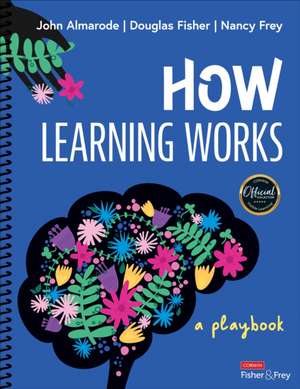
How Learning Works
Autor Douglas Fisher, John T. Almarode, Nancy Freyen Limba Engleză Paperback – 14 feb 2022
Scrisă de Douglas Fisher, John T. Almarode și Nancy Frey, nume de referință în pedagogia modernă, această lucrare fundamentează strategiile de predare pe date riguroase din neuroștiințe și psihologie cognitivă. Autorii, cunoscuți pentru cercetările lor asupra alfabetizării și învățării vizibile, propun aici un model aplicat care transformă teoria aridă în intervenții pedagogice măsurabile.
Remarcăm structura de tip „playbook” a volumului How Learning Works, care se distanțează de manualele teoretice clasice. Cartea este organizată în module de lucru ce ghidează profesorul prin procese complexe: de la captarea atenției și gestionarea sarcinii cognitive, până la consolidarea memoriei și transferul de cunoștințe. Fiecare capitol include exerciții de practică și strategii de feedback reciproc, facilitând o progresie logică de la înțelegerea modului în care creierul procesează informația la implementarea unor tehnici precum practica distribuită sau interogarea elaborativă.
Această abordare completează perspectiva oferită de Do I Have Your Attention? de Blake Harvard, adăugând un cadru metodologic mult mai vast care nu se limitează doar la constrângerile memoriei, ci acoperă întreg spectrul motivațional și social al învățării. În contextul operei lor, How Learning Works reprezintă puntea necesară între The Distance Learning Playbook, Grades K-12 și How Feedback Works, oferind mecanismele cognitive care explică de ce anumite forme de feedback sau interacțiune funcționează mai bine decât altele. Apreciem rigoarea cu care sunt demontate miturile despre învățare, oferind educatorilor un limbaj comun pentru a descrie succesul academic în context local.
Preț: 239.16 lei
Carte disponibilă
Livrare economică 05-19 august
Livrare express 22-28 iulie pentru 136.14 lei
Specificații
ISBN-10: 1071856634
Pagini: 240
Dimensiuni: 282 x 231 x 24 mm
Greutate: 0.68 kg
Ediția:1
Editura: Sage Publications, Inc
Locul publicării:Thousand Oaks, United States
De ce să citești această carte
Apreciem această resursă pentru modul în care simplifică știința învățării fără a o banaliza. Este o lectură esențială pentru cadrele didactice care doresc să își fundamenteze metodele de predare pe dovezi, oferind instrumente clare pentru a gestiona atenția și memoria elevilor. Cititorul câștigă strategii direct aplicabile la clasă care accelerează progresul elevilor și încurajează autonomia acestora în procesul de învățare.
Despre autor
Douglas Fisher este profesor de leadership educațional la San Diego State University și un autor prolific în domeniul alfabetizării și dezvoltării profesionale. Alături de colaboratoarea sa de lungă durată, Nancy Frey, a publicat numeroase titluri de succes, printre care Background Knowledge și Word Wise & Content Rich, concentrându-se pe legătura dintre limbaj și învățare. Împreună cu John T. Almarode, aceștia formează o echipă editorială de elită care reușește să integreze cercetarea academică în ghiduri practice pentru profesori, fiind recunoscuți la nivel internațional pentru contribuțiile lor în cadrul mișcării Visible Learning.
Descriere scurtă
The content, skills, and understandings students need to learn today are as diverse, complex, and multidimensional as the students in our classrooms. How can educators best create the learning experiences students need to truly learn?
How Learning Works: A Playbook unpacks the science of how students learn and translates that knowledge into promising principles or practices that can be implemented in the classroom or utilized by students on their own learning journey. Designed to help educators create learning experiences that better align with how learning works, each module in this playbook is grounded in research and features prompts, tools, practice exercises, and discussion strategies that help teachers to
- Describe what is meant by learning in the local context of your classroom, including identifying any barriers to learning.
- Adapt promising principles and practices to meet the specific needs of your students—particularly regarding motivation, attention, encoding, retrieval and practice, cognitive load and memory, productive struggle, and feedback.
- Translate research on learning into learning strategies that accelerate learning and build students’ capacity to take ownership of their own learning—such as summarizing, spaced practice, interleaved practice, elaborate interrogation, and transfer strategies.
- Generate and gather evidence of impact by engaging students in reciprocal teaching and effective feedback on learning.
Cuprins
INTRODUCTION
The Purpose of This Learning Playbook
The Learning Plan With the Modules
Learning Within the Modules
Collaborating for Great Learning
PART I
CHAPTER 1. WHAT DOES LEARNING LOOK LIKE IN YOUR CLASSROOM?
A Definition of Learning
Checks for Understanding
CHAPTER 2. WHAT ARE DIFFERENT WAYS TO THINK ABOUT LEARNING?
Three Different Types of Knowledge
Three Parts of the Learning Process
Checks for Understanding
CHAPTER 3. WHAT ARE THE BARRIERS TO LEARNING?
Acquisition
Consolidation
Storage
Challenges to Learning by Design
Checks for Understanding
CHAPTER 4. HOW DO STUDENTS LEARN?
Learning Myths
The Science of Learning
Checks for Understanding
PART II
CHAPTER 5. PROMISING PRINCIPLE 1: MOTIVATION
What Is Motivation?
What Does This Principle or Practice Look Like in the Classroom?
How Do We Implement This Principle and Practice Into Our Classrooms?
Checks for Understanding
CHAPTER 6. PROMISING PRINCIPLE 2: ATTENTION
What Is Attention?
Factors Influencing Attention
What Does This Principle or Practice Look Like in the Classroom?
How Do We Implement This Principle and Practice Into Our Classrooms?
Checks for Understanding
CHAPTER 7. PROMISING PRINCIPLE 3: ELABORATE ENCODING
What Is Elaborate Encoding?
Components of Elaborate Encoding
Approaches to Promoting Elaborate Encoding
What Does This Principle or Practice Look Like in the Classroom?
How Do We Implement This Principle and Practice Into Our Classrooms?
Checks for Understanding
CHAPTER 8. PROMISING PRINCIPLE 4: RETRIEVAL AND PRACTICE
What Is Retrieval and Practice?
Timing of Retrieval
Types of Retrieval Practice
What Does This Principle or Practice Look Like in the Classroom?
How Do We Implement This Principle and Practice Into Our Classrooms?
Checks for Understanding
CHAPTER 9. PROMISING PRINCIPLE 5: COGNITIVE LOAD
What Is Cognitive Load?
What Does This Principle or Practice Look Like in the Classroom?
How Do We Implement This Principle and Practice Into Our Classrooms?
Checks for Understanding
CHAPTER 10. PROMISING PRINCIPLE 6: PRODUCTIVE STRUGGLE
What Is Productive Struggle?
What Does This Principle or Practice Look Like in the Classroom?
How Do We Implement This Principle and Practice Into Our Classrooms?
Checks for Understanding
CHAPTER 11. PROMISING PRINCIPLE 7: FEEDBACK
What Is Feedback and What Makes It Effective?
What Does This Principle or Practice Look Like in the Classroom?
How Do We Implement This Principle and Practice Into Our Classrooms?
Checks for Understanding
Where to Next?
PART III
CHAPTER 12. EXPLICIT STRATEGY INSTRUCTION
The Gradual Release of Responsibility
Effective Learning Practices
A Return to Germane Cognitive Load
Checks for Understanding
CHAPTER 13. LEARNING STRATEGY 1: GOAL SETTING
The Benefits of Goal Setting
Getting Ready for Goal Setting
The Process of Goal Setting
Checks for Understanding
CHAPTER 14. LEARNING STRATEGY 2: INTEGRATING PRIOR KNOWLEDGE
The Benefits of Integrating Prior Knowledge
Getting Ready to Integrate Prior Knowledge
A Process for Integrating Prior Knowledge
Bonus Material: Annotated Reading
Checks for Understanding
CHAPTER 15. LEARNING STRATEGY 3: SUMMARIZING
Essential Characteristics of Summarizing
Getting Ready to Summarize
A Process for the Explicit Instruction of Summarizing
Checks for Understanding
CHAPTER 16. LEARNING STRATEGY 4: MAPPING
Three Different Ways to Map
Getting Ready for Mapping
A Process for the Explicit Instruction of Summarizing
Checks for Understanding
CHAPTER 17. LEARNING STRATEGY 5: SELF-TESTING
Benefits of Self-Testing
What if Learners Make Mistakes?
Getting Ready to Implement Self-Testing
A Process for Implementing Self-Testing
Bonus Material: Cooperative Learning
Checks for Understanding
CHAPTER 18. LEARNING STRATEGY 6: ELABORATIVE INTERROGATION
Benefits of Elaborative Interrogation
Getting Ready to Implement Elaborative Interrogation
Bonus Material: Jigsaw
A Process for Implementing Elaborative Interrogation
Checks for Understanding
PART IV
CHAPTER 19. GENERATING AND GATHERING EVIDENCE
Planning for Evaluation
Success Criteria and Evaluation
Planning to Gather Evidence
Planning to Collect and Organize Evidence
Making Sense of the Evidence
Conclusion
References
Index
About the Authors
Notă biografică
Continuing his collaborative work with colleagues on what works best in teaching and learning, How Tutoring Works, Visible Learning in Early Childhood, and How Learning Works, all with Corwin Press, were released in 2021.